
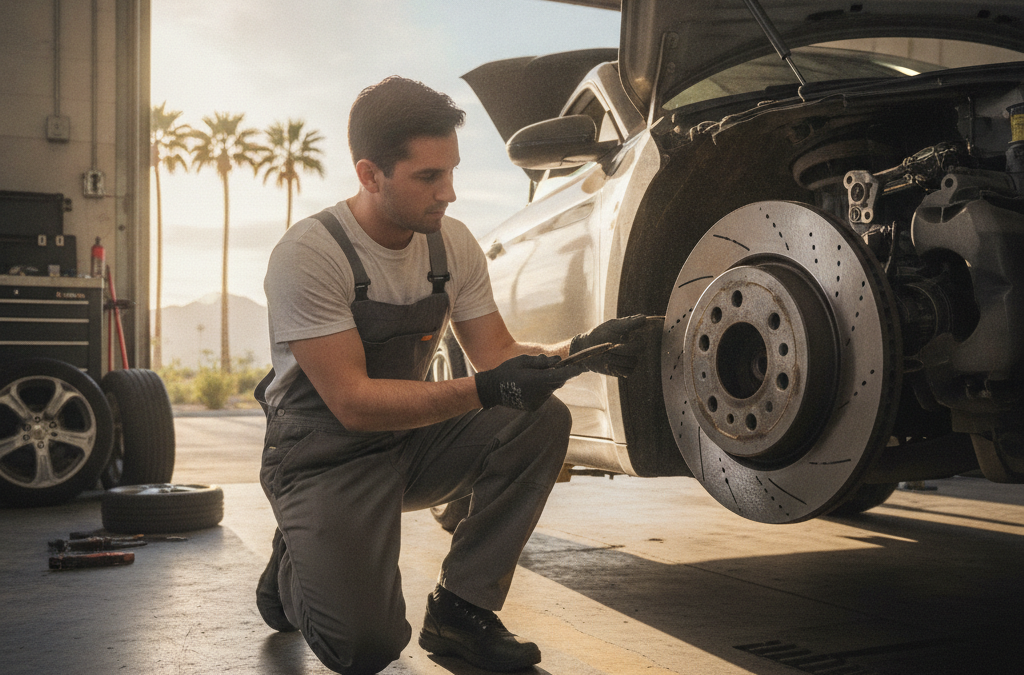
How Do You Know When Your Brakes Need to Be Replaced in Surprise, AZ?
If your car makes a high-pitched squeal every time you tap the brakes in a parking lot, that’s not a random noise you can tune out. That’s your vehicle telling you something. In Surprise and throughout the Phoenix West Valley, brakes tend to wear differently — and often faster — than they do in cooler parts of the country. The combination of heavy stop-and-go traffic on Bell Road and Grand Avenue, extreme summer heat, and the constant road construction tearing up major corridors creates conditions that are genuinely hard on brake components. The good news is that catching brake problems early almost always saves you money. The bad news is that a lot of drivers wait until the situation is harder — and more expensive — to fix.
The Warning Signs Your Brakes Are Telling You Something
Your brakes are pretty good at communicating when they’re unhappy. Here’s what to pay attention to:
- Squeaking or squealing when you slow down. Most brake pads have a small metal wear indicator built in. When the pad material gets thin enough, that indicator scrapes against the rotor and makes a high-pitched squeal. It’s not a defect — it’s designed to do exactly that. Don’t ignore it.
- Grinding noise when braking. If the squealing has graduated to a metallic grinding sound, the pad material is likely gone and metal is grinding directly on metal. At this point, you’re probably looking at rotor damage too, which raises the cost of the repair significantly.
- The brake pedal feels soft or spongy. A pedal that sinks closer to the floor than normal, or one that feels mushy instead of firm, can point to air in the brake lines or a brake fluid issue. This one shouldn’t wait.
- Your car pulls to one side when you brake. This can mean a caliper is sticking, brake wear is uneven, or there’s a problem with the brake fluid in one line. It’s also a safety concern because it affects steering control in an emergency stop.
- Vibration or pulsing through the pedal. If the pedal shudders when you press it, that often means a warped rotor. Rotors can warp from repeated heavy braking or from the kind of extreme heat cycling that’s common in Arizona summers.
- Your brake warning light comes on. Some vehicles have a sensor that triggers a dashboard light when pad thickness drops below a safe level. If that light comes on, get it checked — don’t just reset it and hope for the best.
Why Arizona Heat Changes the Brake Equation
Here’s something that doesn’t get talked about enough: the desert heat that Surprise, Peoria, and El Mirage drivers deal with every summer doesn’t just wear on your AC and battery — it affects your braking system too. Brake fluid absorbs moisture over time, and in high-heat environments, that moisture causes the fluid’s boiling point to drop. When fluid boils under hard braking, it can create vapor in the lines, which makes your pedal feel soft and reduces stopping power right when you need it most.
On top of that, the constant thermal expansion and contraction from swinging between 115°F days and cooler evenings puts stress on rubber brake hoses and seals. We see cracked or swollen brake hoses far more often here than shops in the Midwest or Pacific Northwest would. It’s just part of living and driving in the Valley of the Sun.
What Actually Happens During a Brake Inspection
A real brake inspection isn’t a 90-second visual through the wheel spokes. When you bring your vehicle to All Valley Car Care in Surprise, here’s what a thorough inspection actually covers:
- Measuring pad thickness on all four corners (not just the front wheels)
- Inspecting rotor condition — thickness, surface scoring, and whether there’s any warping
- Checking caliper operation to make sure they’re releasing properly and not sticking
- Examining brake lines and hoses for cracks, swelling, or signs of leaking
- Testing brake fluid condition — moisture content matters here
- Checking the parking brake
You’ll get a straight answer on what needs to be done now, what can wait, and a written estimate before any work starts. No surprise charges, no pressure to approve work you’re not ready for.
How Long Do Brake Pads Actually Last in the Phoenix Area?
You’ll see a lot of generic answers online — “30,000 to 70,000 miles” is the usual range. But that number is heavily influenced by driving habits and environment. In the Phoenix metro, most drivers who do a fair amount of city driving on roads like Litchfield Road, Dysart, or Reems can expect pads to wear on the shorter end of that range. Frequent hard stops, heavy vehicles like trucks and SUVs, and towing all accelerate wear. If you’re driving a loaded-up Silverado through Goodyear every day or running a commercial vehicle out of Sun City West, your brakes are working harder than a single-driver sedan on the freeway.
The honest answer: get your brakes visually inspected at least once a year, or any time you notice one of the warning signs listed above. Don’t rely solely on mileage intervals.
Front Brakes vs. Rear Brakes — They Don’t Wear the Same Way
This is something a lot of drivers don’t realize, and it’s worth understanding. In most passenger vehicles, front brakes do the majority of the stopping work — typically 60 to 70 percent of the braking force. That means front pads usually wear out faster than rear pads. But rear brakes still matter, and on vehicles with rear drum brakes (still common on older trucks and budget sedans), the inspection and service process is different.
Some shops only quote front brakes when you come in asking about the squeak. A complete brake service should always include all four corners, even if only the fronts need replacement right now. You want to know the full picture.
What Does a Brake Job Cost in Surprise?
We’re not going to list a number here and have it be wrong by the time you read this. Brake repair pricing depends on your vehicle, which axle needs service, whether the rotors need replacement or just resurfacing, and parts quality. What we will say is this: replacing pads alone is always cheaper than replacing pads and rotors. Catching brake wear early almost always saves money. And at All Valley Car Care, you’ll get a written estimate before anything is approved — so there are no surprises on your invoice. See our full list of services if you want to understand what’s included in a complete brake service.
Frequently Asked Questions About Brake Repair in the Phoenix West Valley
Can I drive with squeaking brakes for a little while?
For a very short time, yes — but don’t push it. Squealing pads are a warning, not an emergency, but once they start grinding, you’re damaging rotors and your stopping distance increases. Get it looked at within a week or two of the noise starting.
Do I need to replace all four brake pads at once?
You should always replace both pads on the same axle at the same time — both front or both rear — to keep braking balanced. You don’t always have to do all four corners at once, but get a full inspection so you know where each axle stands.
My parking brake feels loose. Is that a brake problem?
It can be. A loose or weak parking brake sometimes points to stretched cables or worn rear brake components. It’s worth having it checked, especially if you park on any incline or if your vehicle is a daily driver for work.
How do I know if I need new rotors or just new pads?
A technician will measure rotor thickness and check for scoring or warping. If the rotors are above minimum thickness and the surface is in decent shape, they may be resurfaced instead of replaced. If they’re below spec or heavily grooved, replacement is the right call. We’ll show you what we find and explain the recommendation.
Do you service commercial vehicles and work trucks?
Yes. We work on light commercial vehicles, small fleets, and work trucks regularly. If your business runs vehicles in and around Surprise, Glendale, or the surrounding West Valley, we can schedule service to work around your operation. Reach out to us to talk through your fleet’s needs.
Don’t Wait Until the Grinding Starts
Brakes are one of those things where early action almost always costs less than waiting. A squeal that gets addressed today is usually a pad replacement. A squeal that turns into a grind is often a pad-and-rotor job. And a brake system that’s been neglected long enough can mean caliper or brake line repairs on top of that.
If you’re hearing something you don’t like, or if it’s been more than a year since anyone looked at your brakes, bring your car, truck, or SUV into All Valley Car Care. We’ve been serving drivers in Surprise and across the Phoenix West Valley since 2010, and we’ll give you an honest assessment — not a list of repairs designed to pad an invoice. Schedule your brake inspection today at our contact page and we’ll get you in quickly.