
How Do You Know If Your Car’s Cooling System Is About to Fail — and What to Do Before It Does in Sun City, AZ?
If you drive anywhere in the Phoenix West Valley during summer — and especially if you’re in Sun City or the surrounding communities — your cooling system is working harder than it was ever designed to. Most engines are built to run comfortably in temps up to around 100°F. Out here, we’re regularly pushing 115°F or higher, and that heat doesn’t just affect you inside the car. It stresses every component under the hood, and the cooling system is right in the middle of the fight. The good news is that cooling systems rarely fail without warning. If you know what to look for, you can usually catch a problem before it leaves you stranded on the side of Grand Avenue with steam pouring out from under your hood.
What Does Your Cooling System Actually Do?
Your engine burns fuel and generates an enormous amount of heat as a byproduct. Left unchecked, that heat would destroy your engine in minutes. The cooling system’s job is to pull that heat away from the engine and release it safely through the radiator. It does this by circulating coolant — also called antifreeze — through channels in the engine block, through hoses to the radiator, and back again, over and over while the engine runs.
That system includes your radiator, water pump, thermostat, radiator cap, coolant reservoir, upper and lower hoses, and the coolant itself. When any one of those components fails or degrades, the whole system can fall apart fast — and in Arizona heat, fast means very fast.
Warning Signs Your Cooling System Is Struggling
Here’s what to watch for. None of these are things to put off until your next oil change.
Your Temperature Gauge Is Climbing Higher Than Normal
Your dashboard temperature gauge should sit comfortably in the middle range when your engine is warmed up. If it’s creeping toward the red — especially when you’re sitting in traffic or running the AC hard on a hot afternoon — that’s your cooling system telling you something is wrong. Don’t wait to see if it comes back down. Pull over, turn the engine off, and let it cool before driving further. Running an overheated engine can warp cylinder heads or crack engine blocks, and those are expensive repairs — often $2,000 or more.
You’re Seeing Coolant Under the Car
Coolant is usually bright green, orange, or pink and has a slightly sweet smell. If you notice a puddle under your car after parking — especially toward the front — there’s a good chance you have a leak somewhere in the system. It could be as simple as a cracked hose or a loose clamp, or it could be a radiator leak or a failing water pump seal. The leak itself might be small, but losing coolant means your engine is running with less protection against heat.
Your Heater Smells Sweet Inside the Cabin
This one surprises people. If you notice a sweet, almost syrupy smell coming through your vents — even when the AC is on — that’s often coolant leaking into the heater core, which sits inside the dashboard. Heater core issues can be tricky and a little pricey to access, but they’re worth catching early before coolant starts fogging up your windshield or damaging interior components.
Your Coolant Level Keeps Dropping
Coolant isn’t supposed to disappear. Unlike oil, it doesn’t burn off or get consumed. If you’re topping it off regularly and it keeps going down, you have a leak somewhere — even if you can’t see it on the ground. Sometimes coolant leaks internally into the engine, which is a sign of a failing head gasket. That’s a serious repair, but catching it before the engine overheats can save you from far worse damage.
You See White Smoke or Steam from the Hood
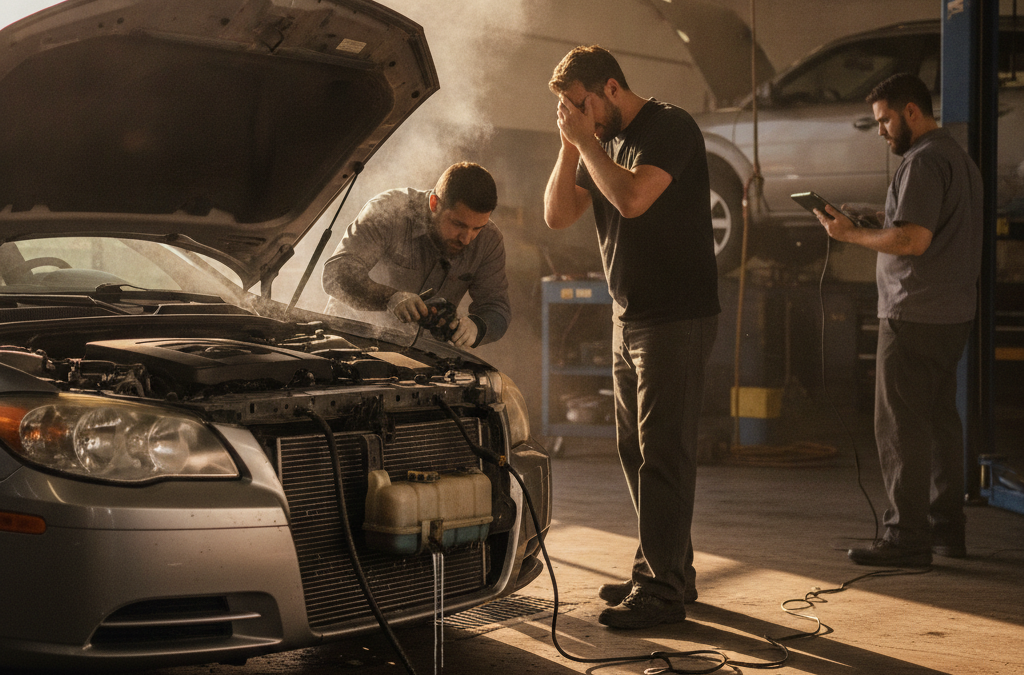
White smoke from the exhaust or steam from under the hood is a clear sign your engine is overheating or that coolant is burning somewhere it shouldn’t be. If this happens while you’re driving, pull over safely and don’t keep driving. Do not open the radiator cap while the engine is hot — the system is pressurized and you can get seriously burned.
Why Arizona Heat Makes Cooling System Problems Worse — and Faster
Coolant hoses that might last 10 years in a milder climate can harden, crack, and fail in four or five years out here in the desert. The constant exposure to extreme heat — both ambient air temperature and engine heat radiating in an engine bay that can get well over 200°F — accelerates breakdown of rubber, seals, and the coolant itself. Coolant loses its protective additives over time and becomes acidic, which corrodes the inside of your radiator and the metal parts it contacts.
If your vehicle has never had a coolant flush, or it’s been more than two to three years since the last one, it’s worth having it checked — especially heading into a West Valley summer. A basic coolant flush and refill is one of the least expensive preventive services you can do, and it protects one of the most expensive systems in your vehicle. Drivers in Sun City, El Mirage, and Youngtown often find their vehicles have been running on degraded coolant for years simply because it’s not a service national quick-lube chains commonly recommend or inspect thoroughly.
See the full list of cooling system and maintenance services we offer at All Valley Car Care.
What’s Actually Involved in a Cooling System Inspection?
A proper cooling system inspection isn’t just a glance at the coolant reservoir. A thorough check should include a visual inspection of all hoses and clamps for cracking, swelling, or softness; a pressure test on the radiator cap and the system itself to check for leaks that aren’t visible at idle; a coolant condition test to check the pH and freeze/boil protection level; a check of the water pump for leaks or bearing wear; and a look at the radiator for external damage, blockage, or corrosion.
If a shop just glances under the hood and says everything looks fine without pressure testing, that’s not a cooling system inspection — that’s a visual check. Those are two very different things.
How Much Does Cooling System Repair Cost in the West Valley?
It depends heavily on what’s wrong. A coolant flush is generally one of the more affordable services on the maintenance schedule. Replacing a hose or a thermostat is usually a straightforward job. Radiator replacement is more involved but still a manageable repair for most vehicles. Water pump replacement varies depending on whether it’s driven by the serpentine belt or the timing belt — if it’s driven by the timing belt, shops often recommend doing both at the same time to save labor. Head gasket repair is the expensive one, which is exactly why catching the smaller issues early matters so much.
At All Valley Car Care, we give you a written estimate before we touch anything. No surprises, no pressure. If you want a second opinion, we’ll tell you that too — because we’d rather earn your trust than chase a repair you’re not comfortable with.
Frequently Asked Questions: Cooling System Service in Sun City and the Phoenix West Valley
How often should I flush my coolant in Arizona?
Most manufacturers recommend a coolant flush every 30,000 miles or every two to three years. In Arizona’s extreme heat, we typically recommend not waiting longer than that, since heat degrades coolant’s protective additives faster than in cooler climates. Have it tested at your next service if you’re unsure.
Can I just add water if my coolant is low?
In an emergency, plain water can buy you time to get to a shop — but it’s not a fix. Water doesn’t have the corrosion inhibitors or the boil-point protection that coolant provides, and in Arizona summer heat, using water alone can actually make things worse. Get the proper coolant mixture restored as soon as possible.
Is it safe to drive with a small coolant leak?
Not really. Even a slow leak can drop your coolant level enough to cause overheating, and overheating can turn a $200 repair into a $2,000 one very quickly. If you suspect a leak, get it checked out before your next long drive — especially if you’re commuting between Sun City and Peoria or heading into Phoenix regularly.
What’s the difference between a radiator flush and just topping off the coolant?
Topping off adds fresh coolant to what’s already in the system. A flush drains out the old, degraded coolant completely, flushes the system clean, and refills it with fresh fluid. If your coolant is old or contaminated, just topping it off is like adding clean water to a dirty fish tank — you’re diluting the problem, not fixing it.
My car ran hot once but seems fine now — do I still need to have it checked?
Yes. A single overheating event can cause damage that isn’t immediately obvious — warped head gaskets, stressed seals, or a weakened radiator. If your temperature gauge spiked and came back down, it’s worth having a technician check for signs of internal damage before you assume everything is fine. This is especially true for older vehicles or those with higher mileage.
Get Your Cooling System Checked Before Summer Takes Its Toll
Whether you’re driving a family SUV through Sun City Grand, running a work truck between job sites in El Mirage and Glendale, or just trying to get your daily commuter through another Phoenix summer without a breakdown, your cooling system deserves attention. It’s one of those things that works quietly in the background — until it doesn’t.
All Valley Car Care has been serving the Phoenix West Valley since 2010, with locations in Surprise, Glendale, and Gilbert. Our ASE-certified technicians will inspect your cooling system, give you an honest assessment, and only recommend what your vehicle actually needs. Every repair comes with our 3-year/36,000-mile warranty, extendable to 5 years and 60,000 miles — because we stand behind our work.