
How Do You Know If Your Car Needs a Coolant Flush — and How Often Should It Happen in Glendale, AZ?
Most drivers in Glendale don’t give their coolant a second thought — until the temperature gauge creeps into the red on a 112-degree afternoon. At that point, you’re not just uncomfortable. You’re looking at potential engine damage that could cost thousands of dollars. A coolant flush is one of the most overlooked maintenance services out there, and in the Phoenix West Valley, it matters more than it does just about anywhere else in the country. Here’s what you actually need to know.
What Coolant Does — and Why It Wears Out
Your engine runs hot. To keep it from destroying itself, your cooling system circulates a mixture of antifreeze and water — commonly called coolant — through the engine and radiator to absorb and release heat. Without it working correctly, your engine can overheat in minutes.
But coolant doesn’t last forever. Over time, it breaks down chemically. The additives that prevent rust, corrosion, and scale buildup inside your cooling system get depleted. When that happens, old coolant can actually become acidic — and acidic coolant starts eating away at the metal and rubber components it was designed to protect. Radiator leaks, damaged water pumps, and corroded hoses are often the result of coolant that simply wasn’t changed often enough.
A coolant flush removes the old degraded fluid, flushes out any built-up deposits or contaminants, and refills the system with fresh coolant and the right additive package for your vehicle. It’s not glamorous, but it’s genuinely important — especially here.
Why Arizona Heat Changes the Math on Coolant Service
Automaker maintenance schedules are typically written with average driving conditions in mind. Glendale, Peoria, Avondale, and the surrounding area are not average. When summer temperatures hit 115°F and your asphalt is radiating heat from below while the sun hammers down from above, your cooling system is working far harder than it was designed to in a mild climate.
That sustained heat stress accelerates the breakdown of coolant additives. It puts more load on your water pump, your radiator, your hoses, and your thermostat. A vehicle that might comfortably go 5 years between coolant flushes in Minnesota could realistically need service every 2 to 3 years here in the Valley of the Sun — sometimes sooner depending on the vehicle and coolant type.
Many manufacturers now use long-life coolant formulas rated for 5 years or 100,000 miles under normal conditions. That interval shrinks meaningfully in extreme desert heat. If you’re not sure what interval applies to your vehicle, ask — a shop worth trusting will look it up and tell you straight, not just sell you a service you don’t need yet.
Signs Your Coolant System Needs Attention Now
You don’t have to wait for a scheduled interval if something’s already telling you there’s a problem. Watch for these warning signs:
- Temperature gauge climbing higher than normal — especially in stop-and-go traffic or during a long idle
- Sweet smell inside or outside the car — coolant has a distinctive sweet odor; smelling it usually means a leak somewhere
- Visible puddles under the front of your vehicle — coolant is often green, orange, pink, or yellow depending on the type
- Cloudy, rusty, or oily-looking coolant — if you can see the coolant in the reservoir and it looks anything other than clean, it’s overdue
- Heater that stopped working properly — your heater core relies on hot coolant; if it’s struggling, the cooling system may be part of the story
- Engine overheating — if this is already happening, don’t drive it. Get it looked at before more serious damage occurs
If you’re seeing any of these, don’t just top off the reservoir and hope for the best. That’s a short-term fix at best.
What a Coolant Flush Actually Involves
This is something that often gets glossed over on competitor websites — you’ll see “coolant flush” listed as a service without much explanation of what actually happens. Here’s the honest version:
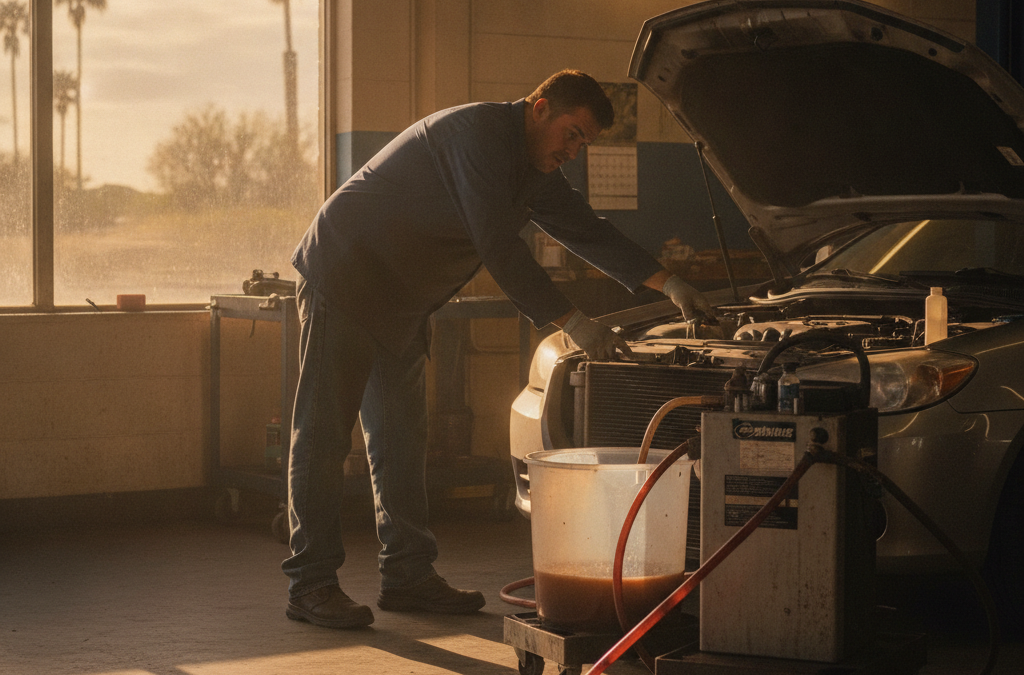
A proper coolant flush isn’t just draining the radiator and refilling it. That only removes some of the old fluid. A full flush uses equipment to push fresh fluid through the entire cooling system — including the engine block and heater core — to displace and remove the old coolant along with any rust particles, scale, or contaminants that have built up over time. Then the system is refilled with the correct type and concentration of coolant for your specific vehicle.
While the system is open, a good technician should also inspect the hoses, belts, radiator cap, and thermostat for signs of wear. In Phoenix’s heat, hoses and belts age faster than in most other climates, and catching a cracked hose during a coolant flush is a lot cheaper than dealing with a roadside breakdown later.
See the full range of services we offer — from cooling system work to diagnostics, brakes, and fleet maintenance.
How Often Should You Flush Your Coolant in the West Valley?
Here’s a practical rule of thumb for drivers in Glendale, Surprise, and surrounding areas:
- Older vehicles with conventional green coolant: every 2 years or 30,000 miles
- Vehicles with extended-life coolant (orange, pink, or yellow): every 3 to 5 years — but check the condition and color at each oil change interval
- Any vehicle showing warning signs listed above: have it inspected now, regardless of mileage
- Used vehicles with unknown service history: get the coolant tested or changed as part of a post-purchase inspection — you often have no idea what the previous owner did or didn’t do
When in doubt, have the coolant tested. A simple test can measure the freeze point and the pH — which tells you whether the additives are still doing their job or if the fluid has gone acidic. It’s a quick check, and it removes the guesswork.
Why Quick-Lube Chains Often Miss This Service
National quick-lube franchises focus on speed, not depth. They’ll change your oil in 10 minutes, but they’re not set up to do a proper cooling system flush and inspection. In many cases, the person checking your fluids isn’t a certified technician — they’re running a checklist. That’s not a criticism, it’s just the reality of the business model.
A proper coolant flush takes time, the right equipment, and someone who actually looks at the condition of your hoses, belts, and other cooling components while the system is open. That’s the kind of thing a full-service shop handles — and it’s where we’d rather catch a problem than have you find out on the freeway.
At All Valley Car Care, our ASE-certified technicians do this right, explain what they find, and don’t recommend a service unless your vehicle actually needs it. No unnecessary repairs. No hidden costs. That’s the standard we hold ourselves to at every location.
Visit our Glendale location for cooling system service, or stop by our Surprise shop — same honest service either way.
Frequently Asked Questions: Coolant Flush Service in the Phoenix Area
Can I just add coolant instead of doing a flush?
Topping off the reservoir helps if you’re low, but it doesn’t remove old, degraded fluid or flush out contaminants. If your coolant is due for a change or looks discolored, adding more on top of the old stuff doesn’t fix the underlying issue. Think of it like adding clean oil on top of dirty oil — you’re diluting the problem, not solving it.
How long does a coolant flush take?
A full cooling system flush typically takes about an hour at a full-service shop. Add a bit more time if we’re inspecting hoses, belts, and related components at the same time — which we always recommend in a vehicle that hasn’t had this service recently.
Is coolant the same as antifreeze?
They’re related but not identical. Antifreeze is a concentrated chemical (usually ethylene glycol) that gets mixed with distilled water to create the coolant that goes into your vehicle. The mixture ratio matters — too much water reduces heat protection, too much antifreeze isn’t better either. A proper coolant flush uses the right concentration for your climate and vehicle.
My car isn’t overheating — do I still need a coolant flush?
Yes, if it’s been a while. The damage that degraded coolant does to your cooling system is gradual — internal corrosion, scale buildup, and chemical wear on components that aren’t obvious until something fails. Overheating is the result of ignoring the problem, not a reason to start paying attention. Prevention is far cheaper than a radiator replacement or head gasket repair.
Does the type of coolant in my car matter when it gets flushed?
It does. Using the wrong coolant type can cause chemical incompatibility and actually accelerate corrosion. European vehicles, Asian imports, and domestic trucks often have different coolant specifications. A reputable shop looks this up for your specific vehicle — it shouldn’t be a guessing game.
Schedule Your Coolant Flush at All Valley Car Care
If you can’t remember the last time your coolant was changed — or you’ve never thought about it — now is a good time to check. In a Phoenix summer, your cooling system doesn’t get a break. Neither should your maintenance schedule.
All Valley Car Care has been serving drivers across Glendale, Surprise, and the greater West Valley since 2010. We’ll check your coolant condition, tell you honestly whether a flush is needed, and handle the service correctly if it is. No pressure. No surprises on the bill. Contact us today to schedule a cooling system inspection — before summer turns your temperature gauge into a problem you can’t ignore.