
What Happens to Your Tires in Arizona Heat — and When Should You Replace Them in Surprise, AZ?
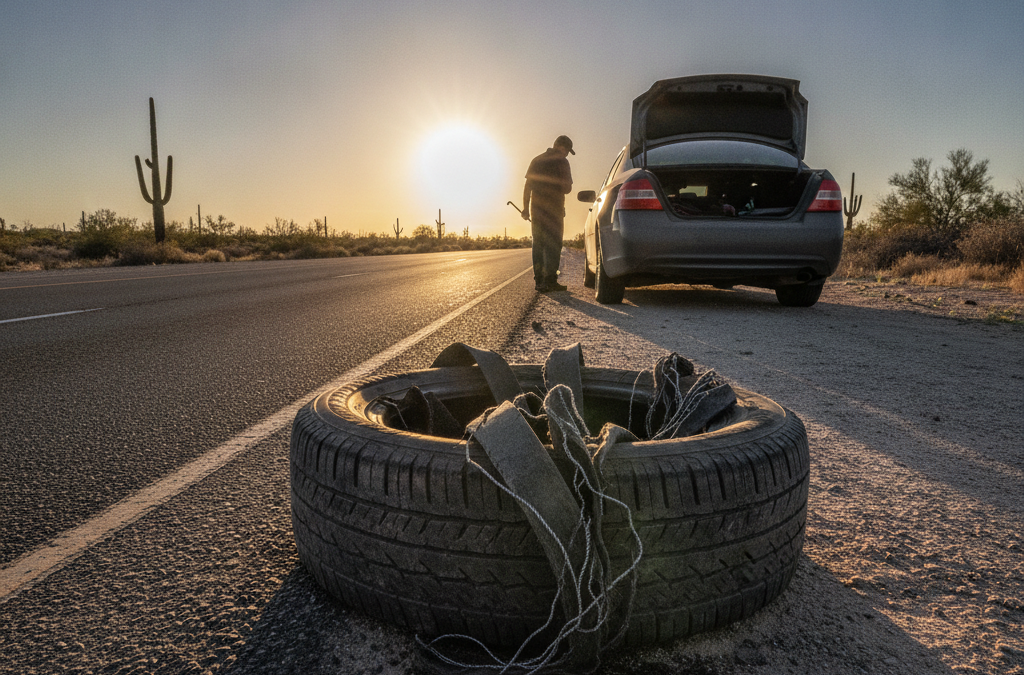
Most drivers think about tires when something goes wrong — a blowout on the Loop 303, a flat in a Surprise parking lot on a 112-degree afternoon, or a slow leak that keeps triggering the TPMS light. But by the time any of those things happen, the damage was probably building for months. Arizona heat is genuinely brutal on tires, and it works quietly — baking rubber from the outside in until the tire looks fine on the surface but is compromised underneath. Here’s what’s actually happening to your tires in this climate, how to spot the warning signs early, and when it’s time to stop waiting and get them replaced.
Why Arizona Heat Is So Hard on Tires
Tires are made of rubber, and rubber degrades when it gets hot — repeatedly, over time. In most parts of the country, that’s not a big deal. In the Phoenix West Valley, where summer pavement temperatures routinely hit 150°F or higher, it’s a serious issue that shortens tire life in ways most drivers aren’t accounting for.
Here’s what the heat is actually doing:
- Accelerating dry rot and cracking. UV exposure and heat cause the oils in rubber to evaporate faster, making tires stiff and brittle. You’ll start seeing small cracks in the sidewall — often called dry rot — even on tires that have plenty of tread left. A tire with sidewall cracking can fail without warning.
- Increasing blowout risk. Heat causes air inside the tire to expand. If you’re already running at the higher end of your recommended pressure (or slightly over), summer heat can push pressure into dangerous territory. Add in a stretch of hot pavement and freeway speeds, and blowout risk climbs significantly.
- Wearing tread faster. Hot pavement is softer asphalt, and it’s more abrasive on tire rubber. Tires in Arizona typically wear faster than the same tire in a cooler climate — even under identical driving conditions.
- Breaking down the internal structure. Heat degrades the steel belts and rubber compounds inside the tire, not just the surface. By the time you can see visible damage, the tire may already be structurally weakened.
The national average for tire replacement is often quoted as every 50,000 to 60,000 miles, or six years. In the Arizona desert, that math doesn’t always hold. Many drivers here find themselves needing new tires at 40,000 miles or less — and age matters just as much as mileage when you live somewhere this hot.
Warning Signs Your Tires Need Attention Now
You don’t need a mechanic to do a basic visual check. Walk around your vehicle and look for these:
- Sidewall cracks or bulges. Any crack in the sidewall is worth getting checked immediately. A bulge means the internal structure has already failed — that tire needs to come off.
- Uneven tread wear. If the edges are worn down but the center is fine, or vice versa, that usually points to an inflation problem or an alignment issue. If one side of a tire is more worn than the other, alignment is likely overdue. This is very common in Peoria, El Mirage, and other West Valley communities where road construction and rough pavement are ongoing facts of life.
- The penny test failing. Stick a penny into the tread groove with Lincoln’s head pointing down. If you can see the top of his head, the tread is at or below 2/32 of an inch — legally worn out and unsafe in wet conditions. The quarter test (Washington’s head) gives you an earlier warning at 4/32 of an inch.
- Vibration at highway speeds. Some vibration comes from balance issues, but persistent vibration can also mean internal tire damage or a separated belt.
- TPMS light that won’t quit. Your tire pressure monitoring system will flag a low-pressure tire, but it won’t tell you whether the problem is a slow leak, a valve stem issue, or heat-related pressure fluctuation. If the light keeps coming back, get it inspected — don’t just keep adding air and ignoring it.
How Many Years Do Tires Actually Last Here?
This is the question most local drivers — and, frankly, most competitor websites — don’t give a straight answer on. The general rule of thumb from most tire manufacturers is to replace tires after six years regardless of tread depth, and no later than ten years from the manufacture date. In Arizona, we’d push that to be more conservative. If your tires are five or more years old and you’re parking outside in the Surprise, Goodyear, or Avondale heat all summer, a visual inspection and professional assessment are worth doing — even if the tread looks okay on the surface.
You can find the manufacture date on the sidewall of every tire. Look for a four-digit code at the end of the DOT number — the first two digits are the week, the last two are the year. A tire stamped 2419 was made in the 24th week of 2019. That’s useful information when you’re evaluating whether a used car purchase makes sense, or when you’re trying to figure out whether your current tires need attention.
What About TPMS — Is It Enough to Keep You Safe?
Your TPMS system is helpful, but it’s not a replacement for regular tire inspections. The system only alerts you when pressure drops below a certain threshold — it won’t catch a tire that’s structurally compromised but still holding air, sidewall cracking, or uneven wear. Think of TPMS as a last-resort alert, not a monitoring system. A visual check every month and a professional inspection at least once a year goes a lot further.
If your TPMS light is on and you’re not sure why, our team can diagnose the issue — whether it’s a sensor problem, a leak, or something else. We won’t just reset the light and send you on your way.
The One Thing Competitor Shops Often Skip: Explaining Tire Age vs. Tread Depth
Here’s the gap most shops — and most competitor websites in this area — don’t fill: they talk about tread depth as the main measure of whether a tire needs replacing, and they mostly ignore age and heat degradation. That’s a problem in a climate like ours. A tire with 6/32 of tread that’s six years old and has lived through five Arizona summers may be less safe than a tire that’s technically more worn but newer and not heat-degraded. If you live in Sun City, El Mirage, or anywhere else in the Phoenix West Valley and your tires are getting up there in age, ask about age-related inspection — not just tread depth.
At All Valley Car Care, we look at both when we evaluate tires. We’ll tell you honestly what we see — including when we think a tire still has life in it and when it doesn’t. No invented urgency.
Can You Drive on Worn or Cracked Tires a Little Longer?
It’s tempting, especially when you’re juggling other car expenses. But in Arizona summers, the risk calculation is different than it would be in Minnesota or Oregon. Blowouts are more likely in high heat, the consequences at freeway speeds are severe, and there’s very little margin for error when pavement temperatures are over 150 degrees. If a tire is showing sidewall cracks or is worn past 2/32, we’d tell you not to wait — not because we want to sell you tires, but because it’s genuinely not worth the gamble.
If money is tight, talk to us. We’ll help you prioritize which tires need immediate attention and which ones you have a little more time on. That’s an honest conversation we’re glad to have.
If you’re unsure where to start, come see us at our Surprise location and we’ll walk through your tires with you — no appointment needed for a quick visual check.
Frequently Asked Questions About Tires in Arizona Heat
How often should I check my tire pressure in the summer?
Once a month at minimum, and always when your TPMS light comes on. Check pressure when the tires are cold — before you’ve driven more than a mile or two — because driving heats the air inside and gives you a higher reading than your actual baseline. In Arizona summers, pressure can swing significantly between morning and afternoon, so consistency matters.
Do I need to rotate my tires more often in Arizona?
Rotation every 5,000 to 7,500 miles is a good rule everywhere, but it matters especially here because uneven wear from hot pavement can get ahead of you quickly. Front tires typically wear faster than rears, and rotating regularly keeps the wear even so you get the most life out of the full set.
My car has a slow leak that keeps coming back. Do I need a new tire?
Not necessarily — it depends on where the leak is. A nail or screw in the tread can often be patched. A leak in the sidewall or shoulder of the tire, or a bead seal issue from heat, usually means the tire needs to be replaced. We’ll tell you which situation you’re in after we look at it.
How do I know if my TPMS sensor is broken or if I actually have a pressure problem?
The easiest way is to manually check the pressure with a gauge when the light comes on. If pressure looks fine on all four tires, there’s a good chance it’s a sensor issue rather than a real pressure problem. Sensors can also fail after tire rotations if they weren’t reset. We can diagnose and reset or replace TPMS sensors as part of a tire service.
Should I be worried about tires on a used car I just bought?
Absolutely — and this is worth checking before you buy, not after. Arizona used cars sometimes sit in outdoor lots for months, and tires can look acceptable on the surface while being old enough to be unsafe. Ask for the DOT date code on any used vehicle you’re considering, or have a pre-purchase inspection done. We can check tires as part of that inspection.
Ready to Get Your Tires Checked?
If it’s been a while since anyone looked at your tires — or if you’re seeing cracks, getting TPMS warnings, or just not sure what shape they’re in after another Arizona summer — we’re here. All Valley Car Care has been serving drivers across the West Valley since 2010, and we’ll give you a straight answer on what your tires actually need. No pressure, no upsell. Just an honest look and an honest recommendation.
Contact us to schedule a tire inspection or stop by — we’d rather catch a problem early than hear from you on the side of the freeway.