
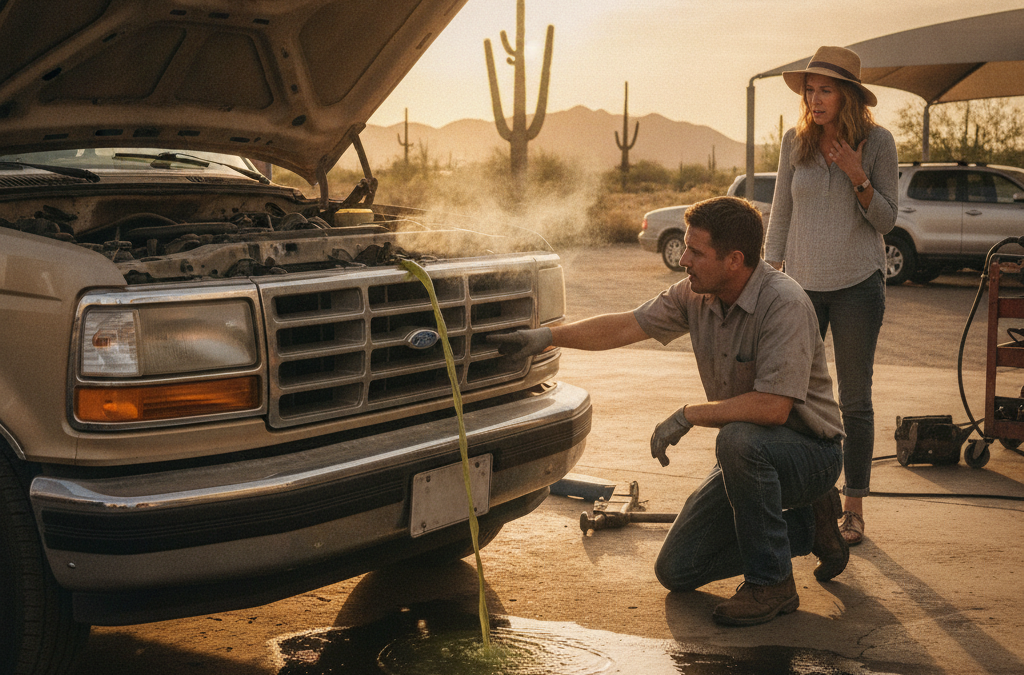
How Do You Know If Your Car’s Radiator Is Leaking — and What Should You Do About It in Surprise, AZ?
If you’ve noticed a puddle under the front of your car, your temperature gauge creeping toward the red, or a faint sweet smell when you park in the garage, there’s a decent chance your radiator has a leak. In Surprise and across the Phoenix West Valley, a slow coolant leak has a way of becoming a serious problem fast — because when outside temps are pushing 110°F or higher, your engine has almost no margin for error if the cooling system isn’t doing its job. The good news is that catching a radiator leak early is usually a straightforward, affordable fix. Ignoring it is what turns a repair into an engine replacement.
What Does a Radiator Actually Do?
Your radiator is the core of your vehicle’s cooling system. It circulates coolant through the engine to absorb heat, then passes that hot coolant through the radiator’s fins where airflow (or your cooling fans) brings the temperature back down. That cycle repeats constantly while your engine is running. When there’s a leak — whether it’s a small crack in the tank, a corroded fitting, or a failing radiator cap — coolant escapes faster than it can do its job, and your engine starts running hotter than it should.
In a milder climate, a small leak might give you weeks of warning before anything serious happens. In the middle of a Surprise summer, that same slow leak can put you on the side of Loop 303 with steam pouring from under your hood in under an hour.
Warning Signs Your Radiator Is Leaking
You don’t need to be a mechanic to catch these early. Here’s what to watch for:
- A puddle under the front of your car. Coolant is typically bright green, orange, or pink depending on the type. It’s thinner than oil and has a slightly sweet smell. If you see a puddle that isn’t water from your AC drain (which is clear), take it seriously.
- Your temperature gauge is running higher than normal. If your gauge is climbing toward the middle or beyond — especially on short trips or in stop-and-go traffic — your cooling system isn’t keeping up.
- You’re adding coolant more often than you used to. Coolant is a closed system. If the reservoir level keeps dropping and you’re topping it off regularly, that fluid is going somewhere.
- A sweet or maple-syrup smell. Coolant has a distinctive sweet odor. If you smell it inside the cabin or outside after parking, that’s a red flag.
- Visible white residue or crusty buildup around hose connections. Coolant leaves mineral deposits behind when it evaporates, and those dried streaks around fittings or on the radiator itself are a telltale sign of a slow leak.
- Steam from under the hood. At this point, you’ve already got a problem. Pull over safely and don’t try to drive further — running an overheated engine even for a few minutes can warp a head gasket or crack the block.
Why Arizona Heat Makes Radiator Leaks Worse — and More Common
Cooling systems take a beating in the Valley of the Sun in ways that drivers who moved here from cooler states don’t always expect. The combination of extreme ambient heat, long daily commutes, and eight-plus months of AC use keeps your engine — and your radiator — working harder and hotter than the national average. Over time, that stress degrades plastic radiator tanks, weakens hose connections, and accelerates corrosion inside the radiator core itself.
Drivers in communities like El Mirage, Youngtown, and Sun City West who are running older vehicles often find that cooling system problems surface right around July and August, when daytime temps are at their worst and the radiator just can’t keep up anymore. It’s not bad luck — it’s physics. The desert simply accelerates wear on components that other climates let slide for another year or two.
What makes this tricky is that a lot of drivers don’t realize their radiator was already marginal until they hit a stretch of heavy traffic on a 115-degree afternoon and the temperature gauge tells the whole story at once.
What Causes Radiator Leaks — and Can You Fix It Yourself?
Radiator leaks usually come from one of a few places:
- Cracked or brittle plastic end tanks — common on vehicles over 8 to 10 years old, especially after years of desert heat cycling
- Corroded or pinhole leaks in the aluminum core — often caused by old coolant that’s lost its anti-corrosion additives
- Loose or deteriorated hose connections — the clamps and rubber hoses that connect to the radiator can soften and fail over time
- A failing radiator cap — if the cap can’t hold proper pressure, coolant boils out faster than it should
- Internal leaks at the transmission cooler lines — on vehicles with automatic transmissions, the transmission fluid and coolant share a section of the radiator, and a failed separator can contaminate both fluids
You’ll find stop-leak additives at any auto parts store, and they’re tempting as a quick fix. In some very limited situations — a pinhole leak on a long road trip when you have no other options — they can get you home. But as a real repair, they fall short. Stop-leak products can clog your heater core, gum up your water pump, and mask the actual damage until it becomes much worse. A proper pressure test and visual inspection by a technician will tell you exactly where the leak is and what it actually takes to fix it.
What a Radiator Repair Actually Involves
When you bring your vehicle to All Valley Car Care in Surprise, diagnosing a radiator leak starts with a cooling system pressure test. A technician pressurizes the system and watches for where the pressure drops — that points directly to the leak source without guesswork. From there, the repair depends on what’s actually causing the problem.
Minor leaks at hose connections or a faulty radiator cap are inexpensive fixes. A cracked plastic tank on an otherwise good radiator can sometimes be repaired, but on older or heavily damaged radiators, replacement is the more reliable long-term choice. Your technician should be able to walk you through the options and give you a written estimate before any work begins — that’s the standard at All Valley Car Care, and it’s how repairs should work everywhere.
After any radiator work, the system should be flushed and refilled with fresh coolant mixed to the proper ratio for Arizona driving. Old, depleted coolant is part of why corrosion starts in the first place, so it doesn’t make sense to repair the radiator and leave degraded fluid behind.
What Competitors Often Miss: The Connection Between Old Coolant and Radiator Failure
One gap worth addressing directly: a lot of local shops talk about radiator repair as a standalone fix, but rarely explain the role that neglected coolant plays in causing the damage in the first place. Coolant has anti-corrosion additives that wear out over time — typically every 30,000 to 50,000 miles depending on the type. Once those additives break down, the coolant becomes acidic and starts eating away at the aluminum and metal components inside your cooling system, including the radiator itself.
For drivers in the Peoria and Glendale areas who are commuting long distances daily, coolant service intervals matter more than the calendar. If you can’t remember the last time your coolant was tested or replaced, that’s worth checking before a leak develops — not after. You can explore the full range of cooling system services we offer at our services page.
Frequently Asked Questions
Can I drive with a small radiator leak?
Not recommended — especially in summer in the Phoenix West Valley. Even a slow leak can drop coolant levels fast enough to cause overheating within a single commute. If your temperature gauge is climbing or you’re losing coolant regularly, get it looked at before your next long drive.
How much does it cost to fix a radiator leak?
It depends on the source. A bad radiator cap or loose hose clamp is very inexpensive. A full radiator replacement on most passenger vehicles runs more, but we’ll always give you a written estimate upfront so you know exactly what you’re looking at before we start.
How do I tell the difference between a radiator leak and an AC condensate drain?
AC drain water is clear and odorless — it’s just condensation. Coolant is usually tinted (green, orange, or pink depending on the type) and has a faint sweet smell. If the puddle is under the front of the car and doesn’t look or smell like plain water, have it checked.
Does a radiator leak always show as a puddle under the car?
Not always. Internal leaks — like a head gasket failure — can burn coolant without leaving a visible puddle. Signs of an internal leak include white exhaust smoke, a milky film on the oil dipstick, or persistent overheating with no visible coolant loss outside the engine. These are serious and need to be diagnosed quickly.
How often should coolant be replaced to prevent radiator problems?
Most manufacturers recommend testing coolant condition every 30,000 miles and replacing it every 50,000 miles or so — but in Goodyear, Surprise, and other hot Arizona communities where vehicles run harder and hotter, erring on the earlier side makes sense. A quick coolant test at your next service visit can tell you exactly where yours stands.
Get Your Cooling System Checked Before It Becomes an Emergency
A radiator leak is one of those problems that’s easy and affordable to deal with early — and genuinely expensive to ignore. If you’ve noticed any of the warning signs above, or if it’s just been a while since anyone looked at your cooling system, bring your vehicle in and let us take a look. We’ll tell you exactly what we find, give you a written estimate, and never recommend a repair you don’t need.
All Valley Car Care has been serving Surprise and the surrounding West Valley since 2010. Our work comes backed by a 3-year/36,000-mile warranty — extendable to 5 years/60,000 miles — and our ASE-certified technicians work on domestic vehicles, European imports, and everything in between. Contact us or schedule your appointment online — we’ll get your cooling system in shape before the next heat wave hits.