
Why Is My Car Shaking or Vibrating at Highway Speed — and What’s Causing It in Surprise, AZ?
You merge onto the Loop 303 or I-10, your speed climbs past 60 mph, and suddenly your steering wheel starts buzzing in your hands — or your whole seat is shaking like you’re driving over rumble strips that never end. It’s unsettling, and it usually gets worse the faster you go. If this sounds familiar, you’re not alone. It’s one of the most common complaints we hear at All Valley Car Care in Surprise, and the good news is: in most cases, the fix is straightforward once you actually find the cause.
The less-good news? There are several different things that can make a car vibrate at highway speed, and some of them are more serious than others. Guessing at the cause — or ignoring it and hoping it goes away — can end up costing you a lot more than catching it early.
The Most Likely Reason: Your Wheels Are Out of Balance
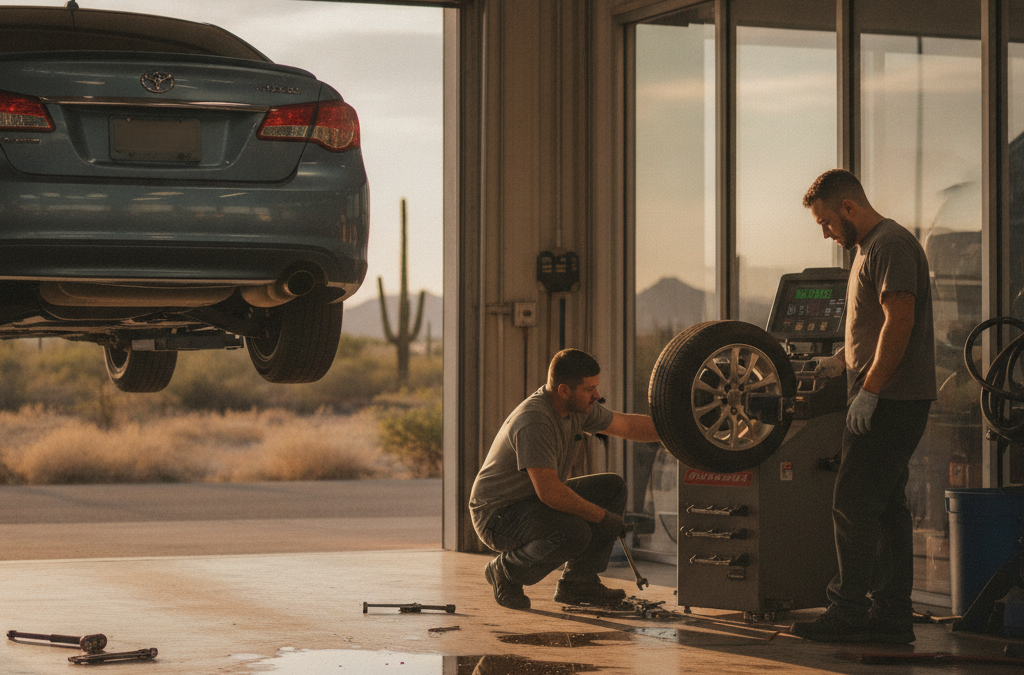
If the shaking starts somewhere between 55 and 70 mph and smooths out a little above or below that range, unbalanced tires are the first thing to check. Every tire and wheel assembly has tiny weight differences around the rim. When those aren’t compensated for with small balancing weights, you get a vibration that shows up at specific speeds — often right in the highway driving range.
In the Phoenix West Valley, this problem shows up faster than it does in milder climates. Arizona’s extreme heat — pavement temps can hit 150°F in summer — accelerates tire wear and can cause tires to develop flat spots or uneven wear patterns more quickly. Tires also lose air pressure faster in the heat, and low pressure changes how weight is distributed around the wheel. If you haven’t had your tires balanced recently, that’s a cheap and easy first step.
Other Common Causes of Vibration at Speed
Tires With Uneven Wear or Internal Damage
A tire that’s worn unevenly — cupped, scalloped, or flat-spotted from sitting too long — can shake the whole car even if it’s perfectly balanced. Internal belt separation, where the steel belts inside the tire come apart, is especially dangerous. You may feel a rhythmic thump or wobble that gets worse with speed. In Arizona, tires age faster because UV radiation and extreme heat degrade the rubber compounds. A tire that looks fine on the outside can still be compromised inside.
Bent or Damaged Wheels
If you’ve hit a pothole lately — and between the road construction on Grand Ave, Bell Road, and seemingly half the streets in Peoria and El Mirage, that’s basically inevitable — there’s a decent chance you bent a wheel. Even a slight bend that you can’t see with the naked eye can cause a wobble that shows up clearly at 65 mph. This is something a shop can check on a balancing machine; it’ll show up immediately.
Worn Tie Rods or Ball Joints
These are the steering and suspension components that keep your wheels pointed where you want them to go. When they wear out, there’s play in the system — and at highway speed, that play becomes a shimmy or shake, often felt through the steering wheel. Worn tie rods and ball joints are also a safety issue, not just a comfort issue. If a ball joint lets go completely while you’re driving, you lose control of that corner of the car.
If you’re noticing vibration alongside any wandering or pulling while driving, or if the car doesn’t feel planted when you hit a bump, a full steering and suspension inspection is worth scheduling sooner rather than later.
CV Axle Problems
Front-wheel-drive and all-wheel-drive vehicles use CV (constant velocity) axles to transfer power to the wheels. When the CV boot tears — which happens more often in the desert because the rubber dries out faster — grease gets flung out and the joint wears quickly. A worn CV axle typically causes a clicking noise when you turn, but it can also cause a vibration at highway speed, especially when accelerating. This is one of those problems that’s easy to ignore for a while but tends to get worse fast.
Driveshaft Issues on Trucks and SUVs
If you’re driving a rear-wheel-drive truck or an SUV with a solid rear axle — which describes a lot of the vehicles people drive in Surprise, Goodyear, and Avondale — a vibration at highway speed could be a driveshaft problem. A worn U-joint or an out-of-balance driveshaft causes a vibration that you’ll often feel more in the floorboard and seat than in the steering wheel. It can also show up as a clunk when you accelerate from a stop.
Warped Brake Rotors
This one’s a little different — warped rotors usually cause a vibration or pulsing in the brake pedal when you slow down, not just at cruising speed. But if you feel it primarily when braking from highway speed, rotors are a likely suspect. Arizona’s heat, combined with frequent heavy braking (think: quick stops on surface streets after cruising the freeway), can warp rotors faster than in cooler climates.
What a Good Diagnosis Actually Looks Like — and Where Competitors Often Fall Short
Here’s the thing: a lot of shops will look at a vibration complaint and go straight to selling you four new tires. Sometimes that’s the right answer. But sometimes it’s a worn tie rod or a bent wheel, and slapping new tires on it won’t fix the vibration — it’ll just cost you money you didn’t need to spend.
A real diagnosis involves a road test to feel where the vibration is coming from (steering wheel vs. seat vs. floorboard, under acceleration vs. coasting, braking vs. not), followed by a visual inspection of the tires, wheels, and suspension components — and then a balance check on the machine. Not every shop takes that full approach before recommending parts. At All Valley Car Care, we’ve been doing this since 2010, and our promise is simple: we tell you what we actually found, not what’s easiest to sell. Our Surprise location has ASE-certified technicians who handle everything from basic tire balancing to full suspension work.
Frequently Asked Questions
Is it safe to keep driving if my car is vibrating at highway speed?
It depends on the cause. An unbalanced tire is annoying but not immediately dangerous. A worn ball joint, failing CV axle, or tire with internal belt damage is a different story — any of those can fail suddenly. If the vibration is new or getting worse, get it checked soon.
How much does it cost to fix a vibration problem?
That depends entirely on the cause. A tire balance is one of the least expensive services a shop offers. A set of new tires, a CV axle replacement, or tie rod work costs more. We’ll always give you a written estimate before any work begins — no surprises.
Can a wheel alignment fix a vibration at highway speed?
An alignment corrects the angle of your wheels, which affects tire wear and steering pull — but it won’t fix a vibration caused by imbalance, bent wheels, or worn suspension parts. You might need both an alignment and a balance, especially if your tires have been wearing unevenly. We’ll tell you what’s actually needed.
How often should I have my tires balanced in Arizona?
Most manufacturers suggest every 5,000 to 7,500 miles, or with every tire rotation. In Arizona, where heat and road conditions are harder on tires, sticking to that schedule matters more than it does in milder climates. If you feel a new vibration at any point, don’t wait for your next rotation — get it checked.
My car only shakes when I brake from highway speed. Is that a different problem?
Yes — that’s usually warped rotors or brake pad deposits on the rotor surface. It’s a brake issue, not a tire or suspension issue, and it’s worth having inspected. Sun City and Youngtown drivers who do a lot of freeway-to-surface-street driving tend to see this more often because of frequent hard braking.
Don’t Guess — Get It Diagnosed Right the First Time
A highway vibration is one of those things that’s easy to put off because the car still drives. But the underlying cause usually gets worse over time, not better. Whether it’s a quick balance job or something that needs more attention, the sooner you know what you’re dealing with, the simpler — and cheaper — the fix tends to be.
If your car is shaking on the freeway and you want a straight answer about what’s causing it, contact All Valley Car Care and schedule an inspection. We serve drivers across Surprise, Peoria, Glendale, Goodyear, Avondale, and the surrounding West Valley. No unnecessary repairs, no hidden costs — just honest answers and quality work backed by our 3-year/36,000-mile warranty.