
How Do You Know If Your Car’s TPMS Light Is Telling You Something Serious — or Just Being Picky in Surprise, AZ?
That small orange horseshoe symbol with an exclamation point just lit up on your dashboard. If you’re a driver in Surprise, your first reaction is probably somewhere between mild annoyance and low-level panic — and honestly, that reaction is completely reasonable. Sometimes the TPMS light is warning you about a slow leak that could become a blowout on the 303. Other times it clicked on because the temperature dropped 20 degrees overnight and your tires just need a little air. The trick is knowing which situation you’re actually in, because one of them needs immediate attention and the other takes five minutes at a gas station.
What Is TPMS and Why Does Arizona Make It Extra Complicated?
TPMS stands for Tire Pressure Monitoring System. Every vehicle sold in the U.S. after 2008 is required to have one. There’s a small sensor inside each wheel that measures the air pressure in your tire and sends a signal to your car’s computer. When pressure in any tire drops below about 25% of the recommended level, that warning light comes on.
Simple enough in theory. But here in the Phoenix West Valley, your tires are dealing with conditions that make pressure management genuinely unpredictable. Pavement surface temperatures regularly hit 150°F or higher during summer. That heat causes the air inside your tires to expand — so a tire that read perfectly fine at 7 a.m. can read several PSI higher after sitting in a parking lot at noon. Then that same tire cools overnight and reads low again. Your TPMS sensor is just reporting what it sees, and what it sees changes constantly in this climate.
This is one of the reasons we see a lot of confused drivers coming in from neighborhoods like Marley Park, Rancho Gabriela, and Sun City West who aren’t sure whether their tire warning is real or just the weather messing with their gauge.
The Four Most Common Reasons Your TPMS Light Is On
1. A Tire Is Actually Low on Air
This is the most common cause, and the most important one to rule out first. Check all four tires with a reliable gauge — not just a visual inspection, because a tire can look fine and still be 8–10 PSI low. If one or more tires are below the recommended pressure (usually found on a sticker inside your driver’s door jamb), add air and see if the light goes off. Most cars reset the TPMS automatically after you drive a few miles at normal speed.
If the light comes back on within a day or two, you likely have a slow leak. In the West Valley, road construction debris — screws, wire, gravel — is everywhere, and slow punctures are one of the most common tire issues we see at our Surprise location. Don’t ignore a slow leak. They get worse, especially in extreme heat.
2. Temperature Change Caused a Temporary Pressure Drop
During Arizona’s cooler months — roughly November through February — you may wake up to a TPMS light that wasn’t there the night before. Cold air causes tire pressure to drop (roughly 1 PSI for every 10-degree temperature drop). Once the day warms up and you’ve driven a few miles, the light may go off on its own.
This doesn’t mean you should ignore it. It’s still worth checking your pressures manually. But if all four tires are within range and the light clears itself after a short drive, you can usually chalk it up to the weather.
3. A TPMS Sensor Has Failed or Has a Dead Battery
The sensors in your wheels run on small batteries — and like every battery in Arizona, they don’t last as long as the manufacturer intended. Normal sensor life is five to seven years. In our climate, where electronics take a beating from constant heat exposure, it’s not unusual to see sensors failing closer to the four-year mark. A dead or malfunctioning sensor will trigger the TPMS light even when your tire pressure is perfectly fine.
Here’s a clue: if your TPMS light blinks for about 60–90 seconds when you first start the car and then stays on solid, that’s often a sign the system is detecting a sensor malfunction rather than a pressure problem. A quick scan at a shop can confirm which sensor is acting up and whether it needs to be replaced.
4. The System Wasn’t Reset After a Tire Rotation or New Tires
Every time your tires get rotated or replaced, the TPMS system needs to be recalibrated so it knows which sensor is where. If a shop does your rotation and doesn’t reset the system — which happens more often than it should at busy quick-lube chains — you may get a warning light that has nothing to do with your actual tire pressure. The fix is a simple TPMS reset, but it does require the right equipment and the correct procedure for your specific vehicle.
When the TPMS Light Is a Genuine Emergency
Don’t drive on a tire that’s visibly flat or dramatically low. A tire running 15 or more PSI below its recommended pressure generates dangerous amounts of heat — and on 150-degree pavement in summer, that heat builds fast. Blowouts on Arizona freeways are serious accidents. If you pull over and the tire looks obviously soft or flat, do not try to drive it to the shop. Call for roadside assistance or put on your spare.
Also pay attention to how your car handles. If the TPMS light came on and you’re also noticing pulling to one side, a vibration, or unusual noise, stop and inspect the tire before driving further.
What Happens When the TPMS Light Gets Ignored
This is the gap we see most often — drivers who acknowledge the light is on but keep driving because the car seems fine. In mild climates, that habit might be low-risk for a while. In the Phoenix area, especially during summer, it’s genuinely dangerous. Underinflated tires wear unevenly, reduce your fuel economy, and overheat far more quickly when pavement temperatures are already extreme. What starts as a $20 plug repair can turn into a $200 tire replacement if the sidewall gets damaged from running low too long.
For drivers in areas like El Mirage, Youngtown, and Goodyear who are doing significant highway mileage, this matters even more. The longer you’re on the road with an underinflated tire, the more heat builds up.
TPMS Service at All Valley Car Care
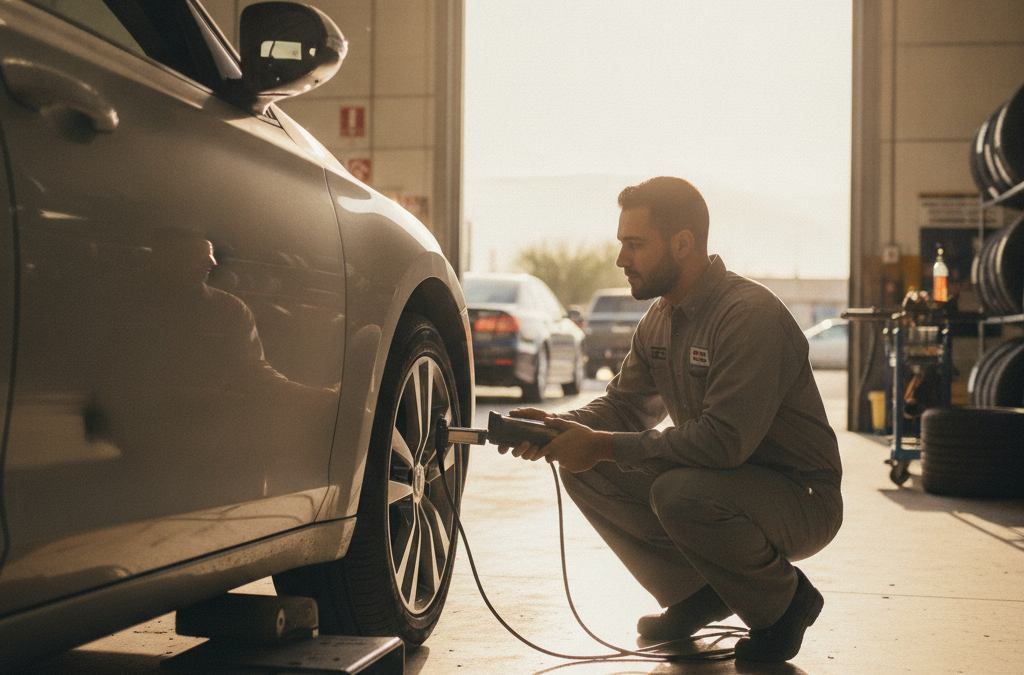
We can read your TPMS system with professional diagnostic equipment, tell you exactly which sensor triggered the light and why, check your tire pressures against the manufacturer spec, and reset the system properly after any rotation or new tire installation. If a sensor needs to be replaced, we’ll tell you what it costs before we do anything — no surprises on the bill. Our full list of tire and alignment services includes TPMS sensor replacement, tire rotation, balancing, and flat repairs.
We also check TPMS as part of any routine oil change or multi-point inspection, because it’s one of those things that’s easy to overlook until it becomes a problem on the freeway.
Frequently Asked Questions About TPMS in Surprise and the West Valley
Can I drive with the TPMS light on?
It depends. Check your tire pressures first. If all tires are within range and the light clears after driving, you’re likely fine. If a tire is noticeably low, add air before driving further. If the light stays on after correcting pressure, bring it in for a sensor check.
How much does it cost to replace a TPMS sensor in Arizona?
Sensor replacement costs vary by vehicle make and model. We don’t publish flat-rate pricing because sensor type and labor time differ across vehicles — but we’ll give you a written estimate before any work starts. There’s no charge just to scan the system and tell you what’s going on.
Does Arizona’s heat damage TPMS sensors faster?
Yes. The sensor batteries don’t like prolonged heat exposure, and the sensors themselves can degrade faster in extreme conditions. We typically see sensor failures coming earlier here than manufacturers’ published lifespan estimates suggest.
Why does my TPMS light blink instead of staying solid?
A blinking TPMS light — usually 60 to 90 seconds of flashing when you start the car — typically indicates a system fault rather than a simple pressure issue. This often points to a dead or malfunctioning sensor. A solid light means pressure is low in one or more tires. Either way, it’s worth getting checked.
Do I need to reset TPMS after adding air to my tires?
Most modern vehicles reset the TPMS automatically after you’ve driven for a few miles at normal speed following a pressure correction. Some older vehicles require a manual reset — usually holding a button under the dash. If your light doesn’t clear after driving, a shop can reset it quickly with a scan tool.
Don’t Let a Dashboard Light Become a Roadside Problem
Most TPMS issues are minor and quick to fix. But in Surprise and across the West Valley, where summer heat turns small tire problems into big ones fast, it pays to deal with them promptly. If your light is on and you’re not sure why, come by and we’ll figure it out together — no pressure (pun intended) and no unnecessary repairs. Schedule a visit or reach out to our team here and we’ll get you in and sorted out quickly.