
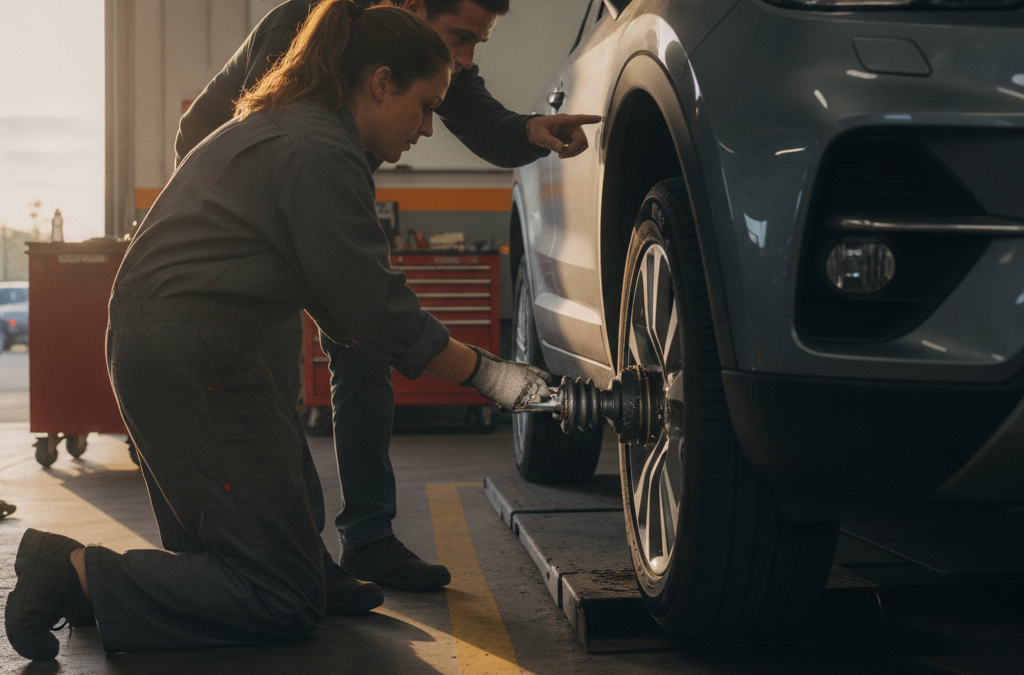
How Do You Know If Your Car’s CV Axle Is Failing — and What Does It Cost to Fix in Surprise, AZ?
If you’ve noticed a clicking or popping noise coming from the front of your car when you turn — especially in a parking lot or making a tight turn — there’s a good chance you’re dealing with a failing CV axle. It’s one of those problems that’s easy to ignore at first, but it doesn’t go away on its own. Drivers all over the Surprise area bring their vehicles in wondering what that sound is, and more often than not, it’s the CV joint telling them it’s time. Here’s what you need to know: what a CV axle actually does, how to spot the warning signs before things get worse, and what you can realistically expect to pay for the repair.
What Is a CV Axle and Why Does It Matter?
CV stands for constant velocity. Your CV axle is the shaft that transfers power from your transmission to your wheels — and the CV joints at each end of the axle are what allow that shaft to flex as your suspension moves and your wheels turn. On most front-wheel drive cars, and on all-wheel drive vehicles too, you have CV axles on the front. Some AWD and rear-wheel drive vehicles also have them in the back.
Each CV joint is packed with grease and protected by a rubber boot — think of it like a flexible rubber sleeve wrapped around a packed bearing. When that boot cracks or tears, the grease escapes and dirt gets in. Once that happens, the joint starts to wear fast. A joint that might have lasted another 50,000 miles with an intact boot can go bad within a few thousand miles once it’s exposed to the grit on Arizona roads.
And we’ve got plenty of grit out here. Between road construction along major corridors in Peoria and Surprise, the sandy soil in El Mirage and Youngtown, and the general wear that comes with high-heat pavement, CV boots don’t always last as long in the Phoenix West Valley as they do in milder climates.
The Warning Signs Your CV Axle Is Going Bad
The good news is that a failing CV axle usually gives you some warning before it becomes a full emergency. Here’s what to watch and listen for:
- Clicking or popping when turning: This is the most common symptom, especially when making slow, sharp turns like pulling out of a driveway or navigating a parking lot. The noise usually comes from the outer CV joint on the front axle.
- Clunking when accelerating or shifting: A worn inner CV joint can cause a thudding or clunking noise when you put the car in drive or accelerate from a stop. This one gets mistaken for transmission problems a lot.
- Vibration at highway speeds: If the axle shaft itself is bent or a joint is badly worn, you may feel a vibration that worsens as you speed up. This is a more advanced symptom.
- Grease on the inside of your wheel or tire: If you see dark, thick grease splattered on the inside edge of your tire or rim, that’s a torn CV boot leaking grease everywhere. The joint isn’t far behind.
- Pulling to one side during acceleration: Less common, but a severely worn axle can affect how power is delivered to the wheel, causing the car to pull.
If you’re only at the clicking stage, you’re in good shape — the repair is straightforward and relatively affordable. If you’ve ignored it to the point where the joint has seized or the axle has actually failed, you’re looking at being towed and potentially facing additional damage to the transmission or wheel hub. Don’t wait that long.
What Most Local Shops Don’t Tell You: Boot vs. Full Axle
Here’s something that often doesn’t get explained clearly — and it’s a gap worth filling. When a CV boot tears early, before the joint itself is damaged, a skilled tech can sometimes replace just the boot and repack the joint with fresh grease. That’s a cheaper fix than a full axle replacement. However, if the joint has been running dry for any length of time, the internal components are already worn, and replacing just the boot won’t solve the clicking. In that case, you need the whole axle replaced.
At All Valley Car Care in Surprise, we take the time to actually inspect the joint before recommending a full axle replacement. If a boot replacement is the right call, that’s what we’ll tell you. No unnecessary repairs, no hidden costs — just an honest assessment with a written estimate before we touch anything.
What Does a CV Axle Replacement Cost in Surprise?
CV axle replacement is a mid-range repair. For most front-wheel drive cars and crossover SUVs — which make up a huge portion of vehicles in neighborhoods like Marley Park, Rancho Gabriela, and Greer Ranch — you’re typically looking at somewhere in the range of $250 to $500 per axle, parts and labor included. That range moves depending on the make and model of your vehicle, whether it’s a domestic or European import, and which axle needs replacing (inner vs. outer, driver side vs. passenger side).
Trucks and SUVs with all-wheel drive or four-wheel drive can be on the higher end, since those drivetrains are more complex. We’ll always give you a clear number before work begins.
One thing to keep in mind: if you’ve been putting this off and the joint has caused damage to your wheel hub bearing or transmission seal, those repairs will add to the bill. That’s not us padding the invoice — those are real consequences of a failed joint. Catching it at the clicking stage is always cheaper.
Can You Drive on a Bad CV Axle?
Technically, yes — for a short time. Practically, it’s not a good idea, and here’s why. A CV axle doesn’t fail on a predictable schedule. It can click for weeks and then let go suddenly, leaving you without power to the wheel mid-drive. That’s a safety issue, not just an inconvenience. In July or August, when it’s 112 degrees outside and you’re pulling off Litchfield Road in Goodyear trying to figure out why your car suddenly won’t move, the situation gets real uncomfortable real fast. Don’t push it.
If you’re hearing the clicking and you’re not sure how urgent it is, give us a call or schedule a quick inspection. We’ll tell you exactly where things stand.
CV Axle Service for Fleet and Commercial Vehicles
If you’re running a small fleet of delivery vans, work trucks, or service vehicles in and around Surprise, Avondale, or Glendale, CV axle wear is something that creeps up on you when your vehicles are racking up miles fast. A van that’s making tight turns in residential neighborhoods all day in 110-degree heat is going to wear its CV joints faster than a passenger car that mostly travels freeways. We work with local business owners to set up proactive inspection schedules so you’re not losing a vehicle — and a day of revenue — to a breakdown that could have been caught early.
Frequently Asked Questions
Is a clicking CV joint dangerous to drive on?
At the early stage, it’s not an immediate emergency, but it will get worse. A failed CV axle can leave you stranded without warning. Get it inspected soon rather than waiting until the noise gets louder or the vibration starts.
How long does a CV axle replacement take?
For most vehicles, it’s a same-day repair. Typically one to two hours of labor depending on the vehicle. We’ll let you know at the time of inspection if anything makes your specific job more involved.
Does Arizona heat affect CV boots and joints?
Yes. Rubber components like CV boots degrade faster in extreme heat. The same 115°F summers that shorten battery life and stress your AC system are also hard on rubber boots. Routine inspections help catch a cracking boot before grease has a chance to escape.
Will a CV axle problem trigger my check engine light?
Usually not. CV axle failure is a mechanical drivetrain issue, not an electronic one. Your check engine light won’t warn you about it — which is exactly why the clicking noise is so important to pay attention to.
Do you handle CV axle repairs on European imports and AWD vehicles?
Yes. We service domestic vehicles, European imports, and all-wheel drive platforms. If you’re driving a European-brand SUV or a truck with four-wheel drive, we can handle the inspection and repair. Check out our full list of services to see what we cover.
Don’t Let a Small Click Turn Into a Big Problem
A clicking CV axle is one of those repairs that feels minor right up until it isn’t. The drivers who catch it early pay a reasonable shop bill and move on. The ones who ignore it end up stranded on the side of the road, paying for a tow on top of the repair, and sometimes dealing with secondary damage too. We’ve seen both scenarios more times than we can count.
If you’re in Surprise, Peoria, Sun City West, El Mirage, or anywhere in the Phoenix West Valley and something about your car’s front end doesn’t sound right when you turn, bring it in or give us a call. We’ll give you a straight answer and a written estimate — no pressure, no surprises. That’s how we’ve operated since 2010, and it’s not changing anytime soon.