
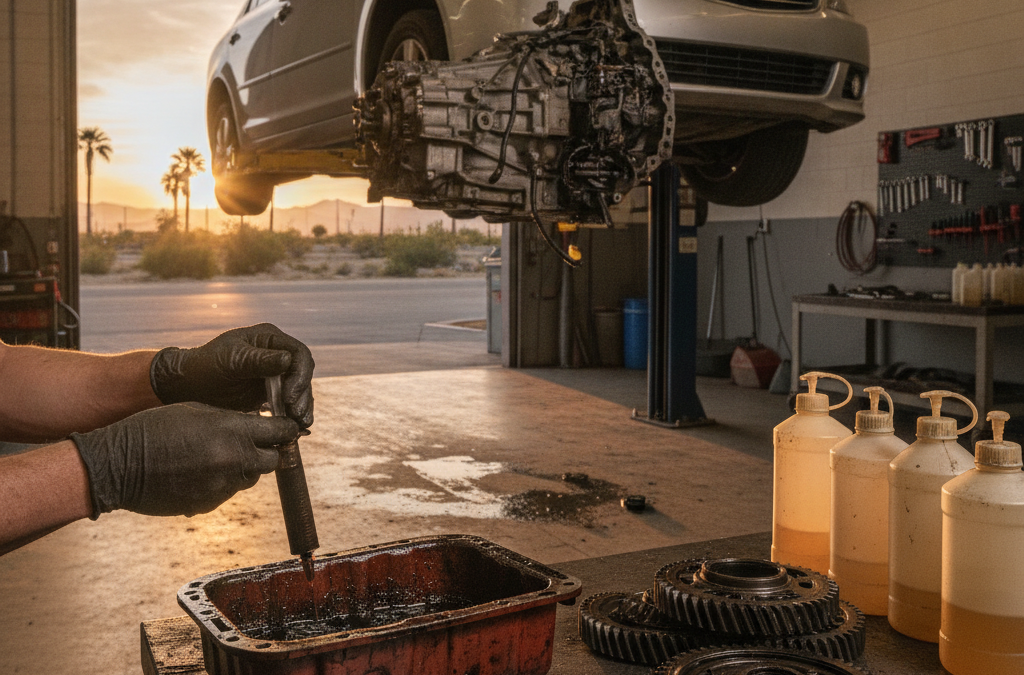
What Happens When You Skip Your Car’s Transmission Fluid Exchange — and How Long Can You Really Wait in Glendale, AZ?
If your owner’s manual says your transmission fluid is good for 60,000 miles, that guideline was written for somewhere like Minneapolis — not Glendale in July. Out here in the Phoenix area, your transmission works harder than the engineers assumed, and the fluid breaks down faster than most drivers realize. Skipping or delaying a transmission fluid exchange isn’t just a minor oversight. Over time, it’s one of the most expensive mistakes you can make with a vehicle you plan to keep.
The good news is that this is one of the easiest and least expensive things to stay on top of — when you catch it before something goes wrong.
What Transmission Fluid Actually Does
Your automatic transmission has dozens of moving parts — clutch packs, bands, solenoids, a torque converter — all moving at high speed while submerged in fluid. That fluid does three things at once: it lubricates the moving parts, transfers hydraulic pressure to shift gears, and carries heat away from components that generate a lot of friction.
Over time, that fluid degrades. It picks up microscopic metal particles from normal wear, the additives that prevent oxidation and foaming break down, and the viscosity changes. Once the fluid can no longer do those three jobs properly, parts start to wear faster. Shifts get rougher. Heat builds up. And eventually, the transmission starts failing in ways that are expensive to fix — sometimes not fixable at all without a full rebuild or replacement.
Why Arizona Heat Shortens Transmission Fluid Life
Heat is the single biggest enemy of transmission fluid. Every time your transmission runs hot — which in the Phoenix West Valley happens constantly — the fluid oxidizes a little faster. Stop-and-go commutes on the I-17 or surface streets through Glendale and Peoria during summer afternoons are especially hard on transmissions. Towing anything, driving through extended construction zones, or sitting in traffic with the engine working to keep up the AC puts even more heat into the fluid.
Most transmission fluid is rated to handle temperatures up to around 200°F before degradation accelerates sharply. Transmission temps in stop-and-go Arizona traffic can routinely push past that threshold. When fluid breaks down from heat, it loses its ability to lubricate and carry away heat — which causes even more heat, which causes more breakdown. It compounds fast.
The practical result: what your manual calls a 60,000-mile interval may realistically be closer to 30,000–45,000 miles here, depending on your driving habits and vehicle. That’s not us trying to upsell you — it’s just the math of desert driving.
What the Warning Signs Look Like Before It’s Too Late
Transmission problems rarely announce themselves all at once. Usually there’s a window where something feels slightly off — and that’s your best opportunity to deal with it affordably.
Here are the things worth paying attention to:
- Sluggish or rough gear shifts — especially between first and second gear at low speeds
- A slight shudder or vibration when the transmission shifts, particularly at highway speeds
- A delay before the car moves after you shift from Park into Drive or Reverse
- Transmission slipping — the engine revs but the car doesn’t accelerate the way it should
- Dark or burnt-smelling fluid — healthy transmission fluid is pink or light red and doesn’t smell like anything; dark brown or black fluid with a burnt smell means it’s well overdue
- A warning light — some vehicles have a dedicated transmission temperature warning, and any transmission-related code on a diagnostic scan is worth taking seriously
If you’re seeing any of these signs, don’t wait it out. A fluid exchange done at the right time protects the transmission. A fluid exchange done after slipping has started may help, but it won’t undo wear that’s already happened.
Fluid Exchange vs. Flush — What’s the Difference and Why It Matters
This is a question a lot of shops gloss over, and it’s worth explaining clearly.
A transmission fluid exchange drains the old fluid and replaces it with fresh fluid — typically removing somewhere between 40 and 70 percent of the total fluid volume, since some fluid always stays in the torque converter and cooler lines. It’s the most common service and, for a transmission in reasonably good condition, it’s the right approach.
A transmission flush uses a machine to push all the old fluid out — closer to a 100 percent replacement. It sounds more thorough, and sometimes it is. But on a transmission that’s been neglected for a long time, a full flush can dislodge debris that’s been sitting relatively harmlessly in the fluid and push it somewhere it causes a problem. It’s not always the right call, particularly on high-mileage vehicles with older fluid.
At our Glendale location, we’ll look at the condition of your current fluid and the service history of your vehicle before recommending one over the other. You’ll know what we’re recommending and why before we do anything.
What This Service Actually Costs — and What It Costs to Skip It
A transmission fluid exchange is one of the more affordable services we offer. It’s not something we’d ask you to skip, but it’s also not going to break the budget. The exact cost depends on your vehicle’s make, model, and fluid specification — some vehicles require a specific OEM-compatible fluid that costs more than a generic alternative.
What skipping it costs is a different conversation. A transmission rebuild on a domestic SUV or truck can run anywhere from $1,800 to $3,500 or more. A replacement transmission on some vehicles exceeds $5,000 installed. A fluid exchange done on the right schedule costs a fraction of either of those outcomes and often prevents them entirely.
Drivers in Sun City, El Mirage, and Avondale who rely on their vehicles daily — especially families with one car or small business owners running service vehicles — can’t afford to be without a transmission. Preventive service is always cheaper than emergency repair.
What to Ask Before You Authorize Any Transmission Service
A lot of drivers feel uncertain about transmission work because the transmission is invisible and complicated. Here are honest questions worth asking any shop before you authorize the service:
- What does my current fluid look like, and can you show me?
- Are you recommending an exchange or a flush — and why?
- What fluid specification does my vehicle require?
- Will you check for any transmission codes on the diagnostic scanner before and after?
- Is there any evidence of a leak, or is it just a fluid service?
A shop that can answer all of those clearly and without pressure is a shop you can trust. We put the written estimate in your hands before anything starts — no surprises on the invoice.
You can see a full list of what we service at our services page if you want to know what else is worth reviewing while your vehicle is in.
Frequently Asked Questions — Transmission Fluid in Arizona
How often should I really get a transmission fluid exchange in the Phoenix area?
A good general rule for Arizona driving is every 30,000 to 45,000 miles for most automatic transmissions, rather than the 60,000-mile interval you might see in the owner’s manual. If you tow, drive in heavy stop-and-go traffic regularly, or have a high-mileage vehicle, lean toward the shorter end of that range.
Can I check my transmission fluid myself?
Some vehicles have a transmission dipstick that lets you check fluid level and color at home — it’s similar to checking engine oil. However, many newer vehicles are sealed units with no dipstick, and checking or servicing those requires a shop with the right equipment. If your vehicle has a dipstick, pull it when the engine is warmed up and look for pink or light red fluid with no burnt smell. Dark brown or black fluid means it’s time.
Is it safe to get a transmission fluid exchange on a high-mileage vehicle that’s never had one?
This depends on the vehicle and the current fluid condition. On very high-mileage vehicles with severely degraded fluid, a full flush can sometimes cause problems by disturbing deposits. In those cases, a partial exchange is often the safer starting point. A shop with a diagnostic scanner can check for any existing transmission codes before the service to help assess the situation.
My car shifts fine — do I still need the service?
Yes. Transmission fluid breaks down chemically long before it causes noticeable shifting problems. By the time you feel something wrong, the internal wear has already been happening for a while. Staying on a regular service interval protects you from ever reaching that point.
Does All Valley Car Care service transmissions on all vehicle types?
Yes — we work on domestic, European import, and a wide range of vehicle makes and models. We also service commercial and fleet vehicles, including diesel trucks. If you’re managing multiple vehicles for a business, we can work with you on a maintenance schedule that keeps your fleet on the road.
Ready to Get Your Transmission Fluid Checked?
If you can’t remember the last time your transmission fluid was serviced — or if you’ve noticed any of the warning signs above — it’s worth getting an honest look before a small service turns into a big repair bill. We’ll check the fluid condition, run a diagnostic scan if needed, and give you a straight answer about what the vehicle actually needs.
No pressure, no unnecessary services. Just honest work from a shop that’s been taking care of West Valley drivers since 2010, backed by a 3-year/36,000-mile warranty on repairs — extendable to 5 years/60,000 miles. Contact us or schedule your service here and we’ll take it from there.