
How Do You Know If Your Car’s Fuel Injectors Are Clogged — and What Does It Cost to Fix in Surprise, AZ?
If your car has been idling rough, hesitating when you press the gas, or getting noticeably worse fuel economy lately, there’s a decent chance your fuel injectors are the problem. It’s one of those issues that sneaks up on you — your car doesn’t suddenly stop running, it just starts running worse. And in Surprise, where most people are commuting on Loop 303 or heading into the Phoenix metro daily, a sluggish engine gets old fast. The good news: clogged fuel injectors are usually fixable without replacing them, and catching it early keeps the cost manageable.
What Exactly Does a Fuel Injector Do?
Your engine runs on a precise mix of air and fuel. Fuel injectors are the components responsible for spraying fuel into the engine at exactly the right moment, in exactly the right amount. Modern engines have one injector per cylinder — so a four-cylinder has four, a V6 has six, and so on.
Over time, carbon deposits and fuel residue build up inside the injector nozzles. When that buildup gets bad enough, the spray pattern gets disrupted. Instead of a fine mist entering the cylinder, you get an uneven drip. That throws off the air-fuel mixture and causes all the symptoms people tend to chalk up to “the car just getting old.”
Signs Your Fuel Injectors Might Be Clogged
None of these symptoms prove it’s the injectors — that’s why proper diagnosis matters — but these are the most common things drivers notice:
- Rough or uneven idle: The engine shudders or bounces when you’re sitting at a red light. It might feel like it wants to stall.
- Hesitation or stumbling when accelerating: You press the gas and there’s a brief pause or jerk before the car responds. This is especially noticeable merging onto the freeway.
- Worse gas mileage: If you’re filling up more often than usual and your driving habits haven’t changed, the engine may be running rich — using too much fuel to compensate for poor delivery.
- Check engine light: Codes like P0300 (random misfire), P0171 (lean fuel mixture), or cylinder-specific misfire codes can all trace back to injector issues.
- Engine misfires: You might feel a brief shudder or power drop, especially under load.
- Smell of fuel: A partially clogged injector that drips rather than sprays can let raw fuel pass through, which you might smell near the exhaust or under the hood.
If you’re seeing two or three of these at once, it’s worth getting the car looked at rather than hoping it clears up on its own.
Why Arizona Heat Makes This Worse
Here’s something most generic auto repair content doesn’t address: the Phoenix West Valley climate accelerates fuel injector problems in a couple of specific ways.
First, fuel vaporizes faster in extreme heat. When you park a hot car in Surprise in July and fuel sitting in the injector lines vaporizes and then re-condenses repeatedly, it leaves behind residue faster than it would in a cooler climate. Second, if your car sits for extended periods — say, a seasonal vehicle, a second family car, or a fleet truck that’s benched over a holiday weekend — that stale fuel gums up the injector tips quickly in 115-degree heat.
Drivers in Sun City and Sun City West who own cars that sit unused for weeks at a time during the summer are especially prone to this. So are families in Goodyear and Peoria who have a third vehicle that only gets driven occasionally. “The car’s been sitting” is one of the most common things we hear before diagnosing an injector issue.
Cleaning vs. Replacing: What’s the Difference — and What Does It Cost?
This is where a lot of shops either undersell or oversell you, so let’s be straight about it.
Fuel injector cleaning is the first step and works well when the clog is partial and the injector itself is mechanically sound. A professional cleaning — done either in-car with a pressurized cleaning kit or by removing and bench-testing the injectors — runs roughly $100 to $200 for most vehicles. Some shops charge more for removal and bench cleaning, which is more thorough. This service is worth it if caught early and can restore performance noticeably.
Fuel injector replacement is necessary when an injector is cracked, leaking externally, or so fouled it won’t respond to cleaning. Individual injectors typically cost $50 to $200 each depending on the vehicle, plus labor. Replacing all injectors at once (if multiple are failing) can run $400 to $1,000 or more depending on the make and model. That’s not a number to panic over — it’s just the realistic range.
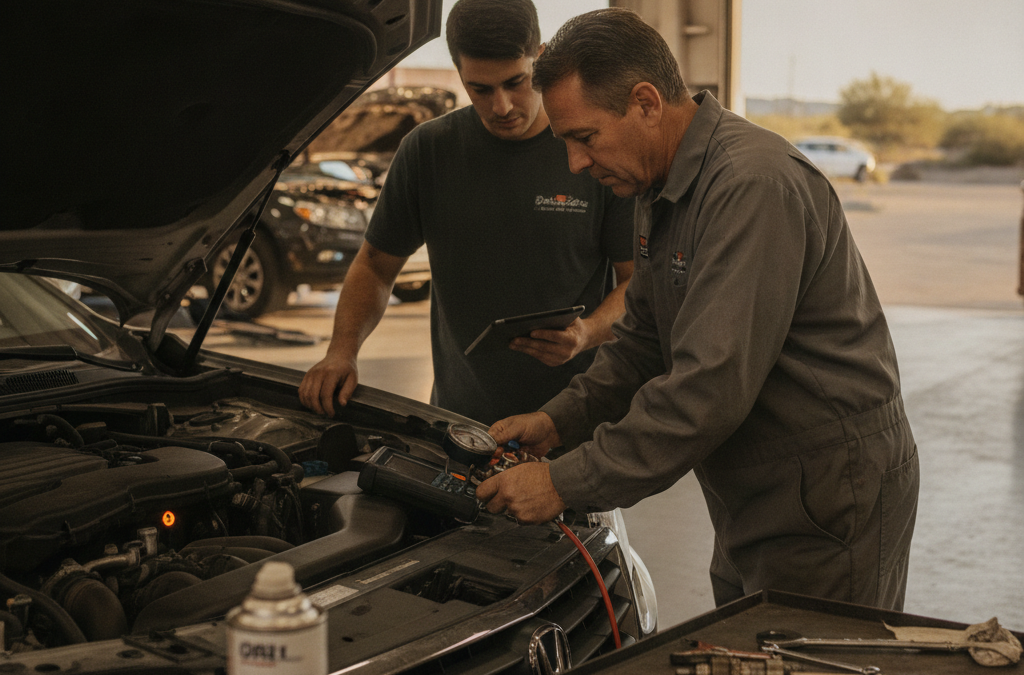
At All Valley Car Care in Surprise, we start with a proper diagnostic scan and visual inspection before recommending anything. We’re not going to push you toward a full replacement if cleaning is going to solve the problem — that’s not how we operate.
What a Real Fuel Injector Diagnosis Should Look Like
One thing worth knowing: the check engine light alone doesn’t tell your mechanic which injector is clogged or whether cleaning will fix it. A proper diagnosis involves pulling the trouble codes, looking at live fuel trim data, and sometimes doing a relative compression test or cylinder contribution test to identify which cylinder is underperforming.
If a shop quotes you injector replacement based purely on a check engine light scan and nothing else, ask more questions. A misfire code has a lot of possible causes — spark plugs, ignition coils, vacuum leaks, and yes, fuel injectors. Jumping straight to the most expensive fix without ruling out the others is a red flag.
Our ASE-certified technicians use computerized diagnostics to read the actual data before recommending a repair. You’ll get a written estimate and a plain-English explanation of what’s happening — no guesswork billed to your card.
Can You Use Fuel Injector Cleaner From the Auto Parts Store?
Bottle additives you pour into the gas tank — brands like Techron or Sea Foam — can help with mild deposit buildup and are worth using as a preventive measure. But if your injectors are already causing misfires or a rough idle, a bottle of additive is not going to cut it. It’s a bit like using a water softener tablet when you actually have a clogged pipe. Good for maintenance, not a substitute for repair.
If the symptoms are already noticeable, have it diagnosed. You’ll save money in the long run compared to running on partially clogged injectors and stressing the rest of the fuel system. See the full list of services we offer if you’re not sure what kind of inspection or maintenance applies to your situation.
Frequently Asked Questions
How long can I drive with clogged fuel injectors?
You can usually keep driving, but you shouldn’t ignore it long-term. Running on a bad fuel mixture stresses the catalytic converter, degrades fuel economy, and can eventually cause carbon buildup on valves and pistons that’s expensive to fix. A few weeks probably won’t hurt. A few months of ignoring it can compound the damage.
Does fuel injector cleaning actually work?
Yes — when the injector is partially clogged and otherwise functional, professional cleaning restores flow and spray pattern effectively. It’s not a magic fix for injectors that are leaking or mechanically failed, but for garden-variety carbon buildup, cleaning works well and is much cheaper than replacement.
Is this something a local shop in El Mirage or Peoria can handle, or do I need a dealership?
A good independent shop can absolutely handle fuel injector diagnosis, cleaning, and replacement. You don’t need a dealership — and in most cases, a local shop will charge significantly less for the same quality of work. All Valley Car Care serves drivers across the West Valley including El Mirage, Peoria, and Glendale.
How often should fuel injectors be cleaned as maintenance?
Most manufacturers don’t specify a hard interval, but many mechanics suggest a professional cleaning every 60,000 to 90,000 miles as a preventive measure — sooner if you use lower-quality fuel or if your car sits for long stretches. In Arizona’s heat, leaning toward the shorter end of that range makes sense.
What’s the difference between a clogged injector and a leaking injector?
A clogged injector delivers too little fuel. A leaking injector (one that drips when it should be closed) delivers too much. Both cause misfires and check engine codes, but they show up differently in the diagnostic data. That’s one reason a proper scan and inspection matters — the fix for each is different.
Get It Diagnosed by a Shop You Can Trust
If your car has been acting up — stumbling at idle, hesitating on the gas, or drinking fuel faster than usual — don’t let it sit. Fuel injector problems are almost always easier and cheaper to fix early than after they’ve been ignored for a season.
All Valley Car Care has been serving drivers in Surprise and across the Phoenix West Valley since 2010. We’ll tell you exactly what’s going on, give you a written estimate before we touch anything, and only recommend what your car actually needs. No upselling. No surprises on the bill.
Contact us or schedule your appointment online — and bring it in before a rough idle turns into a bigger problem.