
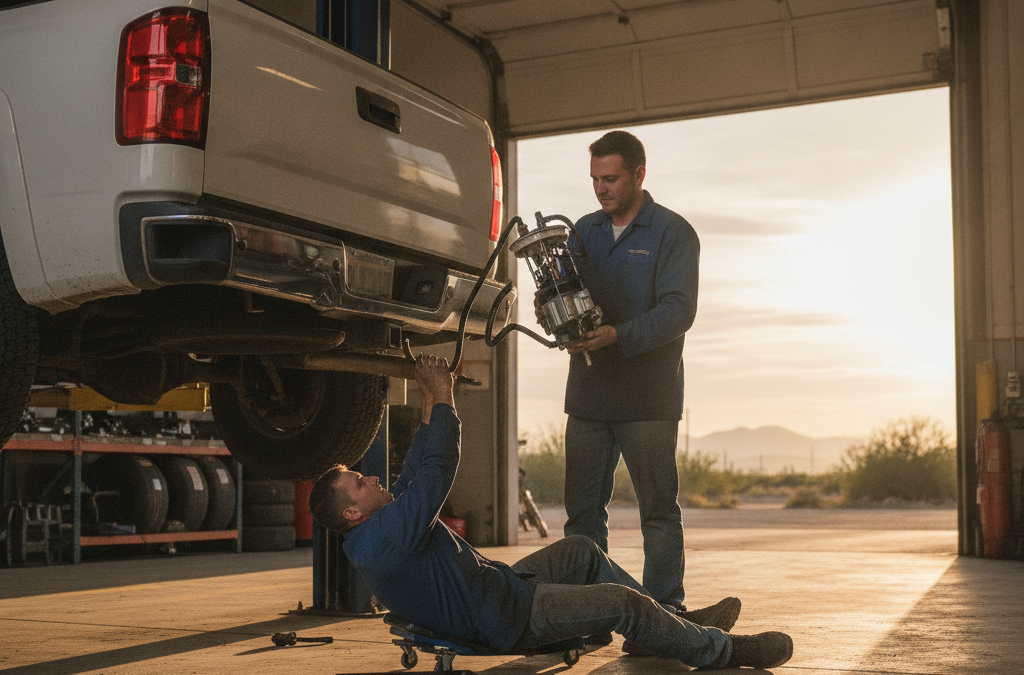
How Do You Know If Your Car’s Fuel Pump Is Failing — and What Does It Cost to Fix in Goodyear, AZ?
If your car has been sputtering on the freeway, struggling to start on a hot morning, or randomly dying at a red light, there’s a decent chance your fuel pump is sending you a warning. In Goodyear and across the Phoenix West Valley, that warning is easy to miss — right up until the moment your car won’t start at all. The good news is that fuel pump problems almost always give you some advance notice before they leave you stranded. The key is knowing what to look for and acting before it becomes an emergency.
What Does a Fuel Pump Actually Do?
Your fuel pump sits inside the gas tank and does exactly what the name says — it pumps fuel from the tank to the engine at the correct pressure. If the engine can’t get enough fuel, it can’t run properly. Most modern vehicles have an electric fuel pump, and while they’re built to last, they’re also under constant stress. In a place like Goodyear where summer temperatures regularly hit 115°F, that stress gets amplified. Heat shortens the life of just about every electrical and mechanical component in your vehicle, and fuel pumps are no exception.
The Warning Signs You Shouldn’t Ignore
Fuel pump failure rarely happens all at once. More often, it creeps up on you over days or weeks. Here are the most common signs that your pump is on its way out:
- Engine sputtering at highway speed. If your car runs fine around town but stumbles or surges when you’re on the I-10 or the Loop 303, that’s a classic fuel pump symptom. At higher speeds, the engine demands more fuel — and a weakening pump can’t keep up.
- Hard starts, especially when the engine is warm. If your car starts fine when it’s cold but takes a few extra cranks after it’s been running, the pump may be losing pressure when it gets hot.
- Loss of power under load. Accelerating uphill, passing someone on the highway, or towing a trailer — these all demand more fuel. A failing pump shows its weakness exactly when you need it most.
- Engine stalling and restarting. If your car randomly dies and then restarts after a minute or two, the pump may be overheating and cutting out briefly before recovering.
- Car won’t start at all. This is the end stage. When the pump finally quits, you’re not going anywhere without a tow.
- A whining noise from the fuel tank area. Fuel pumps make a faint hum under normal operation. A high-pitched whine or grinding sound coming from the rear of the vehicle — near the tank — often means the pump is struggling.
Here’s the thing: all of these symptoms also overlap with other problems. A bad fuel pressure regulator, a clogged fuel filter, or even a failing mass airflow sensor can produce the same results. That’s why a proper diagnostic is so important before anyone replaces anything. At All Valley Car Care, we scan for trouble codes and test fuel pressure directly — so we’re not guessing, and you’re not paying for parts you don’t need.
Why Arizona Heat Makes Fuel Pump Problems Worse
This is a piece that most online articles skip right past, but it matters a lot if you’re driving in Goodyear, Avondale, Litchfield Park, or anywhere else in the Valley of the Sun. Your fuel pump is submerged in gasoline, which actually acts as a coolant for the pump motor. That’s fine when your tank is reasonably full. But in extreme heat, people tend to run their tanks lower — gas expands when it’s hot, and some drivers get into the habit of waiting longer to fill up. When the fuel level drops too low, there’s less liquid surrounding the pump, it runs hotter, and it wears out faster.
In milder climates, a fuel pump might last 100,000 miles or more with no trouble. Here in the Phoenix metro, we see them fail well before that — especially on vehicles that spend a lot of time in stop-and-go traffic during summer or that regularly run low on fuel. If you’re commuting from Goodyear or Peoria every day in August, your fuel pump is working harder than it would almost anywhere else in the country.
What Does Fuel Pump Replacement Actually Cost?
This is the question everyone wants answered, and the honest answer is: it depends on your vehicle. Fuel pump replacement is a labor-intensive job because the pump sits inside the gas tank, which usually has to be dropped to access it. For most cars and trucks, you’re looking at a repair that ranges from a few hundred dollars on the lower end to over a thousand dollars for trucks, SUVs, or European vehicles where access is more involved.
What we can tell you is that at All Valley Car Care, you’ll get a written estimate before any work starts — no surprises when you come to pick up your vehicle. We carry a 3-year/36,000-mile warranty on repairs, extendable to 5 years/60,000 miles, and we use quality parts, not the cheapest thing available. Our ASE-certified technicians will tell you exactly what’s failing and why, and we won’t recommend a fuel pump replacement unless the diagnostic confirms that’s actually the problem.
What Competitors Aren’t Telling You: The Fuel Filter Connection
One thing that’s largely missing from most local auto repair websites in the West Valley — and we noticed it’s not covered well by several shops in the area — is the relationship between your fuel filter and your fuel pump. Many modern vehicles have the fuel filter built into the pump assembly itself, so they’re replaced together. But on older vehicles or certain makes, there’s a separate inline fuel filter that should be replaced on a regular maintenance schedule.
A clogged fuel filter forces the pump to work harder to push fuel through. Over time, that extra strain burns the pump out prematurely. If your vehicle has a serviceable external fuel filter and you’ve never had it replaced, that’s worth asking about — especially if you’ve been dealing with any of the symptoms above. It’s a much cheaper fix than a full pump replacement, and doing it proactively can extend the life of the pump significantly.
If you’re not sure whether your vehicle has a serviceable filter, our team at the Surprise location can check that during any diagnostic or maintenance visit.
Can You Drive on a Failing Fuel Pump?
Technically, maybe — for a little while. But it’s not a smart gamble. A pump that’s intermittently cutting out can strand you anywhere: on the I-10 near Avondale, in a parking lot in Litchfield Park, or in the middle of an intersection in Phoenix at rush hour. The longer you wait, the higher the risk of a complete failure at an inconvenient or unsafe moment. If you’re seeing consistent symptoms, get it looked at sooner rather than later.
Frequently Asked Questions About Fuel Pump Failure in the West Valley
How long does it take to replace a fuel pump?
Most fuel pump replacements take between two and four hours in the shop. It depends on the vehicle — some are more accessible than others. We’ll give you a time estimate when we diagnose the problem so you can plan accordingly.
Will a bad fuel pump always throw a check engine light?
Not always. A failing fuel pump may trigger a code related to fuel pressure or lean fuel mixture, but in many cases the light doesn’t come on until the problem is already advanced. Don’t wait for the check engine light to investigate symptoms like sputtering, stalling, or hard starts.
Is it worth replacing the fuel pump on a high-mileage vehicle?
It depends on the overall condition of the car. If the rest of the vehicle is solid, a pump replacement makes sense — it’s a lot cheaper than a car payment. We’ll give you an honest assessment of whether the repair is worth it based on what we find during the inspection.
Does running my tank low really hurt the fuel pump in Arizona?
Yes, and especially here. In the extreme heat of a Goodyear summer, keeping at least a quarter tank of gas in your vehicle at all times is genuinely good practice. The fuel keeps the pump cooler and helps it last longer.
Can I drive from Glendale or Peoria to your Surprise location with a possibly failing fuel pump?
If the car is starting and running, that short drive is usually manageable — but call us first at (623) 243-6206 so we can advise you based on what you’re experiencing. If the car is stalling frequently or won’t restart reliably, it’s safer to have it towed.
Let’s Get It Diagnosed Before It Gets Worse
If any of what you read above sounds familiar — the sputtering, the hard starts, the whine from the back of the car — don’t wait for a roadside breakdown to find out what’s going on. All Valley Car Care has been serving Goodyear, Surprise, Glendale, and the surrounding West Valley since 2010 with straightforward diagnostics, honest repair estimates, and no unnecessary work. We’ll tell you exactly what’s happening with your fuel system and what it’ll take to fix it.
Schedule your appointment online or give us a call at (623) 243-6206. We’ll get your car back to running right — without the runaround.