
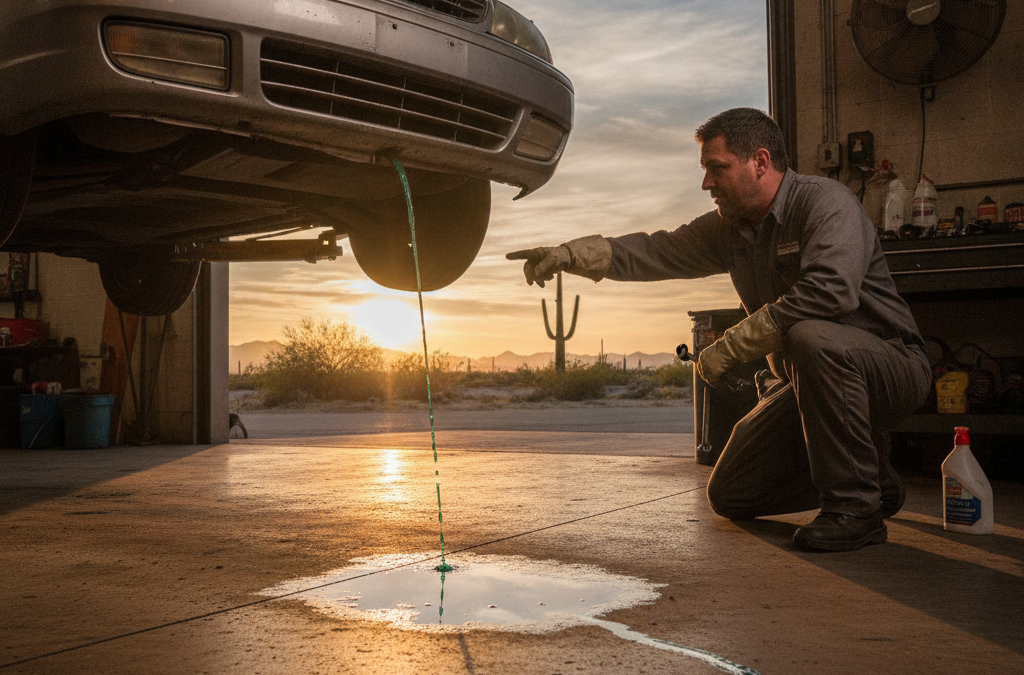
How Do You Know If Your Car’s Radiator Is Leaking — and What Does It Cost to Fix in Surprise, AZ?
If you’ve noticed a puddle of green, orange, or pink liquid under your car after it’s been sitting in your Surprise driveway, there’s a decent chance your radiator — or something connected to it — is leaking. In most parts of the country, a slow coolant leak gives you a little runway to get it checked out. In the Phoenix West Valley in the middle of summer, that runway is a lot shorter. When it’s 115°F outside and your cooling system isn’t doing its job, an engine can go from warm to destroyed in a very short amount of time.
The good news is that radiator leaks usually give you some warning before things go sideways. Here’s how to recognize what you’re dealing with, what it typically costs to fix, and why this is one repair you really don’t want to put off if you’re driving in the desert.
What Does a Leaking Radiator Actually Look Like?
Your radiator’s job is straightforward: circulate coolant through the engine to carry heat away, then push that hot coolant through the radiator core so the heat can escape before the fluid loops back through again. When the radiator develops a crack, a pinhole, or a failed connection — the coolant escapes instead of doing its job.
The most common warning signs of a radiator leak include:
- A puddle under your car — Coolant is usually bright green, orange, pink, or blue depending on the type. It smells faintly sweet and has a slippery feel. An oil leak will look darker and greasier. Water from your AC drain is clear and odorless.
- Your temperature gauge climbing higher than normal — This is your engine telling you it’s not being cooled properly. Don’t ignore it, and don’t keep driving if the needle is in the red.
- Low coolant warning light — If your reservoir keeps needing to be topped off every few weeks, coolant is going somewhere. It doesn’t just evaporate.
- Steam or a sweet smell coming from under the hood — Coolant hitting a hot engine surface burns off fast and smells distinctly different from oil smoke.
- Visible residue or staining around the radiator — White or rust-colored crusty deposits around hose connections or along the radiator tank are a sign of dried coolant from a slow leak.
Any one of these on its own deserves a look. More than one at the same time means get it in sooner rather than later.
Why Radiator Leaks Are a Bigger Deal in Arizona Than Almost Anywhere Else
Here in Surprise and across the greater Phoenix metro, your cooling system works harder than it does almost anywhere else in the United States. From May through September, ambient air temperatures regularly hit 110°F to 115°F. Your engine coolant is already working at its limits just keeping up with normal driving. When stop-and-go traffic on Grand Ave or the 303 cuts airflow through the radiator, the system has almost no margin for error.
A small leak that might only cause a slightly warm engine in Flagstaff can push an engine to overheating within minutes on a Phoenix-area freeway in July. And overheating isn’t just uncomfortable — it can warp cylinder heads, blow head gaskets, and in worst cases seize an engine completely. Those are repair bills that dwarf what a radiator replacement would have cost.
The desert heat also accelerates wear on the radiator itself. Plastic end tanks (used on most modern radiators) become brittle over time from constant heat cycling. Rubber hose connections harden and crack. And the coolant itself degrades faster in extreme heat, becoming acidic and actually corroding the radiator from the inside out — especially if flushes have been skipped.
What Causes a Radiator to Leak in the First Place?
Understanding the cause matters because it affects both the repair approach and the cost. The most common culprits we see at our Surprise location include:
- Cracked plastic end tanks — The sides of most modern radiators are plastic, and they crack from age, heat stress, or a small impact. Sometimes the seam where plastic meets aluminum core fails.
- Corroded or damaged core — The aluminum or brass fin-and-tube core can develop pinhole leaks from internal corrosion, especially if coolant hasn’t been flushed on schedule.
- Loose or cracked hose connections — Sometimes the radiator itself is fine, but a deteriorated upper or lower radiator hose or a failing hose clamp is the actual leak source.
- A blown radiator cap — A weak or failing cap can’t hold system pressure properly, which causes coolant to escape through the overflow and can make a healthy radiator look like it’s leaking.
- Internal contamination from a head gasket failure — If oil or combustion gases have been getting into your coolant, the brown, foamy residue in the reservoir is a sign of something more serious than just the radiator.
This is why a proper diagnosis matters before any parts get ordered. A good visual inspection and a pressure test will tell a technician whether you need a new radiator, a hose, a cap — or something more involved.
What Does Radiator Repair or Replacement Cost in the West Valley?
Costs vary by vehicle and what’s actually needed, but here’s a general picture of what Surprise and West Valley drivers can expect:
- Radiator cap replacement — Usually $15–$40 in parts. Labor is minimal if caught during an inspection.
- Radiator hose replacement — Typically $75–$200 depending on which hose and your vehicle’s make and model.
- Radiator replacement (parts + labor) — Most commonly $400–$900 for a standard passenger vehicle. Trucks, SUVs, and European imports can run higher. Diesel trucks tend to cost more due to larger, heavier-duty cores.
- Coolant flush (done at the same time) — Often recommended when replacing a radiator to ensure the new unit starts with clean fluid. Typically adds $80–$150.
At All Valley Car Care, you’ll get a written estimate before any work starts. No surprises, no pressure. If all you need is a hose and a cap, that’s all we’ll recommend. We’ve been doing business that way since 2010 and we’re not changing it now.
What the Competitor Shops Aren’t Telling You: The Internal Corrosion Problem
One thing that’s largely missing from how local shops talk about radiator repair is the internal corrosion issue — and it’s a big one for Arizona drivers. When coolant isn’t flushed on schedule (typically every 30,000–50,000 miles or every 2–5 years depending on the fluid type), it becomes acidic. That acidic coolant slowly eats away at the aluminum components inside the radiator and engine block from the inside.
What this means practically: a leak that looks like a simple external crack on an older, neglected cooling system may actually be a radiator that’s failing from the inside out. Patching it or doing a quick top-off won’t solve the underlying issue. A shop that doesn’t check and address the coolant condition when replacing a radiator is leaving you set up for another failure down the road.
When we replace a radiator, we check the condition of the old coolant and assess whether a full system flush is warranted. We’ll tell you what we find and let you decide — but at least you’ll have the full picture. See our full cooling system services for more on what a complete inspection covers.
Can You Drive with a Leaking Radiator?
Short answer: maybe a little, but not in Arizona in the summer. If the leak is very minor and your temperature gauge is staying in the normal range, you might be able to make it to a shop the same day without incident. But “topping off the coolant and hoping for the best” is a gamble that gets a lot riskier when daytime highs are above 110°F in Peoria, El Mirage, or Goodyear.
If your temperature gauge is climbing, pull over. Turn on the heat (it draws heat away from the engine) and find a safe place to stop. Don’t open the radiator cap when the engine is hot — pressurized coolant will burn you. Let it cool for at least 30–45 minutes first.
Then call us. We can often get you in the same day, especially at our Surprise location.
Frequently Asked Questions
How do I tell the difference between a radiator leak and an AC drain?
AC condensate is clear and odorless — it’s just water dripping from the drain under the passenger side of your car on humid days. Coolant has a distinct sweet smell, is colored (green, orange, pink, or blue), and feels slightly slippery. If you’re not sure, a quick look under the hood at the coolant reservoir will tell you if the level has dropped.
Is it worth fixing an older car’s radiator?
Usually yes, unless there are multiple other major problems at the same time. A new radiator on a well-maintained car with 150,000 miles is often a much smarter investment than a car payment. We’ll give you an honest read on whether the repair makes sense for your situation.
How long does a radiator replacement take?
For most vehicles, a straightforward radiator replacement takes 2–4 hours. Some trucks and SUVs with more complex front-end setups can take longer. We’ll give you a realistic time estimate when you drop the car off.
Do Sun City and Sun City West drivers have different cooling system concerns?
Older vehicles are more common in Sun City and Sun City West communities, which means radiators with more age-related wear. Seasonal drivers who leave cars sitting through the summer heat without regular maintenance checks can come back to coolant that’s degraded badly. If your car has been parked for months, a cooling system inspection before you drive it regularly again is a smart call.
Does All Valley Car Care work on trucks and SUVs with the same warranty?
Yes. We back our repairs with a 3-year/36,000-mile warranty — extendable to 5 years/60,000 miles — across cars, trucks, SUVs, and commercial vehicles regardless of make or model. That includes the radiator and all related cooling system components we install.
Don’t Wait Until Your Gauge Is in the Red
A leaking radiator caught early is a manageable repair. A leaking radiator ignored through a Phoenix West Valley summer is a potential engine replacement. The difference between those two outcomes is usually just getting it looked at when you first notice the signs.
At All Valley Car Care in Surprise, we’ve been helping families, commuters, and fleet operators across the West Valley keep their vehicles road-ready since 2010. No unnecessary repairs, no hidden charges — just an honest diagnosis and work you can count on. If you think your radiator might be leaking, or your temperature gauge is doing something it didn’t used to do, contact us today to schedule an inspection. We’ll tell you exactly what’s going on and what it will take to fix it.