
How Do You Know If Your Car’s Differential Is Failing — and What Does It Cost to Fix in Gilbert, AZ?
If your truck or SUV has started making a low whining noise from the back end, or you’re feeling a strange vibration when you go around a corner, there’s a decent chance your differential is trying to get your attention. Most drivers in Gilbert and across the East Valley have never given their differential a second thought — and that’s exactly why these repairs catch people off guard. The good news is that a differential problem caught early is usually a manageable fix. Ignored long enough, it can turn into one of the most expensive repairs on your vehicle.
Here’s what you need to know — in plain English.
What Does a Differential Actually Do?
Every vehicle has at least one differential, and most trucks and SUVs have two or three. It’s the mechanical assembly that lets your wheels spin at different speeds when you turn a corner — which is necessary because the outer wheel has to cover more ground than the inner one. Without it, your vehicle would hop and skip through every turn instead of rolling smoothly.
Rear-wheel-drive trucks and body-on-frame SUVs have a rear differential. Front-wheel-drive cars handle this function through a combined unit called a transaxle. All-wheel-drive and four-wheel-drive vehicles — which make up a huge portion of the trucks, Tahoes, Expeditions, and Jeeps you see driving around Gilbert, Chandler, and Mesa — have both a front and rear differential, plus a transfer case.
The differential contains gears, bearings, and a fluid bath that keeps everything lubricated. When that fluid breaks down or leaks out, or when bearings start to wear, the symptoms show up fast — and they get worse quickly in the kind of heat we see across the Phoenix metro every summer.
Warning Signs Your Differential May Be Failing
These are the signs most worth paying attention to:
- A whining or howling noise — especially at highway speeds or during acceleration. This usually points to worn ring and pinion gears inside the differential.
- Clunking when you shift into drive or reverse — a sign that internal components have excess play or wear.
- Vibration from the rear of the vehicle — particularly when you’re accelerating or cruising at a steady speed. Don’t confuse this with tire balance issues; a good shop can tell the difference.
- Tight or skipping sensation in turns — if your AWD or 4WD vehicle feels like it’s fighting itself through a parking lot turn, that’s a classic symptom of a differential or transfer case problem.
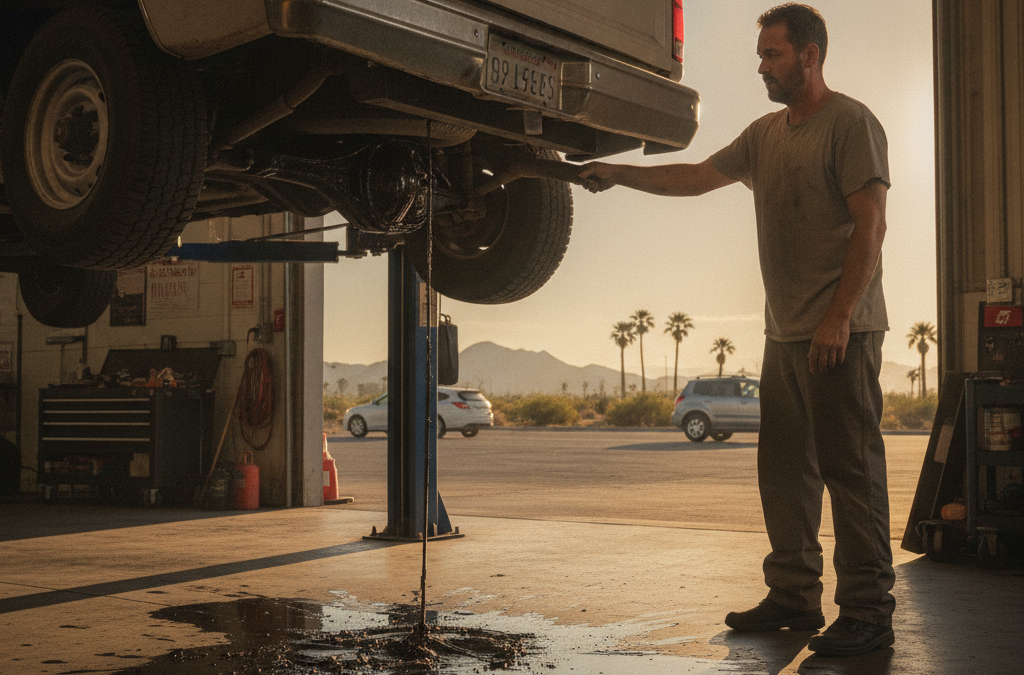
- Fluid puddles under the rear axle — differential fluid is usually a dark, thick oil with a distinct gear-oil smell. A leak means the fluid level is dropping, and low fluid is what causes expensive internal damage.
- Grinding noise, especially under load — if the whining has progressed to grinding, the bearings are likely already damaged and time is short.
None of these symptoms are things you want to put off, particularly if you’re doing regular highway driving between Gilbert and Phoenix, or hauling a trailer or camper on the weekends.
What Differential Repairs Actually Cost — and Why the Range Is Wide
This is where people get surprised, so it’s worth being upfront. Differential repair costs vary significantly based on what’s wrong, what vehicle you drive, and whether you need a repair or a full rebuild.
- Differential fluid service — This is the preventive maintenance step most people skip. Flushing and refilling differential fluid typically runs $80–$150 per differential, depending on your vehicle. It’s cheap insurance against everything below.
- Bearing replacement — Replacing worn pinion or carrier bearings runs $300–$700 in most cases, parts and labor included. Caught early, this is a straightforward repair.
- Ring and pinion gear replacement — When the gears themselves are worn or damaged, expect $500–$1,500 depending on the vehicle and whether a shop does the work in-house.
- Full differential rebuild or replacement — If you’ve let things go too long, a complete rebuild runs $1,000–$3,000+ for rear differentials on trucks and larger SUVs. A replacement with a remanufactured unit can sometimes be more cost-effective than a rebuild, depending on parts availability.
The honest answer is that a shop needs to inspect it before giving you an accurate number. Any shop that quotes you a firm price on a differential repair over the phone without looking at the vehicle first is either guessing or setting you up for a surprise.
See the full list of drivetrain and repair services at All Valley Car Care.
Why This Topic Gets Overlooked — and Why That’s a Problem
Here’s something worth pointing out: most local auto repair shops in the Phoenix area — and most of the auto repair content you’ll find online — covers differentials only in passing, if at all. It’s one of those topics that gets buried under oil change promotions and brake specials, even though differential failure is one of the more common reasons trucks and SUVs end up needing major drivetrain work after the 100,000-mile mark.
That’s especially relevant in a market like the East Valley and West Valley, where a huge share of drivers are in trucks and body-on-frame SUVs — vehicles that all rely on differentials as a core part of how they drive. If you’re in Peoria, Glendale, or Chandler and you’ve put 80,000–120,000 miles on your F-150 or 4Runner without anyone ever mentioning differential fluid service, you’re not alone. But you’re also overdue.
Arizona Heat Makes This Worse Than You Think
Differential fluid has a job to do in any climate, but in the Phoenix metro, that job gets harder. When ambient temperatures are running 110°F+ and you’re sitting in stop-and-go traffic on the 202 or doing a freeway pull in Gilbert, the fluid inside your differential is working at extreme temperatures. Heat breaks down gear oil faster, reducing its ability to protect bearings and gears. Add in the fact that many drivers tow trailers, boats, or fifth wheels on Arizona roads — especially during the cooler months when the snowbirds arrive and construction season kicks back up — and the stress on your differential compounds quickly.
The manufacturer’s service intervals for differential fluid are set for average conditions. Arizona is not average conditions. If you’re towing regularly or have a higher-mileage truck, checking your differential fluid every 30,000–40,000 miles (rather than waiting for the typical 60,000–80,000-mile interval) is a reasonable adjustment.
Fleet and Commercial Vehicles: This Matters Even More
If you run a fleet of work trucks in the greater Phoenix area, differential maintenance is something you can’t afford to skip. A rear differential failure in a loaded work truck doesn’t just mean a repair bill — it means lost work time and a tow from wherever the vehicle decides to stop cooperating. Most fleet operators are good about oil changes and tires but overlook drivetrain fluid services entirely. That’s a gap worth closing before it costs you a vehicle for a week.
Learn more about All Valley Car Care’s Surprise location and fleet service capabilities.
Frequently Asked Questions About Differential Repairs in the Phoenix Area
How often should I change my differential fluid?
For most trucks and SUVs under normal driving conditions, every 60,000–80,000 miles is the standard recommendation. If you tow, haul heavy loads, or do a lot of off-road driving, every 30,000–40,000 miles is smarter. Arizona heat and high-load driving both push you toward the shorter interval.
Can I drive with a bad differential?
Technically yes — for a short time and short distances. But the damage accumulates fast. What starts as a bearing noise can progress to complete gear failure, and a seized differential can lock up a drive axle unexpectedly. It’s not worth it. If you’re hearing symptoms, get it looked at.
Is a differential rebuild better than a replacement?
It depends on the vehicle and the extent of the damage. For common trucks and SUVs, remanufactured differential assemblies are widely available and can be a cost-effective alternative to a full rebuild. A reputable shop will walk you through both options and the cost difference before any work begins.
Does a front-wheel-drive car have a differential?
Yes — it’s integrated into the transaxle alongside the transmission. The symptoms of a failing transaxle differential are similar: noise during turns, vibration, and sometimes a clunking when you accelerate from a stop. It’s less common as a standalone repair discussion, but the fluid service applies equally.
Will a differential problem trigger my check engine light?
Not usually, at least not early on. The check engine light is tied to the emissions and engine management system — differential issues are mechanical rather than sensor-driven. Some AWD systems do have warning lights or codes related to drivetrain sensors, but most differential wear shows up as noise and feel before any warning light comes on. That’s why knowing the physical symptoms matters.
Get Your Differential Inspected Before It Becomes a Bigger Problem
At All Valley Car Care, we’ve been diagnosing and repairing drivetrain problems for drivers across the Phoenix area since 2010 — including trucks, SUVs, and commercial vehicles with rear differentials, front differentials, and transfer cases. We won’t recommend repairs you don’t need, and we’ll give you a clear written estimate before any work begins. Our technicians are ASE-certified and our repairs are backed by a 3-year/36,000-mile warranty, extendable to 5 years/60,000 miles.
If your truck or SUV has started making a noise you can’t explain, or if it’s been more than 60,000 miles since anyone looked at your differential fluid, it’s worth a quick inspection. We serve drivers throughout Gilbert, Surprise, Chandler, Mesa, Peoria, Glendale, and the broader Phoenix metro.
Contact All Valley Car Care today to schedule a drivetrain inspection or ask us what’s making that noise. We’ll give you a straight answer.