
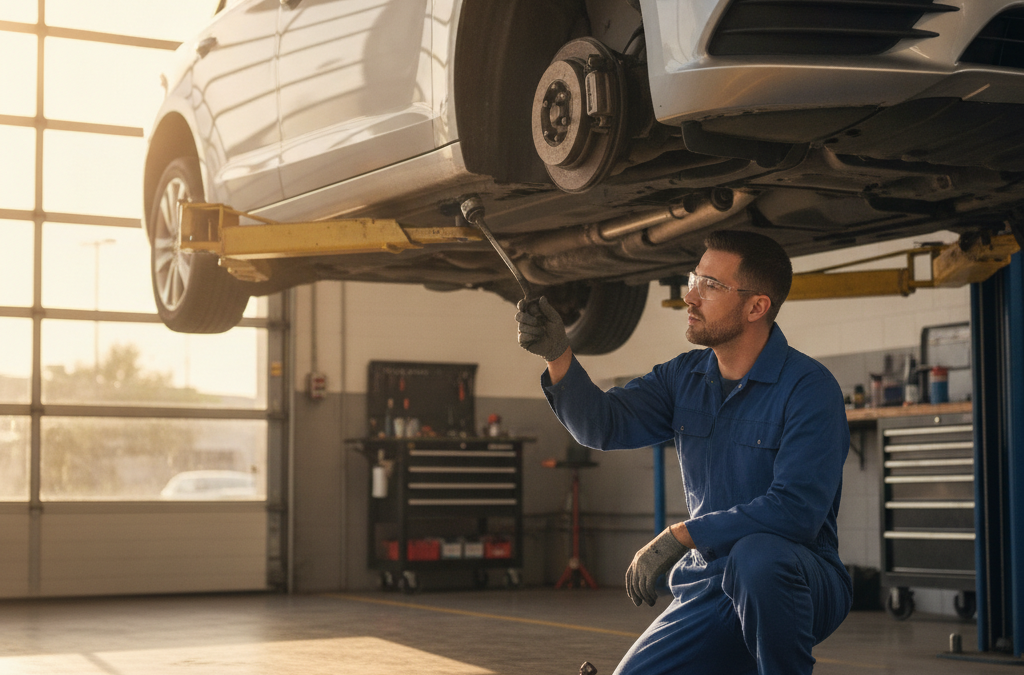
How Do You Know If Your Car’s Tie Rods Are Failing — and What Does It Cost to Fix in Glendale, AZ?
If your steering has started feeling vague or loose — like the car takes a half-second to respond when you turn the wheel — there’s a good chance your tie rods are starting to wear out. It’s one of the more common steering problems we see at All Valley Car Care, especially on vehicles that have been racking up miles on Glendale’s surface streets and the rougher stretches of the West Valley’s constantly-under-construction roadways. The good news is that tie rod problems give you plenty of warning signs before they become dangerous. The bad news is that most drivers don’t know what those signs sound or feel like — and most competitor shop websites we’ve seen don’t go much beyond “get your car inspected.” So let’s actually walk through it.
What Do Tie Rods Do, Exactly?
Tie rods are part of your car’s steering linkage. When you turn the steering wheel, the tie rods are what physically push or pull your front wheels to point in the right direction. Each front wheel has an inner and outer tie rod end connected to it. They’re built to last, but they’re also constantly moving, absorbing small shocks, and dealing with every pothole and dip in the road — which in the Phoenix metro area means they work hard.
When a tie rod end wears out, the joint gets loose. That slop in the joint translates directly into how your car steers. And once a tie rod fails completely, you lose the ability to steer that wheel. That’s not a minor inconvenience — it’s a loss of vehicle control.
Warning Signs That Your Tie Rods May Be Failing
None of these symptoms should be ignored, but you don’t need to panic either. Worn tie rods usually give you time to get to a shop — you just need to recognize what you’re feeling.
- Loose or vague steering: The wheel feels like it has too much play in it, or the car doesn’t respond immediately when you steer. This is the most common complaint.
- The car wanders or drifts on the highway: You find yourself making constant small corrections to keep the car going straight. This can also be an alignment issue, but worn tie rods are often the root cause.
- Clunking or knocking when turning: You hear or feel a thud or knock when you make low-speed turns, like pulling into a parking lot. That’s the worn joint moving when it shouldn’t.
- Uneven tire wear on the inside or outside edge: Bad tie rods throw your alignment off, which causes one edge of the tire to wear significantly faster than the rest of the tread. If you notice this, don’t just buy new tires — find out why they wore that way first.
- Vibration in the steering wheel: Especially at highway speeds. This one can have several causes, but a loose tie rod end is one of them.
If you’re experiencing more than one of these at once, there’s a strong chance something in your steering or suspension needs attention. A proper inspection will tell you exactly what’s going on — and what doesn’t need to be touched.
Why West Valley Roads Are Hard on Tie Rods
Drivers in Glendale, Peoria, and Avondale deal with a particular combination of factors that accelerates wear on steering components. Road construction is practically a year-round fixture across the West Valley — new subdivisions, highway widening, utility work — and the resulting uneven pavement, sudden dips, and poorly-patched potholes put stress on tie rod joints every single time you drive over them.
Add in the extreme heat. Arizona’s summer sun bakes the rubber boots that protect tie rod joints from dirt and grit. When those boots crack and tear — which they do faster here than in milder climates — the joint is exposed to road debris. Once contamination gets in, the wear accelerates quickly. We see this regularly on vehicles that haven’t had a steering and suspension inspection in a few years, particularly on older trucks and SUVs.
If you’ve been driving the same vehicle for three or four years in the Phoenix area without anyone looking at your steering linkage, it’s worth having it checked.
What It Costs to Replace Tie Rods in the Phoenix West Valley
Tie rod replacement is a mid-range repair — not cheap, but not a budget-buster either. For most cars and light trucks, you’re typically looking at $150 to $400 per tie rod end for parts and labor, depending on the vehicle and whether you’re replacing an inner or outer end. Outers are more accessible and usually cost less. Inners involve more disassembly.
One important thing to understand: any time tie rods are replaced, a wheel alignment is required afterward. The tie rods directly control wheel angle, so once they’re changed, the alignment is out. Some shops quote the tie rod job and then surprise you with the alignment cost at the end. We write everything out upfront — parts, labor, and alignment — so you know what the total looks like before we start.
At our Glendale location, we handle tie rod inspections and replacements on domestic vehicles, imports, trucks, and SUVs. If we find the tie rods are still within spec during an inspection, we’ll tell you that too — no unnecessary work, ever.
What Competitors Often Miss: The Inner Tie Rod Conversation
Most shop websites — including several we’ve looked at in the area — mention tie rods only in passing, usually buried in a general “steering and suspension” page. Almost none of them explain the difference between inner and outer tie rod ends, or when you might need one versus both replaced.
Here’s what’s worth knowing: outer tie rod ends fail more often because they’re more exposed, but inner tie rod ends can be sneakier. Inner ends are located behind the steering rack boot, so there’s often no visible sign of a problem until you’re under the car with the wheel off. Symptoms like a subtle shimmy in the steering wheel at highway speed, or a loose feeling that doesn’t go away even after the outer ends are replaced, can point to the inners.
When we inspect your steering, we look at both. If only one end needs replacement, we’re not going to recommend replacing all four to run up a bill. But we’ll be honest with you if the others are close — because finding out your inner tie rod failed on the I-10 through Phoenix is not a situation anyone wants to be in.
You can review our full steering and suspension services as part of everything we offer at All Valley Car Care.
How Long Does the Repair Take?
For most vehicles, replacing a single outer tie rod end and doing an alignment takes about two to three hours. Inner tie rod replacements take a bit longer — typically three to four hours — because accessing them requires removing the steering rack boot and sometimes additional components. If we’re doing both sides or combining the job with other suspension work you’ve been putting off, we’ll give you an honest time estimate before you drop off the keys.
All tie rod work at All Valley Car Care is backed by our 3-year/36,000-mile warranty, extendable to 5 years and 60,000 miles — which is significantly longer coverage than you’ll get from most national chains in the area.
Frequently Asked Questions About Tie Rod Repair in the West Valley
Can I drive with a bad tie rod?
For a short time, possibly — but it depends on how far gone it is. A tie rod that’s just starting to show slop gives you warning time. A tie rod that’s nearly seized or the boot has completely failed can let go without much additional notice. If your steering feels noticeably loose or you’re hearing clunking, get it looked at within a few days, not a few weeks.
Will a bad tie rod fail my Arizona vehicle inspection?
Arizona doesn’t have a mandatory annual safety inspection the way some states do, but if you’re buying or selling a vehicle, a pre-purchase inspection will flag bad tie rods immediately. It’s one of the first things a good inspector checks.
Do I need an alignment every time a tie rod is replaced?
Yes, every time. This is not optional or a recommendation — it’s a mechanical necessity. The tie rod adjustment directly sets your toe angle. If that’s changed, the alignment must be reset. Any shop that replaces your tie rod without doing an alignment afterward is leaving the job incomplete.
How long should tie rods last?
In milder climates, tie rod ends often last 70,000 to 100,000 miles or more. In the Phoenix area, the combination of heat degrading the protective boots and rough road surfaces can shorten that significantly — especially on trucks and SUVs that do a lot of stop-and-go driving in Glendale or on the surface streets through Avondale and Peoria.
What’s the difference between a tie rod and a ball joint?
Both are suspension joints, but they do different things. Tie rods control steering direction — left and right. Ball joints connect the control arm to the steering knuckle and handle the up-and-down motion of the wheel. They can produce similar symptoms when worn, which is why a proper inspection matters. We won’t guess — we’ll put it on the lift and show you what’s actually moving.
Get Your Steering Checked at All Valley Car Care
If anything in this article sounds familiar — the loose steering, the wandering, the edge wear on your tires — don’t put it off. Steering problems don’t fix themselves, and in the West Valley’s driving conditions, they tend to get worse faster than you’d expect.
All Valley Car Care has been serving drivers across the greater Phoenix area since 2010. Our ASE-certified technicians will inspect your tie rods and full steering linkage, explain exactly what they find in plain English, and give you a written estimate before anything is touched. No pressure, no surprise charges, no repairs you didn’t ask for.
Contact us online to schedule an inspection at our Glendale or Surprise location, or give us a call at (623) 243-6206. We’ll get you looked at and back on the road safely.