
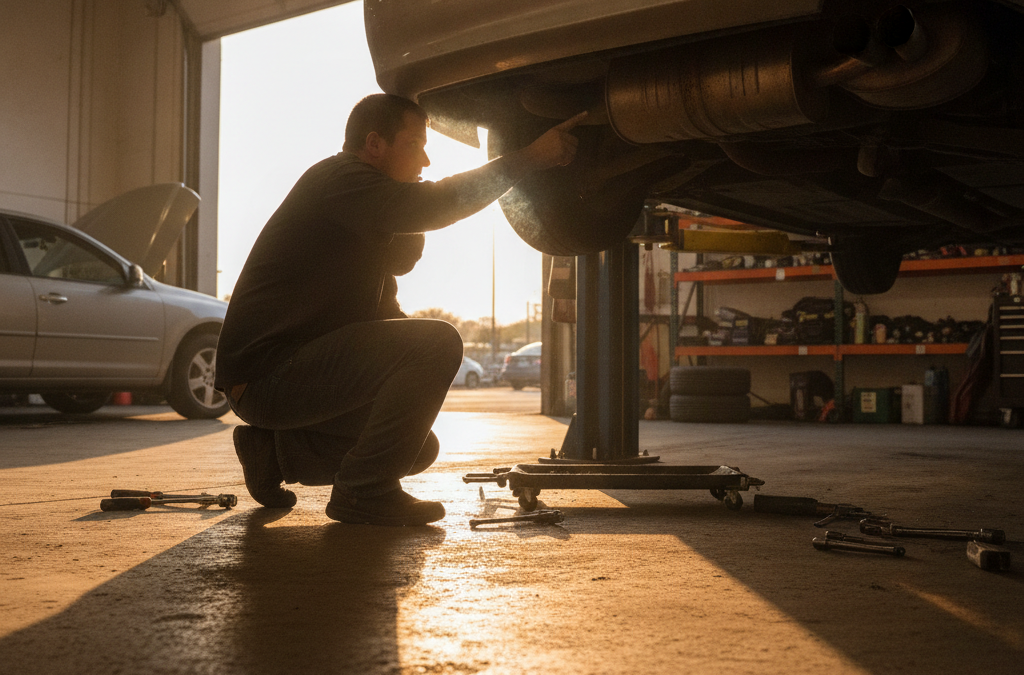
How Do You Know If Your Car’s Exhaust System Is Failing — and What Does It Cost to Fix in Mesa, AZ?
If your car has suddenly gotten a lot louder, or you’re catching a faint whiff of something odd with the windows down on the drive to Mesa or back across the Valley, your exhaust system may be trying to tell you something. Most drivers figure it’s just a nuisance — a noisy muffler, nothing urgent. But exhaust problems can quietly chip away at your fuel economy, trigger a check engine light, reduce engine power, and in serious cases allow harmful gases to seep into the cabin. It’s worth knowing what the warning signs actually look like and what it costs to fix them before things get worse.
What Does the Exhaust System Actually Do?
Your exhaust system does a lot more than muffle engine noise. It routes burned combustion gases safely away from the engine and cabin, reduces harmful emissions through the catalytic converter, and helps the engine breathe efficiently. When any part of that system develops a crack, hole, or failed connection, the whole chain is compromised.
The major components are the exhaust manifold (bolted directly to the engine), the oxygen sensors, the catalytic converter, the resonator, the muffler, and the pipes connecting everything. Any one of these can fail on its own — and in Arizona’s climate, they tend to fail in predictable ways.
Warning Signs Your Exhaust System Is Having Problems
Louder Than Usual Engine Noise
This is usually the first thing drivers notice. If your car sounds deeper, raspier, or just louder than it used to — especially when accelerating — there’s a good chance you have a hole or crack somewhere in the exhaust. It could be a rusted-through muffler, a cracked exhaust manifold, or a broken flange connection between pipes. The noise often gets worse when the engine is cold and then quiets down slightly once things heat up.
A Smell of Exhaust Inside the Cabin
This one matters more than the noise. If you’re smelling exhaust fumes with the windows up — especially sitting in traffic or idling — that’s a sign that gases are leaking somewhere upstream and finding their way in. Carbon monoxide is odorless, so if you’re smelling exhaust at all, it means other combustion byproducts are present too. Don’t ignore this one. Roll the windows down and get it looked at promptly.
Decreased Fuel Economy
An exhaust leak, especially near the oxygen sensors or manifold, can throw off the readings your engine relies on to calculate the right air-fuel mixture. When those readings are off, your engine burns more fuel than it needs to. If you’ve noticed your gas budget creeping up without a clear reason, the exhaust system is worth checking — especially alongside a diagnostic scan.
A Check Engine Light
Oxygen sensor codes are among the most common check engine light triggers in the Phoenix metro area. If a sensor is reading faulty data because of an exhaust leak nearby, or the sensor itself has failed, your car’s computer will flag it. A proper computerized diagnostic scan can identify whether the code points to the sensor itself, an upstream exhaust leak, or a catalytic converter that’s no longer functioning efficiently.
Rattling or Vibration Under the Car
Exhaust systems are suspended under the vehicle by rubber hangers and brackets. When those hangers crack or the pipes shift position — which happens frequently after pothole hits on the road construction zones common throughout the Phoenix East Valley and beyond — you’ll hear a rattle or feel a vibration through the floor or gas pedal. Left alone, a dragging or shifting exhaust pipe can cause additional damage to surrounding components.
Why Arizona’s Climate Is Hard on Exhaust Systems
You might think exhaust rust is a northern-states problem — cars exposed to road salt and winter moisture. And it’s true that Arizona vehicles don’t rust out as quickly as vehicles in wetter climates. But the Phoenix heat creates its own stress. Exhaust components go through intense heating and cooling cycles every single day, and the extreme temperatures — 115°F ambient air plus the heat the exhaust system generates internally — accelerate cracking in the manifold, gaskets, and welds. Exhaust manifold gaskets in particular tend to fail earlier in the desert than you’d expect. That failure often shows up as a ticking or hissing noise from the engine bay that disappears once the engine fully warms up.
Road construction is the other factor. If you’re driving through Peoria, Chandler, or anywhere along the Grand Ave corridor regularly, you know the potholes and rough patches are constant. Those hits stress the exhaust hangers and pipe connections more than most people realize. Our Surprise location sees this regularly from drivers commuting across the West Valley on roads that seem like they’re always under construction.
What Does Exhaust Repair Actually Cost?
Exhaust repair is one of those services where the range is genuinely wide depending on what’s actually wrong. Here’s a realistic breakdown to set your expectations:
- Exhaust hanger or bracket replacement: Usually minor — parts are inexpensive and labor is quick. Often under $100.
- Muffler replacement: Typically $150–$400 depending on the vehicle and whether an aftermarket or OEM unit is used.
- Exhaust pipe section repair or replacement: Varies by location and length, but generally $100–$350.
- Exhaust manifold gasket replacement: More involved because of access to the engine. Plan for $200–$600 depending on the vehicle.
- Exhaust manifold replacement: If the manifold itself is cracked, costs range from $300–$900+ depending on the vehicle.
- Oxygen sensor replacement: Usually $150–$300 per sensor, parts and labor included.
These are real-world ranges — not worst-case or best-case numbers. At All Valley Car Care, you’ll always get a written estimate before any work begins. No surprises, no pressure.
What Local Competitors Often Miss on This Topic
Most local shop websites that mention exhaust at all treat it as a footnote — a single bullet point buried in a services list. What they don’t explain is how exhaust problems connect to other issues: the check engine light that won’t go away, the fuel economy drop you can’t explain, or the cabin smell that’s easy to rationalize away. Exhaust diagnosis requires more than a visual inspection under the car. It requires a computerized diagnostic scan, a thorough inspection of the manifold and gaskets, and an experienced technician who knows what an exhaust leak sounds like versus what a valve train noise sounds like — because they can be easy to confuse.
That’s the kind of full-picture diagnosis we do at All Valley Car Care, whether you’re coming in from Mesa, Gilbert, Glendale, or making the drive from across the Valley. You can see everything we handle at our full services page.
Can You Drive with an Exhaust Problem?
It depends on where the leak is. A small hole in the muffler at the rear of the vehicle is unlikely to cause immediate harm, though it’ll get worse over time and may eventually fail an emissions inspection. A leak in the front of the system — near the manifold or upstream of the catalytic converter — is more urgent because fumes can enter the cabin more easily. If you’re smelling exhaust inside the car, that’s a same-day situation. Don’t wait it out.
Frequently Asked Questions
How long does an exhaust repair take?
Most exhaust repairs — muffler replacement, pipe repair, hanger replacement — take one to two hours. Exhaust manifold work can take longer depending on the vehicle, sometimes three to four hours. We’ll give you an honest time estimate when you bring it in.
Will an exhaust leak cause my car to fail Arizona emissions testing?
Possibly. If the leak is affecting how your catalytic converter or oxygen sensors function, your emissions readings will be off. A check engine light on its own will also cause an automatic failure. Getting the exhaust issue fixed before your emissions test makes the whole process easier.
Is it safe to drive with a cracked exhaust manifold?
Not ideal. A cracked manifold can be a fire hazard if the escaping hot gases contact wiring or plastic components nearby. It also puts stress on other engine parts. It’s worth fixing sooner rather than later.
My car is loud but only when it’s cold. Is that an exhaust problem?
It could be. Exhaust manifold gaskets often leak when the metal is cold and contracted, then seal up temporarily as everything expands with heat. If the noise disappears after a few minutes of driving, that’s a classic pattern worth having checked.
Do I need to go to a dealership for exhaust work?
No. Exhaust work is not dealer-exclusive. An independent shop with ASE-certified technicians can handle it correctly and usually at a lower cost. All Valley Car Care covers domestic vehicles, European imports, and a wide range of makes and models.
Get Your Exhaust System Checked at All Valley Car Care
If your car is louder than it used to be, your check engine light is on, or you’re catching any kind of exhaust smell in the cabin, don’t put it off. These problems don’t fix themselves, and they tend to get more expensive the longer they sit. Our ASE-certified technicians will diagnose exactly what’s going on, explain it to you in plain English, and give you a written estimate with no pressure to approve anything you don’t understand or don’t need.
We’ve been serving drivers across the Phoenix West Valley and East Valley since 2010 — with locations in Surprise, Gilbert, and Glendale — and every repair comes backed by our 3-year/36,000-mile warranty, extendable to 5 years and 60,000 miles. Contact us today to schedule a diagnostic appointment or ask any questions. We’re happy to help.