
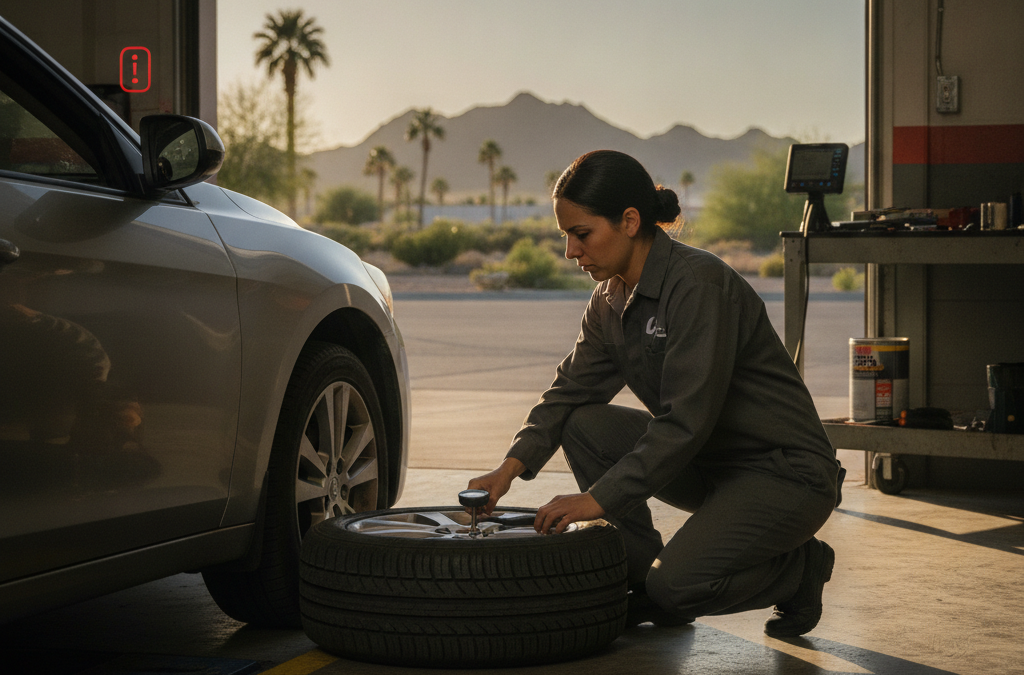
How Do You Know If Your Car’s TPMS Light Is Telling You Something Serious — and What Should You Do About It in Peoria, AZ?
That little horseshoe-shaped light with an exclamation point just lit up on your dashboard — and you’re not sure whether to pull over immediately or just add a little air and move on. If you’re driving around Peoria, Surprise, or anywhere else in the Phoenix West Valley, the answer depends on a few things. Your TPMS (Tire Pressure Monitoring System) light can mean anything from a slow leak to a failing sensor to a tire that’s dangerously underinflated in triple-digit heat. Here’s how to tell what’s actually going on — and when you need to get it looked at before it becomes a much bigger problem.
What Your TPMS Light Is Actually Trying to Tell You
Your car’s TPMS is a federally mandated system that’s been required on all new vehicles sold in the U.S. since 2008. Each wheel has a small sensor mounted inside that monitors tire pressure in real time. When one or more tires drops about 25% below the manufacturer’s recommended pressure, the light comes on.
That sounds simple enough — but there are actually three different things that warning light might mean:
- Low tire pressure: One or more tires is genuinely underinflated. This can happen from a slow leak, a nail or screw in the tread, or just normal air loss over time.
- Temperature-related pressure drop: Tire pressure fluctuates with temperature. For every 10°F drop in ambient temperature, tires lose about 1 PSI. This is more common in cooler months — though in the Valley of the Sun, this effect can still catch drivers off guard on winter mornings.
- A faulty or dead TPMS sensor: The sensors themselves run on small batteries that typically last 5–10 years. When the battery dies, the sensor can no longer report accurate data, and your light will come on — even if your tires are perfectly fine. Some vehicles display a flashing TPMS light to indicate a sensor malfunction rather than a pressure problem.
The important thing to understand: your TPMS light is not a diagnosis. It’s a prompt to go check. Never assume it’s just the sensor and ignore it without physically verifying your tire pressure first.
Why This Matters More in the Phoenix Heat Than Almost Anywhere Else
Here in the greater Phoenix metro, tires take a beating that drivers in most other parts of the country never deal with. Pavement temperatures in Peoria, El Mirage, and Surprise regularly hit 150°F or higher during summer months. That extreme surface heat accelerates rubber degradation, increases the risk of tread separation, and means that an underinflated tire generates significantly more internal heat — which is exactly how blowouts happen.
An underinflated tire flexes more with every rotation. That flexing generates heat. Add desert summer pavement to the equation, and what might be a nuisance in a milder climate becomes a genuine safety risk here. If your TPMS light comes on in July on the way to work in Glendale or Sun City, don’t wait until your lunch break. Check the tires before you get back on the road.
The other Arizona-specific wrinkle: construction debris. The Phoenix West Valley is growing fast — new subdivisions, road widening projects, Grand Ave corridor work — and that means screws, nails, and metal fragments on roads that weren’t there last week. A slow leak from road debris is one of the most common reasons TPMS lights come on around here.
What to Do When Your TPMS Light Comes On
Don’t panic — but don’t ignore it either. Here’s a sensible sequence:
- Step 1: Check all four tires visually. Look for anything obviously flat or bulging. If a tire looks significantly lower than the others, don’t drive on it.
- Step 2: Use a tire pressure gauge. Most gas stations and auto parts stores have air stations with gauges. Check each tire against the pressure listed on the sticker inside your driver’s door jamb — not the number molded into the tire sidewall (that’s the max, not the target).
- Step 3: Add air if needed. If a tire is low, inflate it to spec and see if the light goes off. Many vehicles reset the TPMS automatically after driving a few miles. Others require you to hold a reset button.
- Step 4: If the light stays on, or comes back quickly, get it inspected. A slow leak, a nail in the tread, or a failing sensor all need a professional look. Driving repeatedly on a tire that keeps losing pressure will damage the tire and potentially the wheel.
TPMS Sensor Replacement: What Competitors Often Don’t Tell You
This is an area where a lot of shops in the Phoenix area — and most of the information you’ll find online — leave drivers in the dark. When a TPMS sensor fails, it’s not just a matter of swapping in a new one. The replacement sensor has to be programmed to communicate with your vehicle’s specific system. Not every shop has the right equipment to do that correctly for every make and model.
There’s also the question of when sensors should be replaced. If you’re buying new tires and your sensors are already 7–8 years old, it’s worth replacing the sensors at the same time — because the labor overlap saves you money. Doing it separately later means paying for the work twice. A shop that’s looking out for you will mention this. One that’s just trying to move cars through the bay won’t.
At All Valley Car Care, TPMS service includes checking sensor condition, programming new sensors when needed, and making sure the system is communicating correctly before the car leaves the shop. No unnecessary upsells — just what the system actually needs.
What Does TPMS Service Cost in the Peoria Area?
The cost depends on what’s actually wrong:
- Patching a nail or screw in the tread: Usually modest — often under $30–$40 at a reputable shop. If the damage is in the sidewall, the tire will need to be replaced rather than patched.
- TPMS sensor replacement: Individual sensors typically run $50–$100 per sensor for parts, plus programming time. If you’re replacing all four, some shops offer a discount on the set. Expect the full job to run $150–$400 depending on the vehicle and how many sensors need replacing.
- TPMS system reset or relearn: If your sensors are fine but the system lost its calibration (this can happen after a tire rotation or new tire installation), the fix is usually just a relearn procedure — often quick and inexpensive.
What you want to avoid is paying for sensor replacements you don’t need, or skipping them when you do. Get a straight answer from the shop before authorizing any work.
Frequently Asked Questions About TPMS in the Phoenix Area
Can I drive with the TPMS light on?
It depends. If you’ve verified all four tires are properly inflated and the light is on due to a sensor issue, you can drive carefully — but get it diagnosed soon. If you don’t know why the light is on, check the tires first. Never assume it’s a false alarm without verifying pressure.
Why did my TPMS light come on overnight without any obvious leak?
Temperature drops overnight can cause tire pressure to dip enough to trigger the sensor, especially in winter months. Add air to spec and see if the light resets. If it keeps coming back, you likely have a slow leak worth having checked.
Do TPMS sensors need to be replaced when I get new tires?
Not necessarily — but the sensor valve stems and seals should be inspected. If your sensors are more than 6–7 years old, it’s smart to replace them while the tires are already off the wheels. It saves labor costs down the road.
Will a quick-lube shop handle TPMS sensor programming correctly?
Some can, many can’t. TPMS programming requires specific scan tools matched to your vehicle’s system. National quick-lube chains often skip this step or lack the equipment for less common makes and models. If you drive a European import, a diesel truck, or an older vehicle, a full-service shop is a safer bet.
Can I reset the TPMS light myself?
Sometimes yes. Many vehicles have a TPMS reset button, and after inflating tires to the correct pressure, driving for a few miles at highway speed will reset the system automatically. Check your owner’s manual for your vehicle’s specific procedure. If the light comes back on, that’s your cue to get a professional diagnosis.
Get Your TPMS Sorted Out Before It Becomes a Bigger Problem
A TPMS warning light is one of those things that’s easy to put off — especially when you’re busy and the tires look fine from the outside. But in the Phoenix West Valley heat, with hot pavement, construction debris, and summer temperatures that stress tires harder than almost anywhere in the country, it’s worth taking seriously.
The team at All Valley Car Care in Surprise can diagnose your TPMS system, check for leaks, replace and program sensors, and give you a straight answer about what actually needs attention — without pushing repairs you don’t need. We’ve been serving families and drivers across Peoria, Goodyear, Glendale, and the surrounding West Valley since 2010, and we back our work with a 3-year/36,000-mile warranty.
Don’t let a small warning light turn into a roadside blowout. Contact us online or give us a call to schedule a tire inspection — we’ll tell you exactly what’s going on and what it’ll take to fix it.