
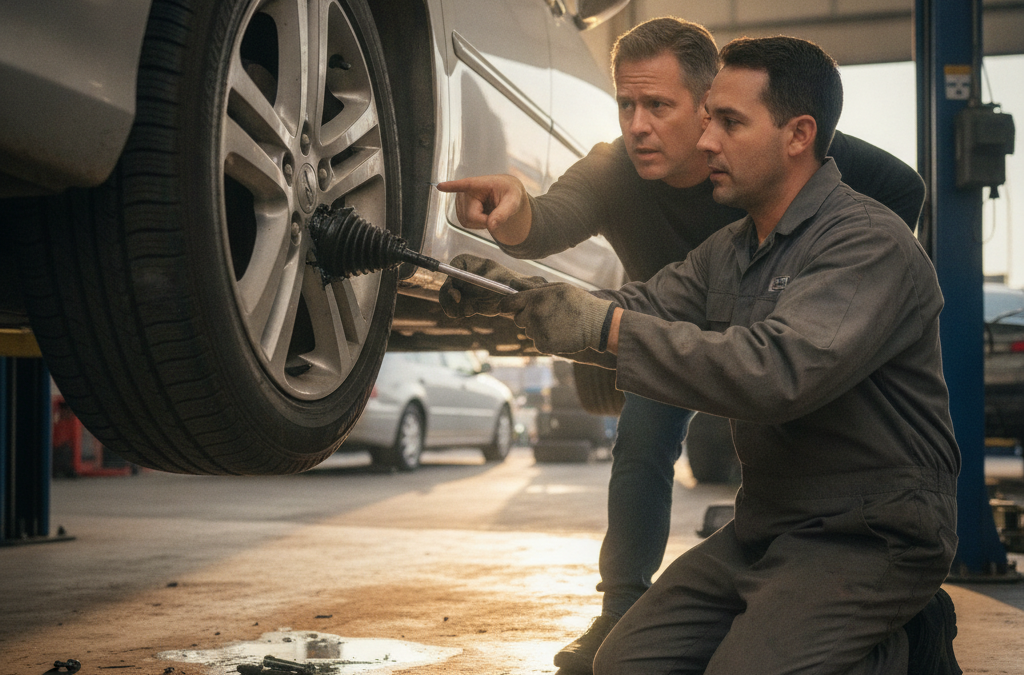
How Do You Know If Your Car’s CV Axle Is Failing — and What Does It Cost to Fix in Goodyear, AZ?
That clicking or popping sound you hear every time you make a sharp turn in a parking lot? It’s one of the most recognizable signs that a CV axle — or more specifically, the CV joint on the end of it — is wearing out. If you’ve been noticing it and hoping it goes away on its own, it won’t. In fact, in the Phoenix West Valley, where road construction is a constant and summer heat accelerates wear on rubber components, a failing CV axle has a way of turning into a much bigger problem faster than you’d expect. The good news is that it’s a very fixable issue when you catch it early.
What Is a CV Axle, and Why Does It Matter?
CV stands for constant velocity. The CV axle is what transfers power from your transmission to your wheels, allowing the wheels to move up and down with the suspension and turn left and right for steering — all while still spinning smoothly. On a front-wheel-drive car, you have two of them. On an all-wheel-drive vehicle, you may have four. Each axle has joints on each end (called CV joints) that are packed with grease and protected by a rubber boot.
When that rubber boot cracks or tears — something that happens faster in extreme heat — the grease flies out and the joint starts running dry. Metal grinding on metal, with no lubrication, creates the clicking you hear. Leave it long enough and the whole axle eventually fails. At that point, you’re not steering your car, you’re barely moving it.
Warning Signs Your CV Axle or Joint Is Going Bad
These are the things to watch and listen for:
- Clicking or popping when turning: This is the classic symptom. It usually shows up during slow, tight turns — like pulling out of a parking space or navigating a roundabout. The clicking often gets louder as the joint deteriorates.
- Vibration that increases with speed: If the CV axle itself is worn or bent, you may feel a shudder or vibration through the steering wheel or floorboard that gets worse the faster you go. This is different from a tire balance issue — it tends to be more of a constant rumble than a rhythmic shimmy.
- Clunking when accelerating: Some drivers notice a thunk or clunk when they press the gas from a stop. That’s often a sign that the inner CV joint — the one closer to the transmission — is worn.
- Grease splattered inside the wheel well: If you notice a dark, greasy mess on the inside of your tire or on the wheel well liner, that’s a torn CV boot throwing grease everywhere. The joint itself may still be okay at that point, but it won’t be for long.
- Car feels sluggish or pulls during acceleration: In more advanced cases, a failing axle can cause the vehicle to feel like it’s not transferring power evenly.
Why This Happens Faster in the Goodyear and West Valley Area
Rubber is the enemy here, and the desert is not kind to rubber. CV boots are made to last, but the combination of extreme UV exposure and underhood heat — where temperatures can push well past 200°F in Arizona summers — accelerates cracking and dryness. Add in the constant road construction along the I-10 corridor and surface streets throughout Goodyear, Avondale, and Litchfield Park, and you’ve got a recipe for more axle stress than you’d see in a milder climate.
The potholes and expansion joints on heavily traveled roads aren’t doing your axles any favors either. Each hard impact puts a jolt through the drivetrain, and over time, that adds up — especially on higher-mileage vehicles or any car that’s spent time being driven hard.
What Does It Actually Cost to Fix a CV Axle?
The cost depends on whether you’re replacing a boot only, a full CV joint, or the entire axle shaft — and that depends on how far along the damage is.
- CV boot replacement only: If the boot is torn but the joint is still in good shape, a boot kit is a less expensive fix. The labor can be significant since the axle often has to come out anyway, but it’s still cheaper than a full replacement.
- Full CV axle replacement: This is the most common repair. On most front-wheel-drive cars and crossovers — the kind of daily drivers most Goodyear and Surprise families are running — a single axle replacement typically runs in the range of $200–$450 per side, parts and labor included, depending on the vehicle.
- AWD vehicles: Rear axle repairs on all-wheel-drive trucks and SUVs tend to be more involved and can run higher. The range varies quite a bit by make and model.
At All Valley Car Care, we give you a written estimate before any work starts. No surprises on the bill, and we’re not going to recommend replacing an axle that still has life in it just to pad the invoice. You can learn more about our full drivetrain and repair services on our services page.
Can You Drive on a Bad CV Axle?
Technically, yes — for a while. But it’s the kind of thing that gets worse the longer you ignore it. A clicking CV joint won’t fix itself, and driving on it accelerates the wear dramatically. If the joint fails completely while you’re driving — which does happen — you lose the ability to put power to that wheel. On a front-wheel-drive car, that means you may lose steering control as well. That’s not a situation you want to find yourself in on the I-10 or Loop 303 during rush hour.
If you’re hearing clicking on turns and you’re not sure what’s causing it, bring it in and let us take a look. A quick inspection takes the guesswork out of it.
What to Expect During the Repair
When you bring your car in for a suspected CV axle issue, the technician will start with a road test to confirm the symptoms, then get the vehicle up on the lift to inspect the boots, joints, and axle shafts visually. If a boot is freshly torn and the joint hasn’t been running dry for long, we’ll tell you that. If the joint is already gritty, noisy, or has visible play in it, the smart move is a full axle replacement rather than just the boot.
Most CV axle replacements on common vehicles take a few hours. We’ll walk you through what we found, what it needs, and what it’s going to cost — before we touch anything.
All Valley Car Care backs repairs with a 3-year/36,000-mile warranty, extendable to 5 years/60,000 miles, and all our technicians are ASE-certified. We’ve been serving the West Valley since 2010, and we’re not in the business of overselling repairs to people who trust us with their vehicles.
If you’re in the Goodyear area or anywhere nearby — Avondale, Litchfield Park, Buckeye, or over in Surprise or Peoria — you’re close to one of our locations. Bring it by or give us a call and we’ll get you sorted out. Find your nearest shop at our locations page.
Frequently Asked Questions
How long can I drive with a clicking CV joint before it becomes dangerous?
It depends on how worn it is, but clicking that’s been getting louder over weeks or months means the joint is deteriorating fast. It’s not a “wait until next month” kind of repair. Get it looked at soon — it’s cheaper to fix early than after it fails.
Is it worth replacing just the CV boot if the joint isn’t clicking yet?
If the boot is freshly torn and the joint hasn’t lost its grease yet, yes — a boot replacement can save the joint. But if it’s been running dry and you’re already hearing noise, the joint is usually too far gone. We’ll tell you honestly which situation you’re in.
Do I need to replace both CV axles at the same time, or just the one that’s bad?
Unlike brake pads, where both sides wear together, CV axles don’t need to be done in pairs. If one side is bad and the other looks fine on inspection, we’ll replace only what needs it. No unnecessary parts.
Can a bad CV axle cause my check engine light to come on?
Not directly — a CV axle doesn’t have a sensor that triggers a trouble code. But severe vibration from a failing axle can sometimes affect sensor readings. If your check engine light is on alongside drivetrain symptoms, a diagnostic scan will sort out what’s actually causing it.
Does Arizona’s heat actually make CV boots fail faster?
Yes. The rubber in CV boots hardens and cracks faster in extreme heat and UV exposure. Arizona drivers often see boot failures earlier than the national average, especially on vehicles that spend a lot of time parked in direct sun. It’s just part of living in the Valley of the Sun — routine inspections catch it before it becomes a bigger issue.
Ready to Get It Checked Out?
If you’re hearing clicking, feeling vibration, or just want peace of mind that your drivetrain is in good shape, we’re here. All Valley Car Care has been a trusted name for West Valley families and drivers since 2010 — no upsells, no hidden fees, and no unnecessary repairs. Contact us today to schedule an inspection or ask us any questions. We’ll give you straight answers and a written estimate before any work begins.