
How Do You Know If Your Car’s Brake Rotors Are Worn Out — and What Does It Cost to Fix in Surprise, AZ?
If your steering wheel shudders in your hands every time you slow down for a red light, or you feel a pulsing vibration through the brake pedal when you stop — that’s your brake rotors trying to get your attention. It’s one of the more common brake complaints we hear from drivers in Surprise, and it’s one of those problems that gets worse (and more expensive) the longer you ignore it. Here’s what’s actually going on, what the warning signs look like, and what you can realistically expect to pay to fix it at a shop that won’t pad your bill.
What Do Brake Rotors Actually Do?
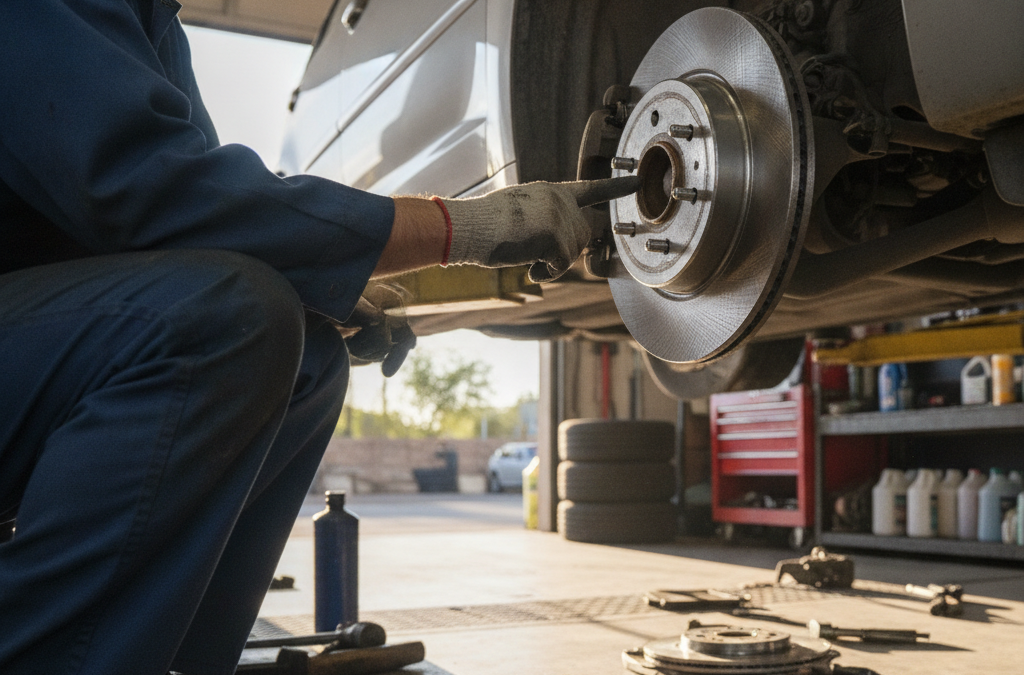
Your brake rotors are the large metal discs that sit behind each wheel. When you press the brake pedal, your brake pads clamp down on those spinning rotors and slow the vehicle. It’s a simple, effective system — but rotors do wear down over time. They also warp, crack, or develop grooves depending on your driving habits, your pads, and yes, the relentless Arizona heat.
Rotors aren’t designed to last forever. Most manufacturers spec them to a minimum thickness, and once a rotor gets too thin — or develops a surface that’s no longer flat — it can’t clamp evenly. That’s when you start feeling that shudder, hearing that grinding, or noticing your car pulling to one side when you stop.
Warning Signs Your Rotors Are Failing
These are the things to pay attention to. Some of them are obvious. A few catch drivers off guard.
- Steering wheel vibration or shuddering when braking: This is the most common sign of warped rotors. You’ll feel it most at highway speeds when you apply the brakes. At lower speeds it may feel more like a wobble.
- Pulsating brake pedal: If the pedal pumps back against your foot when you’re trying to stop smoothly, the rotor surface is uneven.
- Squealing or high-pitched scraping: Sometimes this is pads, but if the sound changes pitch when you brake versus when you’re just rolling, the rotors are often involved too.
- Grinding noise when stopping: This usually means your pads are worn through and metal is contacting the rotor directly. At that point, the rotor is likely being damaged and may need replacement even if it wasn’t ready before.
- Visible grooves or scoring on the rotor face: If you can stick your finger through your wheel spokes and feel deep ridges on the rotor, that’s a problem. A smooth, even surface is what you want.
- Car pulling to one side when braking: Could be a caliper issue, but uneven rotor wear between left and right can cause this too.
- Longer stopping distances: If your car just doesn’t feel like it stops as crisply as it used to, worn rotors — often combined with worn pads — are a likely cause.
Why Arizona Heat Makes Rotor Problems Worse
Brake rotors deal with heat every single time you stop. That’s normal. What’s not normal is starting every braking event from an already elevated temperature — which is exactly what happens when your car has been sitting on 150°F pavement in a Surprise parking lot in July and you’ve been driving in stop-and-go traffic with the AC running full blast.
The repeated thermal stress of Phoenix West Valley summers accelerates rotor wear and warping. Rotors expand and contract with heat. When that cycle happens thousands of times under extreme conditions, the metal fatigues faster than it would in a milder climate. Drivers here in the greater Phoenix area genuinely do go through rotors more quickly than the same driver would in, say, Minnesota. It’s not a sales pitch — it’s just physics.
The road construction throughout the area doesn’t help either. Constant lane changes, sudden stops around construction zones, and rough pavement on stretches like Grand Ave and the loop systems all add irregular stress to your braking components.
Can You Just Resurface the Rotors Instead of Replacing Them?
Resurfacing — also called turning or machining — used to be the standard fix for rotors that were warped but still thick enough to work with. A shop would run the rotor on a lathe to shave the surface flat again. It’s still a valid option in some cases, but here’s the honest answer: on most modern vehicles, rotors come from the factory close to their minimum thickness already. By the time they’re warped or grooved enough to cause symptoms, there often isn’t enough material left to safely resurface them.
At All Valley Car Care in Surprise, we measure your rotor thickness before we recommend anything. If resurfacing makes sense, we’ll say so. If it doesn’t, we’ll tell you that too — and explain why. No unnecessary repairs, no hidden costs. That’s how we’ve operated since 2010.
What Does It Cost to Replace Brake Rotors in Surprise, AZ?
Rotor replacement cost depends on your vehicle make and model, whether you’re doing front, rear, or all four, and whether the pads need to come along for the ride (they usually do — worn rotors and worn pads tend to arrive together). Here’s a realistic range:
- Front rotors + pads on a typical sedan or SUV: Roughly $250–$450 for most domestic and Japanese vehicles. European imports often run higher due to parts cost.
- Rear rotors + pads: Similar range, though some vehicles with integrated parking brake designs cost more in labor.
- All four rotors and pads: Expect $500–$900 or more depending on the vehicle.
These are honest ballpark figures, not quotes. Your actual cost depends on your specific vehicle and what we find when we inspect it. We always provide a written estimate before any work starts — no surprises on the invoice.
What we will say is this: if you’re a Sun City West or El Mirage driver who’s been putting off that brake inspection because you’re worried about getting oversold, bring it in and let us take a look. We’ll tell you exactly what’s worn, show you if we can, and give you an honest recommendation. That’s it.
Can You Drive on Bad Rotors?
Technically, yes — until you can’t. Warped rotors that cause shuddering are annoying but don’t always mean immediate brake failure. However, if the rotors are thin and cracked, if the pads are worn through, or if you’re experiencing grinding, your stopping distance is compromised. In a city like Phoenix where traffic on the 303 or Loop 101 can go from 75 mph to a dead stop without much warning, that matters.
Don’t put this one off until something worse happens. Replacing rotors and pads is a known, manageable cost. Replacing rotors, pads, calipers, and brake lines because a dragging situation went too far — that’s a much harder conversation. Take a look at our full list of brake and auto repair services to see everything we handle.
Frequently Asked Questions About Brake Rotors in the Surprise Area
How long do brake rotors last in Arizona?
In milder climates, rotors can last 50,000–70,000 miles. In the Phoenix West Valley, with extreme heat, dusty conditions, and stop-and-go traffic, many drivers see rotor wear starting around 30,000–50,000 miles. Driving style matters a lot — smooth, gradual braking extends rotor life significantly compared to hard, frequent stops.
Do I need to replace brake pads and rotors at the same time?
Not always, but often yes. If your rotors are being replaced due to wear or warping, putting fresh pads on worn rotors — or old pads on new rotors — can cause uneven bedding and new problems quickly. We’ll check both and give you an honest recommendation on what actually needs to go.
What’s the difference between warped rotors and a bad wheel bearing?
Both can cause vibration, which is why a proper inspection matters. Warped rotor vibration is usually most noticeable when you’re braking and tends to come through the pedal or steering wheel during the stop. A bad wheel bearing often produces a humming or rumbling sound that changes with vehicle speed regardless of braking. We can diagnose both — don’t guess on this one.
Is it safe to drive from Peoria or Youngtown to your Surprise location with shuddering brakes?
If the shuddering is mild and you’re not experiencing grinding or a spongy pedal, a short drive to our shop is usually fine. If you’re hearing metal-on-metal grinding or your pedal is going soft, call us first at (623) 243-6206 — we can help you figure out whether it’s safe to drive in or whether you need roadside assistance.
Does All Valley Car Care offer a warranty on brake rotor replacement?
Yes. Our brake repairs — like all our work — are backed by our 3-year/36,000-mile warranty, which is extendable to 5 years/60,000 miles. We use quality parts, and we stand behind what we install. Written estimates, no surprise charges, ASE-certified technicians.
Get Your Brakes Checked at All Valley Car Care in Surprise
That shuddering when you stop isn’t going to fix itself, and the longer you let worn or warped rotors go, the more you risk turning a straightforward repair into a larger one. Whether you’re commuting from Glendale, running errands in Surprise, or hauling the family across the West Valley, your brakes need to work every single time.
All Valley Car Care has been serving the greater Phoenix area since 2010 — with locations in Surprise, Glendale, and Gilbert. We’ll inspect your brakes, measure your rotors, tell you honestly what needs to be done, and give you a written estimate before we touch anything. Schedule your brake inspection today and get back to driving with confidence.