
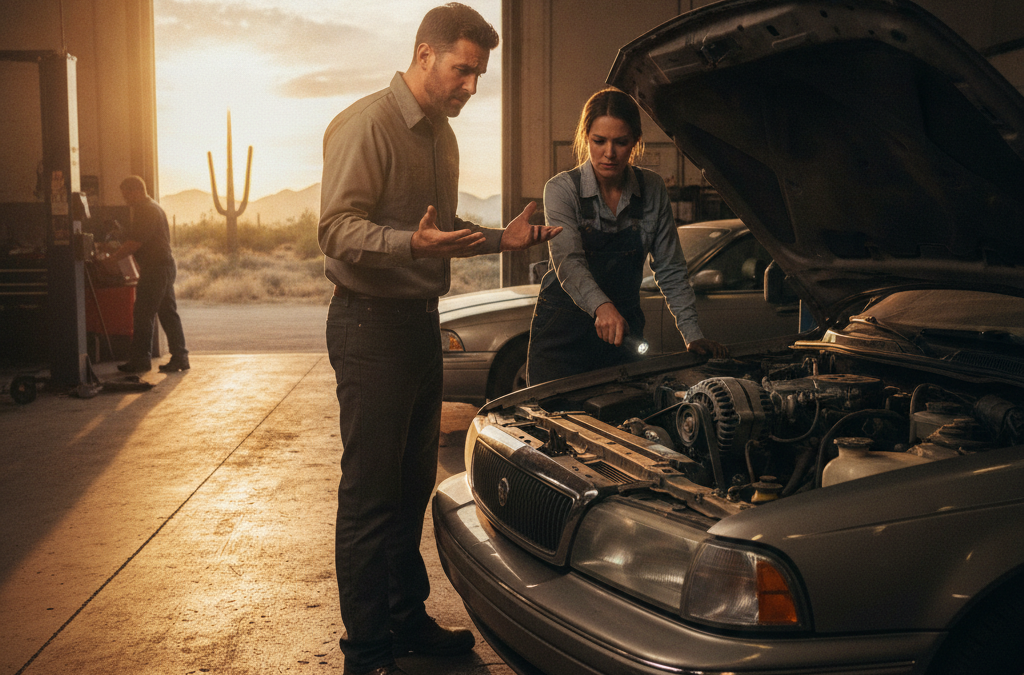
Is Your Car’s Alternator Failing — and How Do You Know Before You’re Stranded in Surprise, AZ?
If your car died in a parking lot and a jump start got you going again, your first instinct was probably to replace the battery. That’s a reasonable guess — but if the new battery goes dead within a day or two, the battery almost certainly isn’t the problem. Your alternator might be. It’s one of the most misdiagnosed electrical issues we see at our Surprise location, and it’s worth understanding the difference before you spend money on parts that won’t fix anything.
What Does an Alternator Actually Do?
Your battery starts the car. Your alternator keeps it running. Once the engine is on, the alternator — driven by a belt off the engine — generates electricity that powers everything: your AC, headlights, phone charger, infotainment screen, and every other electrical system in the vehicle. It also recharges the battery while you drive so it’s ready for the next start.
When the alternator starts to fail, it stops putting out enough power to run everything and recharge the battery at the same time. The battery starts draining even while the car is running. Eventually, there’s not enough juice left to keep the engine going — and you end up on the side of the road wondering what happened.
Warning Signs Your Alternator Is Going Out
The good news: alternators rarely fail all at once. They usually give you several days or weeks of warning before they quit completely. Here’s what to watch for:
- Battery warning light on the dash. This light doesn’t always mean the battery itself is bad — it monitors the entire charging system, which includes the alternator. If it comes on while you’re driving, get it checked soon.
- Dimming or flickering headlights. If your headlights get noticeably dimmer at idle and brighten up when you rev the engine, that’s a classic sign the alternator isn’t producing enough output at low RPM.
- Electrical accessories behaving strangely. Power windows moving slowly, the radio cutting out, the AC seeming weaker than usual — when the alternator can’t keep up, the car starts rationing power.
- A whining or growling noise from under the hood. Worn alternator bearings make noise. If you hear a steady whine or grinding that changes with engine speed, have it inspected.
- Dead battery — again — after a recent replacement. If you’ve replaced the battery in the last few months and it’s already dead, the alternator is the most likely culprit. It may have killed your old battery, and it’ll kill the new one too if it’s not fixed.
- The car starts fine but dies shortly after. If the vehicle runs for a few minutes and then stalls or loses power, the alternator may be outputting nothing and the battery is running the whole car on its own — which it can’t do for long.
Alternator vs. Starter: They’re Not the Same Problem
A lot of drivers confuse alternator failure with starter failure because both can leave you with a car that won’t start. Here’s a quick way to tell them apart:
- If you turn the key and hear a single click or rapid clicking — but the engine doesn’t crank — that’s almost always a dead battery or a failing starter.
- If the car cranks and starts normally but then dies a few minutes later, or if electrical systems start failing while you’re driving, that points more toward the alternator.
- If a jump start gets the car going but it dies again within 20–30 minutes, the alternator is not recharging the battery and needs to be tested immediately.
The only way to know for sure is a charging system test. We run a full diagnostic that checks alternator output voltage, battery condition, and the condition of the charging circuit — not just a quick meter reading at the battery terminals. That distinction matters, because a surface-level test can miss an alternator that’s failing under load.
Why Arizona Heat Makes Alternator Problems Worse
Heat is hard on every electrical component under your hood, and alternators are no exception. In the Phoenix West Valley, we regularly see temperatures over 115°F in July and August — and under the hood, it’s significantly hotter than that. Extreme heat degrades the internal windings, diodes, and bearings in an alternator faster than in cooler climates.
Combine that with the fact that Arizona drivers run their AC nearly every day for eight or nine months out of the year — which puts a constant high-demand load on the alternator — and it’s easy to see why charging system problems are more common here than the national average. Drivers in Peoria, El Mirage, and Sun City West who commute daily during summer are especially likely to notice these symptoms because the alternator rarely gets a break.
We also see alternators fail sooner on vehicles that spend a lot of time idling in traffic on the Grand Ave corridor or sitting in park with the AC blasting. The alternator is working hard, but at low RPM it’s less efficient — and over time, that takes a toll.
What the Repair Actually Involves
Alternator replacement is a straightforward repair at a shop that knows what it’s doing. The old unit comes out, a new or remanufactured alternator goes in, and the charging system gets retested to confirm it’s putting out the right voltage. The job typically takes a couple of hours. We’ll also check the serpentine belt that drives the alternator — if it’s cracked or worn, replacing it at the same time saves you from coming back later.
We give every customer a written estimate before any work begins, and we stand behind alternator replacements with our 3-year/36,000-mile warranty — extendable to 5 years/60,000 miles. No surprises on the invoice. You’ll know what you’re paying before we touch the car.
If you’re in Youngtown, Goodyear, or anywhere across the West Valley and you’re seeing any of the warning signs above, don’t wait until you’re calling a tow truck. See our full list of electrical and diagnostic services — or just bring it in and we’ll tell you honestly what’s going on.
Frequently Asked Questions
Can I drive with a failing alternator?
For a short distance, maybe — but you’re running the car entirely on battery power once the alternator stops charging. Most batteries will last 20–30 minutes under that kind of load before the car dies. Don’t risk it. If you suspect the alternator, drive straight to a shop or call for a tow.
How long do alternators last in Arizona?
Nationally, alternators often last 100,000–150,000 miles. In Arizona’s extreme heat, it’s more realistic to expect 80,000–120,000 miles — sometimes less on vehicles that run AC constantly or see a lot of stop-and-go driving. If your car has higher mileage and you’re seeing electrical symptoms, the alternator should be one of the first things tested.
Will a new battery fix the problem if the alternator is bad?
No. A bad alternator will drain a new battery just as fast as it drained the old one. Replacing the battery without testing the charging system first is a common — and expensive — mistake. Always have the full charging system tested before buying a new battery.
How much does alternator replacement cost?
It varies by vehicle make and model, but alternator replacement is generally in the moderate repair range. We’ll give you an exact written estimate before any work begins. We don’t recommend unnecessary repairs, and we won’t pressure you into additional services you don’t need.
My check engine light is on — could it be the alternator?
Possibly. A failing alternator can trigger multiple trouble codes because low voltage affects sensors throughout the vehicle. A proper computerized diagnostic will pull the codes and help pinpoint whether the charging system is the root cause. Don’t assume the codes are unrelated to an electrical issue — context matters.
Don’t Wait Until You’re Stuck
Alternator problems are frustrating because they tend to hit at the worst possible time — usually when it’s 108°F in Surprise in the middle of July and you’re far from home. The warning signs are almost always there beforehand. If your dash light is on, your lights are flickering, or you’ve already replaced a battery that went dead again, get the charging system tested now.
All Valley Car Care has been serving drivers across the West Valley since 2010. We’ll run a full charging system diagnostic, explain exactly what we find in plain English, and give you a written estimate before anything gets fixed. Contact us to schedule a diagnostic appointment — and let’s figure out what’s actually going on before it leaves you stranded.