
How Do You Know If Your Car’s Brake Calipers Are Failing — and What Does It Cost to Fix in Avondale, AZ?
If your car pulls hard to one side when you hit the brakes, or you’re burning through a fresh set of brake pads in a matter of weeks, there’s a good chance your brake caliper is the problem — not the pads. For drivers in Avondale and across the Phoenix West Valley, a failing caliper isn’t just annoying. It’s a safety issue that tends to get worse fast, especially when summer temperatures are pushing 115°F and your brakes are already working overtime.
Most people know the basics: pads wear down, rotors get scored, brakes squeal. But the caliper — the clamp that actually squeezes your brake pads against the rotor — rarely gets talked about. When it starts to go, the symptoms can be subtle at first and then very obvious in a hurry. Here’s what to watch for and what you’re looking at in terms of repairs.
What Does a Brake Caliper Actually Do?
When you press the brake pedal, brake fluid travels through your brake lines and pushes a piston (or multiple pistons) inside the caliper. That force clamps the brake pads against the spinning rotor, which slows your wheel. Release the pedal, and the caliper is supposed to retract — letting the pads lift away from the rotor so the wheel spins freely again.
When a caliper sticks, seizes, or leaks, that system breaks down. The caliper might keep clamping even when you’re not braking, or it might not apply even pressure, or brake fluid might leak out and reduce your stopping power entirely. Any of those situations creates a problem you don’t want to discover on the I-10 through Tolleson at rush hour.
Signs Your Brake Caliper May Be Failing
Your Car Pulls to One Side When Braking
This is the most common early warning sign. If the caliper on one side is sticking — either partially engaged or not releasing — that wheel gets more braking force than the other. You’ll feel the car tug toward the problem side every time you slow down. It’s often mistaken for an alignment problem, and while road construction and potholes in the West Valley area do knock cars out of alignment regularly, a pulling issue that shows up specifically when braking usually points to the caliper, not the alignment.
Uneven or Unusually Fast Brake Pad Wear
If you pull off a wheel and find the inner brake pad almost gone while the outer pad looks nearly new, that’s a stuck caliper piston — it’s dragging on one side. If both pads on one axle are cooked while the other axle looks fine, same story. A seized caliper will eat a brand-new set of pads in a fraction of the normal time.
A Burning Smell After Driving — Especially in Stop-and-Go Traffic
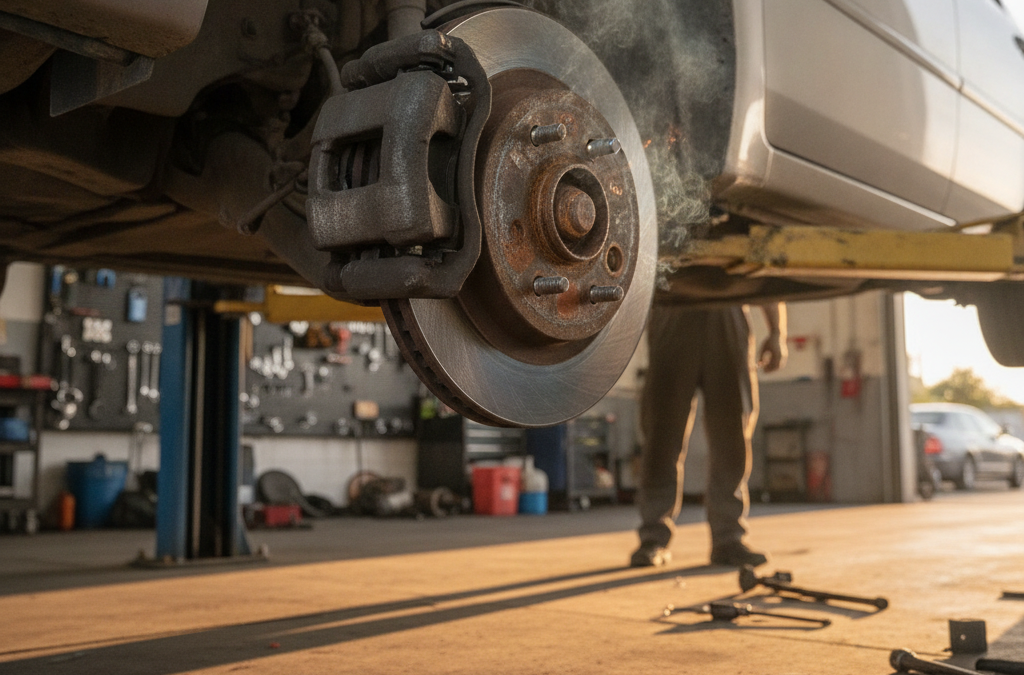
A stuck caliper creates constant friction even when you’re not braking. That generates heat — a lot of it. You may notice a sharp burning or chemical smell coming from one of your wheels after city driving. In extreme cases, you might even see smoke coming off the wheel. This isn’t something to ignore. Extreme heat can warp rotors, boil brake fluid, and in rare situations, start a fire if grease or debris is nearby.
A Spongy or Soft Brake Pedal
If the caliper is leaking brake fluid, you’ll lose hydraulic pressure in the system. That shows up as a pedal that travels further than normal before the brakes engage — or in serious cases, a pedal that sinks all the way to the floor. Any spongy pedal symptom should be treated as an emergency. Don’t drive that car until it’s been inspected. Our full list of brake services includes complete brake system inspections to find exactly where pressure loss is originating.
Visible Fluid Around the Wheel or on the Caliper
Brake fluid is clear to slightly yellow and has a slightly oily feel. If you see wet residue on the inside of a wheel or dripping from behind it, that’s a red flag. It could be a leaking caliper seal or a brake line issue — either way, it needs attention before you drive anywhere.
Why Arizona Heat Makes Caliper Problems Worse
Brake calipers are designed to handle heat — but there’s a limit. When ambient temperatures are above 110°F and pavement temperatures exceed 150°F, braking systems run consistently hotter than they were engineered for in milder climates. Over time, the rubber seals and boots inside a caliper dry out and crack faster in Arizona’s dry desert climate than they would in, say, a coastal city. Once a seal fails, the piston can stick or fluid can leak — and you’re dealing with a caliper problem you wouldn’t have had for another 30,000 miles somewhere else.
Drivers in Avondale, Goodyear, and Litchfield Park who do a lot of stop-and-go commuting on the I-10 corridor tend to see accelerated caliper wear compared to highway-only drivers. If your vehicle is used for fleet work, deliveries, or hauling — anything that adds braking frequency or load weight — your inspection intervals should reflect that.
What It Costs to Replace a Brake Caliper in the West Valley
Caliper replacement cost depends on your vehicle, whether one side or both need replacement, and what else needs attention at the same time. As a general range, expect to pay $150–$400 per caliper for parts and labor — though trucks, SUVs, and European vehicles often run higher. Shops typically recommend replacing calipers in pairs (both front or both rear) to maintain even braking force, so a full front-axle caliper job might run $300–$750 depending on the vehicle.
If the caliper has caused accelerated pad or rotor wear — which is very common — those parts may need to be replaced at the same time, which adds to the total. A thorough inspection will tell you exactly what’s needed and what isn’t. At All Valley Car Care, we give you a written estimate before any work begins. No surprises on the invoice.
Can You Drive With a Failing Caliper?
It depends on how far the problem has progressed, but honestly — you shouldn’t. A mildly sticky caliper might not feel dangerous at first, but it creates a chain reaction: accelerated pad wear leads to metal-on-metal contact, which damages rotors, which increases stopping distance, which eventually becomes a situation where your brakes aren’t working the way they need to. If you’re smelling burning or noticing a hard pull, treat it like a priority, not a “I’ll get around to it” item.
If you’re buying a used car in the Avondale or Surprise area and you’re not sure about the brake history, a pre-purchase inspection at our Surprise location includes a full brake system check — calipers included. It’s one of the most valuable things you can do before signing anything.
What a Proper Brake Caliper Diagnosis Looks Like
A lot of shops will replace pads and rotors without looking at the caliper — and three months later you’re back in with the same uneven wear problem. The caliper itself has to be inspected: does the piston retract cleanly? Are the slide pins moving freely? Are the boots intact? Is there any sign of fluid leakage around the seals?
A thorough diagnosis also rules out other causes — a collapsed brake hose, for instance, can trap fluid pressure and mimic a seized caliper. Getting this right the first time saves you money and keeps you from replacing parts that didn’t need replacing.
Frequently Asked Questions
How long do brake calipers typically last in Arizona?
In milder climates, calipers often last 100,000 miles or more. In the Phoenix area — with extreme heat, dusty conditions, and rubber seals drying out faster — it’s reasonable to see caliper issues start between 60,000 and 90,000 miles, particularly on vehicles used for heavy stop-and-go driving.
Can a stuck caliper fix itself?
No. A seized or sticking caliper will not free itself over time. It will continue dragging, generating heat, and destroying the brake pad on that corner until it’s addressed. The sooner you have it looked at, the less likely you are to need rotors and pads replaced along with the caliper.
Is it safe to drive to a shop if my caliper is sticking?
If the problem is mild and you’re not smelling burning or feeling the pedal go soft, a short, careful drive to a nearby shop is generally okay. If the pedal is spongy, you’re smelling smoke, or the car is pulling severely, call for a tow. It’s not worth the risk.
Should both calipers on an axle be replaced at the same time?
Most mechanics recommend it, yes — especially on higher-mileage vehicles. If one caliper seal has failed, the other is likely not far behind. Replacing both maintains even braking balance and saves you from doing the same job twice six months later.
Do you work on fleet vehicles and commercial trucks in Avondale and Peoria?
Yes. All Valley Car Care services commercial fleets and work trucks across the West Valley, including Avondale, Peoria, Surprise, and Goodyear. We can schedule fleet brake inspections around your business hours to minimize downtime. Reach out to discuss your fleet’s needs.
Get Your Brakes Checked by a Shop That Won’t Oversell You
At All Valley Car Care, we’ve been serving the Phoenix West Valley since 2010. We’re not going to tell you that you need four new calipers when only one is acting up. We show you what we find, explain it in plain terms, and give you a written estimate before we touch anything. Our brake work is backed by a 3-year/36,000-mile warranty — extendable to 5 years/60,000 miles — so you’re covered long after you leave the lot.
If your car is pulling, your brakes smell hot, or you just haven’t had your brake system looked at in a while, don’t put it off. Contact us online or give us a call to schedule an inspection at our Surprise, Glendale, or Gilbert location. We’ll give you an honest answer and a fair price — that’s been the promise since day one.