
What’s the Difference Between a Brake Pad and a Rotor — and When Does Each One Need to Be Replaced in Surprise, AZ?
You’ve probably heard both terms thrown around at the shop or seen them in a repair estimate — brake pads and rotors. Most drivers have a vague sense that they’re both part of the braking system, but when someone behind the counter tells you that your pads are fine but your rotors are worn, or vice versa, it’s hard to know whether that’s an honest assessment or a sales pitch. If you’re in Surprise or anywhere across the Phoenix West Valley, here’s a plain-English breakdown of what each part does, when it actually needs to be replaced, and how to avoid paying for work you don’t need.
What Brake Pads Actually Do
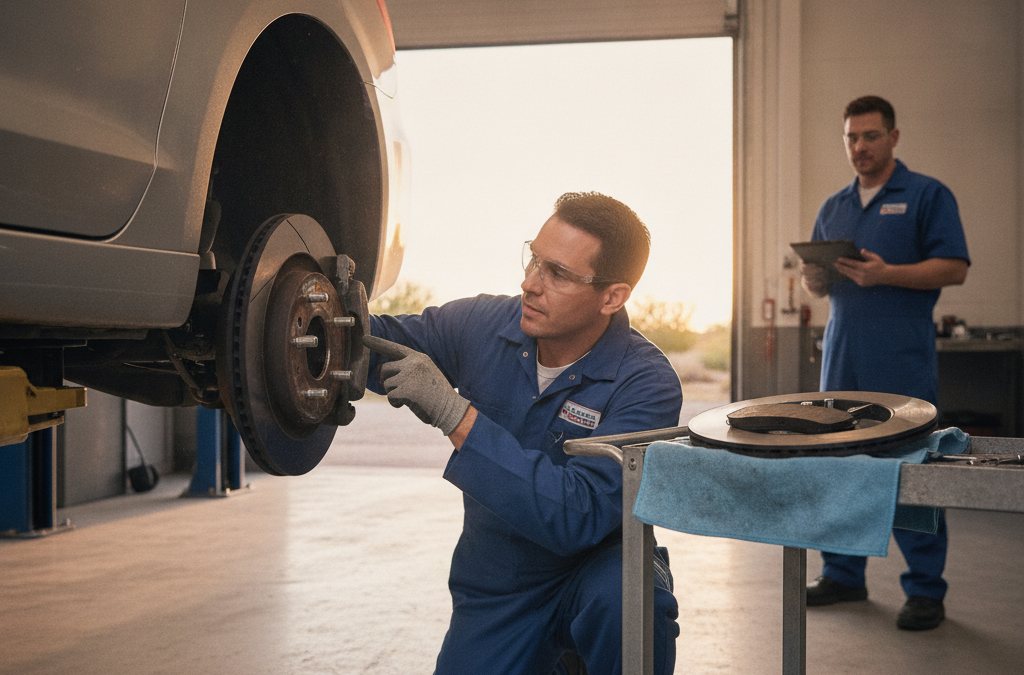
Think of brake pads as the consumable part of your braking system — they’re designed to wear down over time. When you press the brake pedal, the caliper squeezes the brake pad against the spinning rotor. That friction is what slows your car down. Because pads create friction on purpose, they gradually wear away. That’s expected. Most pads have a built-in wear indicator — a small metal tab that starts squealing against the rotor when the pad gets too thin. That high-pitched squeal you hear when you brake is the pad telling you it’s time.
How long brake pads last depends heavily on your driving habits, your vehicle’s weight, and your environment. In a stop-and-go commute through Peoria or on the Grand Ave corridor, pads wear faster than on a highway. Generally speaking, most drivers get somewhere between 30,000 and 60,000 miles out of a set of brake pads — but those are guidelines, not guarantees. Have them inspected once a year or whenever you notice any change in how your brakes feel or sound.
What Rotors Do — and Why They’re Different
Rotors are the large metal discs that the brake pads press against. They spin with your wheel and bear the heat load of every stop you make. Unlike pads, rotors aren’t supposed to wear down quickly — but they do wear. Over time, the constant friction creates tiny grooves in the rotor surface, and if the pads are allowed to wear completely through, the metal backing plate of the pad starts grinding directly into the rotor. That’s the grinding sound drivers sometimes ignore because they don’t want to deal with the repair bill. Ignoring it always makes the bill bigger.
Rotors also warp. Warping happens when the rotor heats unevenly — sometimes from heavy braking, sometimes from a caliper that’s sticking, and sometimes just from the wear pattern over years of use. A warped rotor is what causes that pulsing or vibrating feeling in the brake pedal when you slow down. It’s not subtle once it gets bad.
In Arizona’s summer heat, brake components work harder than in most parts of the country. Temperatures on the pavement routinely exceed 150°F, and the heat that builds up during repeated braking in those conditions is significant. This is one reason we encourage drivers throughout the West Valley — whether you’re in Surprise, El Mirage, or Glendale — to get a brake inspection before summer is fully underway, not after a problem surfaces on a 115-degree afternoon.
Do You Always Need to Replace Both at the Same Time?
This is where a lot of confusion — and some unnecessary spending — happens. The honest answer is: not always, but sometimes yes.
If your pads are worn but your rotors are still within minimum thickness spec and the surface is smooth, replacing just the pads is completely reasonable. If your rotors are scored, warped, or below minimum thickness, they need to be replaced regardless of pad condition. And if you’ve let pads wear all the way through to metal-on-metal contact, the rotors almost certainly need to go too.
What you should always ask at any shop is: what’s the current thickness on my rotors, and what’s the minimum spec? Any honest technician will have that number. At All Valley Car Care, we give you that measurement in writing before recommending a replacement, because you deserve to see the evidence — not just take our word for it. You can learn more about all the brake and maintenance services we offer on our services page.
Warning Signs That Mean You Shouldn’t Wait
There’s a difference between brakes that are getting close to the end of their life and brakes that need immediate attention. Here are the signs that fall in the second category:
- Grinding or metal-on-metal sound — pads are gone, rotors are likely being damaged right now
- Pulsing or vibrating pedal — warped rotors, needs inspection soon
- Pulling to one side when braking — could be a sticking caliper or uneven pad wear
- Spongy or soft pedal — could indicate air in the brake lines or brake fluid issues
- Brake warning light on your dashboard — don’t assume it’s just a sensor; get it checked
If you notice any of these, this isn’t something to schedule for next week. Brakes are the one system where delay has direct safety consequences for you, your passengers, and everyone else on the road.
What Competitors Often Skip — Brake Fluid and Calipers
One thing that tends to get lost in the pads-and-rotors conversation is the rest of the brake system. Most auto repair content online — and honestly, a lot of what you’ll see on competitor websites in the Valley — focuses almost entirely on pads and rotors. But brake fluid, calipers, and brake lines matter just as much.
Brake fluid is hygroscopic, meaning it absorbs moisture from the air over time. As it absorbs moisture, its boiling point drops. In Arizona heat, that matters — fluid that’s loaded with moisture can boil during heavy braking, leading to vapor lock and a dramatically reduced ability to stop. Most manufacturers recommend flushing brake fluid every two to three years. It’s inexpensive compared to what happens when it’s ignored.
Calipers can stick or seize, especially in an environment that swings between extreme heat and occasional monsoon humidity. A seized caliper causes one pad to press constantly against the rotor even when you’re not braking, creating rapid and uneven wear — and a burning smell you’ll notice. If you’ve ever had brakes replaced and they wore out unusually fast on one side, a sticky caliper is often why.
At our Surprise location, a brake inspection covers the whole system — not just the parts that are easiest to upsell.
Frequently Asked Questions About Brake Pads and Rotors
How do I know if I need pads, rotors, or both?
A technician will measure the remaining thickness of your pads and rotors and compare both to the manufacturer’s minimum spec. If pads are low but rotors measure within spec and the surface is clean, you may only need pads. If the rotors are scored, warped, or below minimum thickness, they need to be replaced too. Ask for the measurements in writing.
How long do brake pads typically last in Arizona?
It varies significantly by driving style and vehicle weight, but most drivers see 30,000 to 60,000 miles from a set of pads. Stop-and-go driving in areas like Glendale or through the Grand Ave corridor will wear pads faster than highway commuting. Heat also plays a role — inspect brakes annually.
Is the squealing sound always pads, or could it be something else?
Squealing that happens consistently when you brake is usually the wear indicator doing its job — it’s time for pads. Squealing that happens when you first start driving in the morning but goes away quickly can be normal surface rust on the rotor burning off. Grinding is different from squealing and means metal-on-metal contact — that’s urgent.
Can I drive on worn rotors for a while if the pads are new?
If rotors are scored or below minimum spec, new pads won’t perform the way they should and will likely wear faster than normal. You’ll also continue to feel that pedal pulsation on a warped rotor. Driving on bad rotors with new pads isn’t dangerous the way driving with no pads is, but it’s not a smart long-term plan.
What about brake fluid — does that actually need to be changed?
Yes, and it’s one of the most overlooked services. Brake fluid absorbs moisture over time, which lowers its boiling point and reduces braking performance — especially in Arizona heat. Plan on a brake fluid flush every two to three years, and ask when yours was last done. Most shops in Sun City West and surrounding areas don’t bring this up unless you ask.
Ready to Get Your Brakes Checked?
Whether you’ve been hearing a squeal for a few weeks, noticed your pedal feeling softer than usual, or just haven’t had your brakes looked at in a couple of years, the right move is a simple inspection — not a guess. At All Valley Car Care, we’ll measure what’s there, tell you exactly what’s worn and what’s not, and give you a written estimate before any work is done. No pressure, no invented problems, no repairs you don’t need.
We’ve been serving Surprise, Phoenix, and the greater West Valley since 2010, and every brake inspection is backed by ASE-certified technicians and our 3-year/36,000-mile warranty. Contact us to schedule a brake inspection — it takes less time than you’d expect and gives you real peace of mind before the summer heat turns up even further.