
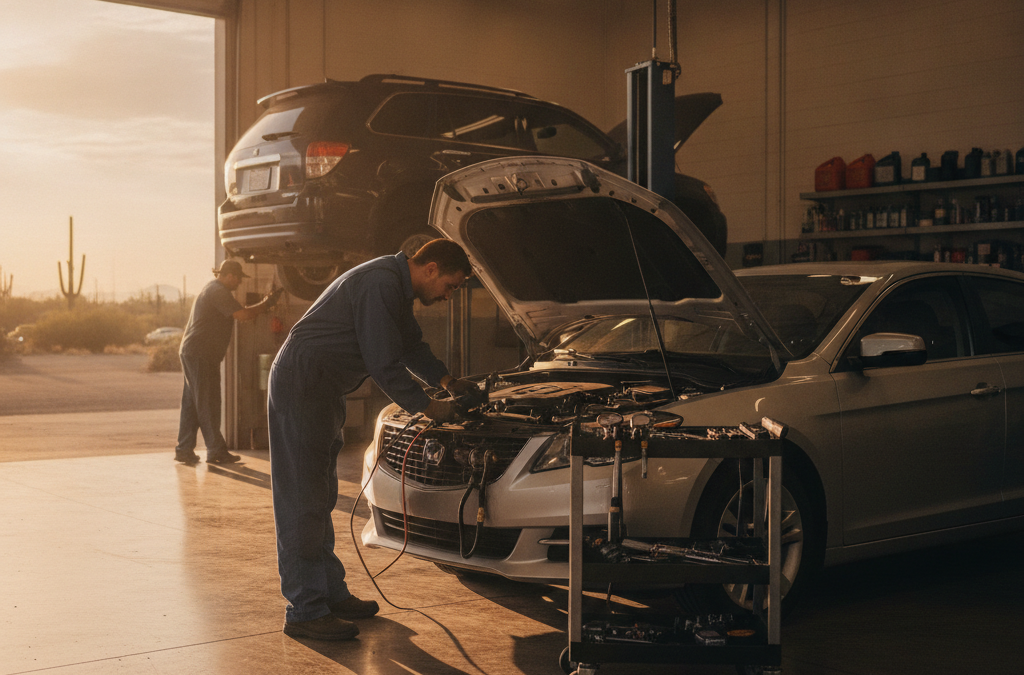
Why Is My Car’s AC Blowing Warm Air — and What Does It Cost to Fix in Surprise, AZ?
If you’ve climbed into your car on a July afternoon in Surprise and hit the AC button only to feel warm air blowing back at you, you already know the specific misery that moment brings. It’s not just uncomfortable — in a Phoenix West Valley summer, driving without a working AC can be genuinely dangerous, especially with kids or pets in the vehicle. The good news is that a car blowing warm air instead of cold usually comes down to one of a few fixable problems. Here’s how to understand what’s going on, what it’s likely to cost, and how to avoid getting overcharged at a shop that sees your desperation as an opportunity.
The Most Common Reasons Your Car AC Is Blowing Warm Air
Your car’s air conditioning is a pressurized loop. Refrigerant circulates through the system, changing states from gas to liquid and back, pulling heat out of your cabin air in the process. When something disrupts that loop — even slightly — you feel it immediately as warm air. Here are the most frequent culprits:
1. Low Refrigerant (Usually From a Leak)
This is the number-one cause of warm AC in Arizona. Refrigerant doesn’t burn off or evaporate with normal use — if your system is low, it means there’s a leak somewhere. A slow leak might take a year or two to show symptoms. A bigger one could leave you sweltering within weeks. Some shops will just recharge your refrigerant without looking for the source of the leak. That’s a short-term fix at best — the refrigerant will leak out again, usually before the next summer. At All Valley Car Care, we find the leak first, fix it, and then recharge the system so you’re not back in the same spot three months later.
2. A Failing or Failed AC Compressor
The compressor is the heart of your AC system. It pressurizes the refrigerant so the whole cycle can work. Compressors take a beating here in the desert because Arizona drivers run their AC for eight or more months out of the year — not the three or four months a driver in Minnesota might use it. That extra wear adds up fast. A failing compressor might start as inconsistent cold air — sometimes it blows cold, sometimes it doesn’t — before eventually giving out entirely. You might also hear a grinding or rattling noise from under the hood when the AC is on. Compressor replacement is one of the more expensive AC repairs, but ignoring it long enough can damage other components and make the bill even bigger.
3. A Clogged or Damaged Condenser
The condenser sits at the front of your vehicle, ahead of the radiator, and it’s responsible for releasing the heat your AC pulls from the cabin. If it gets clogged with debris from the road — and with all the construction dust and gravel kicking around on the Grand Ave corridor and throughout the West Valley, that happens more than you’d think — airflow gets restricted and the system can’t cool properly. Condensers can also get cracked or bent from road debris. Sometimes a condenser just needs a good cleaning. Other times it needs to be replaced. Either way, it’s a straightforward diagnostic job.
4. A Broken Cooling Fan
Your condenser needs a fan to push air through it when you’re sitting in traffic or moving slowly. If that fan stops working, your AC may blow fine on the highway (where airflow through the grille handles the job) but turn warm the moment you’re sitting at a light. If your AC only blows warm in stop-and-go traffic, this is a likely suspect.
5. Electrical Issues or a Bad AC Clutch
Sometimes the problem isn’t refrigerant or a mechanical part at all — it’s an electrical signal not reaching the compressor. The AC clutch engages the compressor when you turn the AC on. If it’s worn out or receiving a faulty signal, the compressor never kicks in and you get nothing but warm air. Diagnosing this correctly requires a shop with the right scan tools and someone who knows how to interpret what they’re seeing.
What AC Repair Actually Costs — and Why It Varies So Much
This is where a lot of drivers get frustrated, and honestly, it’s a fair frustration. You search online for “AC recharge cost” and see prices ranging from $80 to $800. Here’s why the range is so wide:
- A basic refrigerant recharge with no leak repair is a lower-cost service — but again, if there’s a leak, you’ll be back again.
- Finding and sealing a leak adds labor and possibly parts depending on where the leak is (a hose fitting is much cheaper to fix than a condenser or evaporator).
- Compressor replacement is the most involved job and the most expensive, partly because refrigerant has to be recovered, the old compressor removed, and the system evacuated and recharged after the new one goes in.
- Condenser or fan replacement falls somewhere in the middle.
What we’ll always do at our Surprise location is give you a written estimate before any work starts. No surprises, no approvals after the fact. You know what it costs and why before we touch anything.
Why Arizona’s Heat Makes This More Urgent Than It Would Be Elsewhere
In a place like Peoria or El Mirage where July temperatures regularly hit 115°F, a car interior sitting in the sun can reach 160°F or more within minutes. That’s not a discomfort issue — that’s a safety issue if you have children, elderly passengers, or pets. Beyond safety, extreme heat accelerates the wear on every rubber component in your AC system. Hoses, seals, and O-rings that might last a decade in a cooler climate often degrade significantly faster here. That’s why we see so many AC problems every summer — and why getting a small issue checked before it becomes a big one is worth doing sooner rather than later.
Drivers coming in from Sun City, Sun City West, and Goodyear often tell us they noticed the AC “wasn’t quite right” a few weeks before it stopped working entirely. That window between “not quite right” and “completely out” is the best time to bring the car in. Waiting until it’s fully failed almost always means a more expensive repair.
What Competitors’ Sites Miss: Diagnosing AC Problems Before You Recharge
Most local shop websites — and most quick-lube chains — talk about AC recharges as if that’s the whole service. They’ll advertise a low price for topping off your refrigerant, and that’s where the conversation ends. What they don’t explain is that a recharge without a leak check is like refilling a tire that has a nail in it. You’ve spent money and bought yourself a few weeks at best.
A proper AC diagnosis means checking system pressure, inspecting all the components visually, running the compressor under load, and using UV dye or electronic detection to find leaks you can’t see with the naked eye. That’s the service that actually solves the problem — not just masks it temporarily. All Valley Car Care’s full AC service includes exactly that kind of diagnostic work, not just a can of refrigerant and a handshake.
Frequently Asked Questions: Car AC Repair in the Phoenix West Valley
Can I just buy a DIY AC recharge kit from the auto parts store?
You can, but it comes with real risks. Those kits don’t tell you how much refrigerant is already in the system, so it’s easy to overcharge — which can damage the compressor. They also don’t find or fix the leak that caused the low refrigerant in the first place. For a temporary fix when you’re desperate, maybe. For actually solving the problem, no.
How long does an AC repair usually take?
A refrigerant recharge with leak check can often be done in a few hours. Compressor replacement is typically a half-day to full-day job depending on the vehicle. We’ll always give you a time estimate upfront so you can plan accordingly.
My AC blows cold in the morning but warm by afternoon. What does that mean?
This is a classic sign of a system that’s low on refrigerant or has a compressor that’s struggling under heat load. As the ambient temperature rises through the day and the system has to work harder, a marginal system gives out. It’s worth getting diagnosed before it stops working entirely.
Does my car’s AC warranty cover repairs at an independent shop?
If your vehicle is still under the factory powertrain warranty, AC components may or may not be covered — check your warranty documentation. If your car is out of warranty or you’re using an extended warranty, most independent repair shops including All Valley Car Care can work with those plans. Ask when you call. For work we perform, we back it with a 3-year/36,000-mile warranty, extendable to 5 years/60,000 miles.
Is a Glendale or Surprise location more convenient for me?
We have multiple locations to serve drivers across the Valley. If you’re closer to the East Valley or Northwest Phoenix, check our locations page to find the most convenient shop for you.
Get Your AC Looked At Before the Next Heat Wave Hits
If your car’s AC isn’t blowing as cold as it should, don’t wait until it quits entirely. The repair is almost always less expensive and faster when you catch it early — and in a Surprise summer, a working AC isn’t optional. Bring your car by All Valley Car Care and we’ll give you a straight answer about what’s wrong and what it costs to fix. No unnecessary repairs, no pressure, no hidden fees. Just an honest diagnosis and a written estimate before any work begins.
Ready to get it checked out? Contact us here to schedule your AC service — we’ll get you back to cold air fast.