
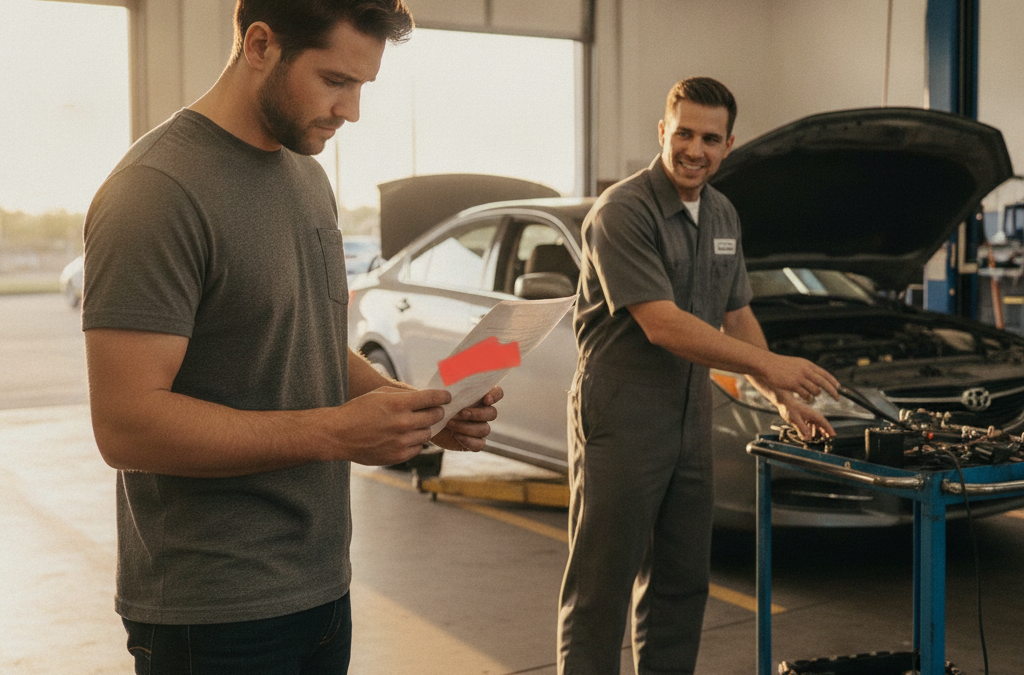
What Should You Do If Your Car Fails a Smog or Emissions Check in Peoria, AZ — and Can a Local Shop Help?
If you just got a failed emissions test result and you’re not sure what to do next, you’re not alone. It happens to a lot of drivers in Peoria, Surprise, and all across the Phoenix West Valley — and the good news is that a failed test almost always has a fixable cause. The frustrating part is figuring out exactly what that cause is and who you can trust to actually fix it without overcharging you. This article breaks down what Arizona’s emissions test actually checks, why cars commonly fail, and how a local repair shop can help you get a passing result without a runaround.
What Does Arizona’s Emissions Test Actually Check?
Arizona requires emissions testing in Maricopa County and a handful of other counties for most gasoline-powered vehicles from certain model years. When you pull into a test station, the technician plugs a reader into your car’s OBDII diagnostic port — a small connector usually located under the dashboard — and checks whether your vehicle’s onboard computer systems are all functioning and reporting clean. They’re not just checking tailpipe smoke the way older smog tests used to. They’re reading the data your car’s own computer is storing.
The test is looking at a handful of things: whether your check engine light is on, whether your emissions-related monitors have completed their self-tests, and whether any fault codes are stored in the system. If your check engine light is illuminated, the test automatically fails — no exceptions. That single detail trips up more drivers than almost anything else.
The Most Common Reasons Cars Fail the Arizona Emissions Test
There’s a short list of culprits that account for most failed tests across the Valley. Here’s what usually shows up:
- Check engine light is on. This is the most straightforward fail. Whatever triggered that light — an oxygen sensor, a loose gas cap, a misfiring cylinder — needs to be diagnosed and repaired before the car will pass.
- Emissions monitors not ready. Your car’s computer runs background self-tests on systems like the catalytic converter and evaporative emissions system. If those tests haven’t completed — which can happen after a battery was recently disconnected or replaced — the computer will show “not ready” and the test fails. This catches a lot of drivers off guard because their car feels fine and the check engine light isn’t on.
- Failed catalytic converter. The catalytic converter is the component that cleans your exhaust before it leaves the tailpipe. Arizona’s extreme heat, stop-and-go Phoenix traffic, and higher mileage can wear these out faster than in milder climates. A failing converter throws codes and often triggers the check engine light.
- Oxygen sensor failure. O2 sensors monitor exhaust gases and feed information to the engine’s fuel management system. A bad sensor throws off fuel mixture and emissions readings — and it’s one of the more common failure points in older vehicles.
- Evaporative emissions (EVAP) system leaks. The EVAP system captures fuel vapors and prevents them from escaping into the atmosphere. A cracked hose, faulty purge valve, or even a loose or damaged gas cap can cause the EVAP monitor to fail.
Why the “Drive It and Hope” Approach Usually Doesn’t Work
One thing a lot of drivers try is clearing the check engine light themselves — either by disconnecting the battery or using a cheap code reader — and then heading back to the test station hoping for the best. Here’s the problem: clearing the codes also resets all of your car’s emissions monitors to “not ready.” The state’s test will catch that immediately and fail you again, even if the underlying issue is temporarily masked.
To get your monitors back to a ready state, your car needs to go through what’s called a drive cycle — a specific pattern of highway and city driving that allows each system to run its self-tests and report back to the computer. That process can take anywhere from one drive to several days of normal driving, depending on your vehicle make and the specific monitors that need to reset. Some monitors are particularly stubborn.
The most reliable way to handle a failed emissions test is to have a shop pull the actual fault codes, identify what failed and why, fix the root cause properly, and then guide you through the readiness process before you go back to test. That’s exactly the kind of straightforward help you’ll get at All Valley Car Care in Surprise, which serves drivers throughout Peoria, El Mirage, Sun City, and the surrounding West Valley.
What the Repair Process Actually Looks Like
When you bring your car in after a failed emissions test, the first step is a proper diagnostic scan. A good shop will do more than just read the top-level code — they’ll look at live sensor data, freeze-frame readings, and monitor status to get a complete picture of what the system is telling them. That’s the difference between fixing the symptom and fixing the actual problem.
From there, the repair could be something minor — a new gas cap, a sensor replacement, a software update — or it could be more involved, like a catalytic converter replacement or EVAP system repair. You should always get a written estimate before any work begins. At All Valley Car Care, that’s standard practice — no surprises on the invoice, and no work done without your approval.
Once repairs are made, the shop can also help you understand what kind of driving your car needs to complete its readiness monitors. Some vehicles need a specific highway drive. Others need a cold start followed by a certain number of warm-up cycles. Knowing that ahead of time saves you a second wasted trip to the test station.
Does Arizona Have a Cost Assistance Program for Emissions Repairs?
It does. Arizona runs a Vehicle Emissions Repair Assistance Program (VERAP) that can help income-qualifying residents cover the cost of emissions-related repairs — up to a certain dollar amount — if your vehicle fails the test. If you’re driving an older vehicle and repair costs are a concern, it’s worth checking whether you qualify before assuming the fix is out of reach. A good local shop will be familiar with how the program works and can help point you in the right direction.
Why a Local Shop Beats a Quick-Lube Chain for Emissions Repairs
This is worth saying plainly: emissions repairs are diagnostic work. They require a technician who can read live data, trace fault codes to root causes, and make informed decisions about what actually needs to be fixed versus what a code reader is suggesting. Quick-lube chains and national franchise shops aren’t set up for that kind of work. They’re set up for volume — oil changes, filters, tires. When something complicated comes in, they either recommend a dealer or guess.
A local shop with ASE-certified technicians and proper scan tools — like the team at All Valley Car Care, serving drivers from Goodyear to Glendale since 2010 — is built for exactly this kind of diagnostic and repair work. You can see a full overview of what’s covered at the services page. The goal is always to tell you what’s actually wrong, fix it correctly, and get you back to passing without unnecessary add-ons.
Frequently Asked Questions: Emissions Test Failures in the Phoenix West Valley
Can I drive my car after it fails the emissions test?
Yes — a failed test doesn’t make your car illegal to drive immediately. You’ll have a set amount of time to make repairs and retest before your registration renewal is affected. Check your test documentation for the specific deadline and requirements in your situation.
How long do I have to fix my car after failing in Arizona?
Arizona typically gives you time to make repairs and return for a retest before your registration expires. The exact window depends on when your registration is due and when you tested. Don’t wait — the closer you get to your registration deadline, the fewer options you have.
Will replacing the battery cause me to fail the emissions test?
It can — and this surprises a lot of people. Disconnecting or replacing a battery resets your car’s emissions monitors to “not ready.” Before you go back for a retest, your car needs to complete a drive cycle to bring those monitors back to a ready state. A shop can confirm whether your vehicle is ready before you test again.
Is a catalytic converter replacement covered under any warranty?
Federal law requires vehicle manufacturers to cover catalytic converters under the emissions warranty for eight years or 80,000 miles on newer vehicles. If your car is still within that window, check with the dealer before paying for an aftermarket replacement. If it’s out of warranty, a local shop can install a quality replacement at a fair price.
What if I can’t afford the repairs needed to pass?
Look into Arizona’s VERAP program, which provides financial assistance for qualifying low-income residents who need emissions repairs. There are dollar limits and eligibility requirements, but it can meaningfully offset the cost. Ask the shop you’re working with — they should be able to tell you whether your repair qualifies.
Ready to Get Your Car to Pass? Let’s Figure Out What’s Going On.
A failed emissions test is fixable — you just need a shop that will diagnose it honestly, explain what needs to be done in plain language, and fix it right the first time. All Valley Car Care has been doing exactly that for drivers across Peoria, Surprise, Glendale, and the wider Phoenix West Valley since 2010. Our ASE-certified technicians use professional diagnostic equipment, provide written estimates before touching your car, and back their work with a 3-year/36,000-mile warranty — extendable to 5 years and 60,000 miles.
If you just failed your emissions test and aren’t sure where to start, reach out to us online or give us a call. We’ll tell you what we find, what it takes to fix it, and what it’s going to cost — before any work begins. No pressure, no unnecessary repairs, no surprises.