
Why Is Your Car Making a Grinding or Clicking Noise When You Turn — and What Does It Mean in Surprise, AZ?
That clicking sound when you back out of the driveway and turn the wheel — or the low grinding noise you hear rounding a corner — isn’t something to put off. For drivers in Surprise, AZ, those noises usually mean one of a handful of specific problems, most of which get worse (and more expensive) the longer you wait. The good news: most of them are very fixable once you know what you’re dealing with.
This article breaks down the most common causes of turning-related noises, how to tell them apart, and what your next step should be.
The Three Most Common Causes of Noise When Turning
Not all turning noises are the same, and the sound itself — along with when and where it happens — gives you a big clue about what’s going on.
1. A Worn or Failing CV Joint (That Clicking Sound)
If you hear a rhythmic clicking or popping when you turn — especially at low speeds while making sharper turns, like pulling into a parking lot or backing out of a garage — there’s a very good chance you’ve got a worn CV (constant velocity) joint. The CV joint is part of the axle shaft that transfers power from your transmission to your wheels. It’s designed to flex as you turn, but the rubber boot that protects it can crack or tear over time. Once the boot fails, the grease inside dries out, dirt and grit get in, and the joint starts to wear fast.
The classic tell: the clicking gets noticeably louder when you make sharp turns under power, and it goes quiet on a straight road. If you’re hearing this, especially on a front-wheel-drive car or SUV, have a shop look at the CV axle sooner rather than later. A torn boot caught early is a cheaper fix than a joint that’s worn out completely.
2. A Worn Wheel Bearing (That Grinding or Humming)
Wheel bearing noise tends to be more of a grinding or humming sound that changes depending on which direction you’re turning. If the noise gets louder when you turn right and quieter when you turn left (or vice versa), that’s a strong indicator of a failing wheel bearing on one side. The turning motion shifts weight load from one side to the other, which changes the stress on each bearing.
Wheel bearings on the Phoenix West Valley’s roads take a beating. Between the road construction along the Grand Ave corridor and the potholes that open up after monsoon season, hitting a good pothole at speed can start the clock ticking on a wheel bearing. A failed bearing won’t fix itself — and at highway speeds, a wheel bearing that’s far gone can become a safety issue.
3. Power Steering Issues (Whining or Groaning)
If the noise is more of a whine or groan — not a click or grind — and it happens mostly when the wheel is turned near its full range of motion (like a tight parking maneuver), the power steering system may be to blame. This could be low power steering fluid, a worn pump, or on newer vehicles with electric power steering, a failing motor or sensor. The desert heat in Surprise and surrounding areas like Peoria and El Mirage accelerates fluid breakdown and puts extra load on pumps that are already working hard in stop-and-go traffic.
What the Noise Sounds Like — and What That Tells You
- Rhythmic clicking or popping on sharp turns: CV joint — especially common on front-wheel-drive vehicles
- Grinding or humming that shifts with turn direction: Wheel bearing on the opposite side of where the noise gets louder
- Clunking when turning from a stop: Could be a worn tie rod end, ball joint, or sway bar link
- Whining at full steering lock: Power steering fluid low or pump wearing out
- Scraping or rubbing sound: Something in contact that shouldn’t be — could be a loose heat shield, debris, or a damaged splash guard
One of the gaps we’ve noticed on a lot of local repair shop websites is that they mention CV joints or wheel bearings in passing — but they don’t actually help you understand the difference between sounds or explain what accelerates these failures in a desert climate. That matters here, because the heat and road conditions in the greater Phoenix metro aren’t the same as what the national repair chains write their generic content for.
How Arizona Heat and Road Conditions Make This Worse
Rubber deteriorates faster in extreme heat. The CV boot — that accordion-shaped rubber sleeve protecting the joint — can crack, dry out, or split much sooner in a place that regularly sees 115°F summers than it would somewhere in the Midwest. The same goes for the rubber bushings in your front suspension: tie rod ends, ball joints, and sway bar links all rely on rubber components that take a beating in this climate.
Add to that the road conditions across the West Valley — the ongoing construction between Surprise and Peoria, the rough patches in Avondale and Goodyear near the freeway ramps — and your front-end components are absorbing impacts on a regular basis. That’s not a scare tactic. It’s just what it is out here.
The Surprise location at All Valley Car Care handles front-end diagnostics and drivetrain noise inspections regularly for drivers from the surrounding neighborhoods — including folks coming in from Sun City West and El Mirage who’ve been putting off that noise for a few weeks.
Is It Safe to Keep Driving?
That depends on which problem you have and how far along it is.
A CV joint that’s starting to click but still has all its grease? You probably have some time — but weeks, not months. One that’s already grinding or making noise even on straight roads is closer to failing completely, which can leave you unable to drive the vehicle.
A wheel bearing that’s in the humming stage is drivable for a while with care, but a bearing that fails completely can seize, and that’s a tow-truck situation — or worse if it happens at freeway speed.
Power steering noise is usually the most forgiving to wait on briefly, but if the pump fails suddenly, steering becomes very heavy and difficult, which is a real problem in traffic.
The honest answer: if you’re hearing any of these noises consistently, have someone look at it. A front-end inspection at a shop that does a proper visual and test drive doesn’t take long, and it tells you exactly where you stand.
What a Front-End Inspection Actually Covers
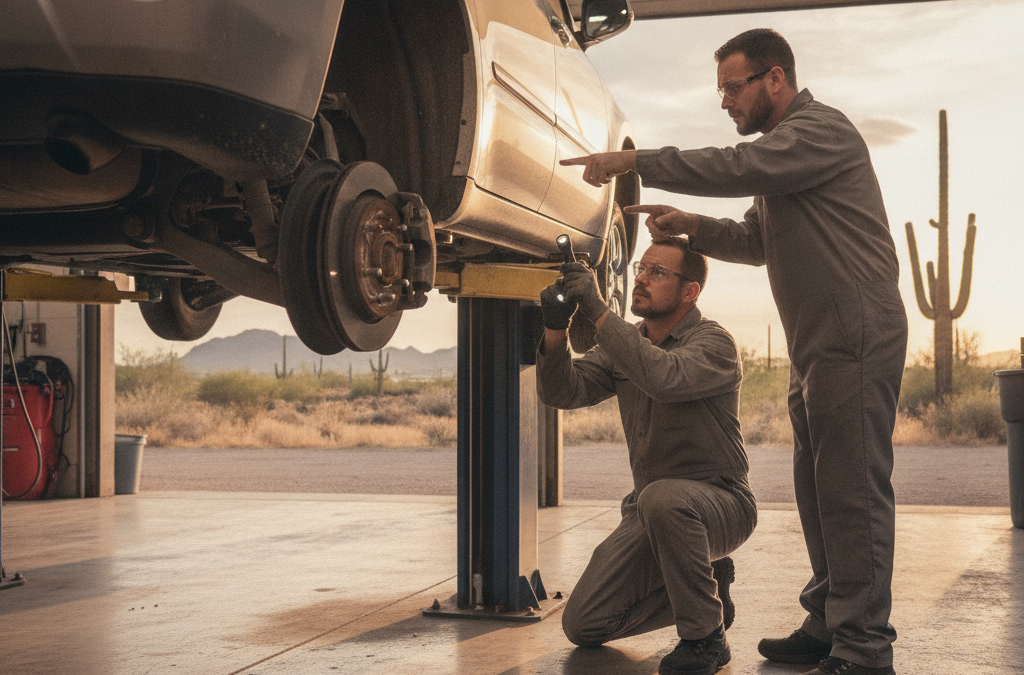
When you bring a car in with a turning noise, a good shop isn’t going to just take a guess. At All Valley Car Care, the process includes a road test to reproduce the noise, a visual inspection of the CV boots and axle shafts, a check of wheel bearing play and steering components, and a look at the power steering fluid level and condition. You’ll get a straight answer about what’s causing it — and a written estimate before any work is approved. No surprises, no pressure.
Check out our full list of services if you’re curious what else we cover during a comprehensive vehicle inspection.
Frequently Asked Questions
Is it expensive to fix a CV joint?
It depends on whether you catch it early or late. Replacing just the CV boot (if the joint itself is still in good shape) is significantly less expensive than replacing the entire axle shaft. Either way, it’s not a repair you want to put off too long — a failed CV axle can strand you, and if one side is worn, the other often isn’t far behind on older vehicles.
Can I drive from Glendale or Peoria to the Surprise shop with a clicking CV joint?
Usually yes, as long as the noise is just a mild click on turns and not a grinding sound or constant noise on straight roads. That said, call us first at (623) 243-6206 and describe what you’re hearing — we can give you a quick read on whether it makes sense to drive it in or if we should advise otherwise.
My car is only 4 years old. Can it really already have a bad CV joint or wheel bearing?
It’s less common on a newer car, but it happens — especially if you’ve hit a significant pothole or curb, or if a boot was damaged during a previous repair. Extreme heat also accelerates wear on rubber components. It’s always worth checking rather than assuming age alone rules it out.
What if my car is making a clunking sound when I turn, not a click or grind?
A clunk is usually a looser, more mechanical sound and often points to a worn ball joint, tie rod end, or sway bar end link rather than a CV joint. These are front suspension parts that allow the wheel to turn and absorb bumps. They’re very repairable, but loose ball joints in particular are something to take seriously because they affect steering control.
How long does a front-end noise inspection take?
Generally about 30–45 minutes for a proper inspection and road test. If we find something, you’ll get a written estimate before anything is touched. If nothing is wrong, we’ll tell you that too — and suggest what to watch for.
Hear Something? Don’t Guess — Get It Checked
Turning noises rarely fix themselves, and the longer most of these issues go, the more they cost to repair. Whether you’re commuting out of Surprise, hauling the family around in an SUV from Sun City West, or running a small fleet of work trucks between Avondale and Phoenix, a reliable front end isn’t optional.
All Valley Car Care has been serving the West Valley since 2010. ASE-certified technicians, a 3-year/36,000-mile warranty on qualifying repairs, and no unnecessary work — ever. Schedule your inspection online or call us directly at (623) 243-6206. We’ll tell you exactly what’s going on and what it will take to fix it.