
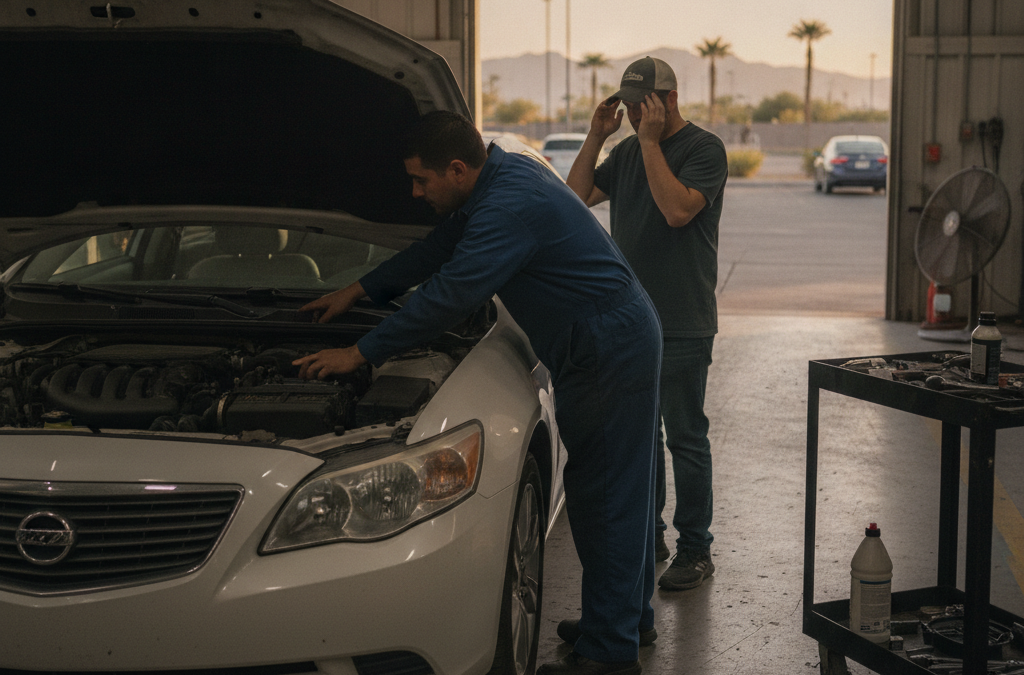
Why Is My Car Overheating in Stop-and-Go Traffic — and What Should You Do About It in Gilbert, AZ?
If your temperature gauge has been creeping toward the red every time you’re stuck in traffic on the 202 or crawling through a construction zone near Gilbert Road, you’re not imagining it. Overheating in slow traffic is actually a different problem than overheating at highway speeds — and in an Arizona summer, where ambient temperatures routinely hit 115°F or higher, it can do real damage in a short amount of time. The good news: there are usually a few clear culprits, and catching it early makes a big difference in what you’ll spend to fix it.
Why Stop-and-Go Traffic Makes Overheating Worse
When you’re moving at highway speeds, airflow through the front of your car helps cool the radiator passively. Slow down or stop completely, and that airflow disappears. At that point, your car depends almost entirely on its electric cooling fan to pull air through the radiator and keep coolant temperatures in a safe range.
If that fan isn’t spinning fast enough — or isn’t spinning at all — heat builds up quickly. In most climates, a sluggish fan is an inconvenience. In the Valley of the Sun in July or August, it’s an emergency waiting to happen. The same traffic jam that’s mildly annoying in Tempe or Chandler can cook a cooling system that’s already running on borrowed time.
The Most Common Causes of Overheating in Traffic
1. A Failing Electric Cooling Fan
This is the most common culprit when a car runs fine on the freeway but overheats in traffic. The fan motor may be weakening, the relay controlling it might be failing, or a sensor that tells the fan when to kick on could be sending the wrong signal. Sometimes the fan spins but not fast enough to do the job. A quick diagnostic check can identify exactly which part in that chain is failing — you don’t have to guess.
2. Low or Contaminated Coolant
Coolant breaks down over time. Old coolant loses its ability to transfer heat efficiently, and if the level drops due to a small leak you haven’t noticed yet, there’s simply not enough fluid to absorb and carry heat away from the engine. In Arizona’s heat, coolant degrades faster than it would in a milder climate, so if you can’t remember the last time yours was flushed, that’s worth checking.
3. A Stuck or Failing Thermostat
The thermostat controls when coolant flows from the engine to the radiator to be cooled. If it sticks in a partially closed position, it restricts that flow — especially under the heavy thermal load of sitting in traffic. A stuck thermostat is an inexpensive part, but if it’s left unchecked, the overheating it causes is not inexpensive to fix.
4. A Clogged or Damaged Radiator
Over time, radiators accumulate debris, and the internal passages can become restricted. If yours has taken a rock chip or a small bend from road debris — something that happens regularly on Phoenix-area construction roads — airflow through the radiator fins gets reduced. Combined with Arizona heat, even a partially clogged radiator can struggle to keep up in bumper-to-bumper traffic.
5. A Weak Water Pump
The water pump circulates coolant through the engine and radiator. If the impeller inside is worn or the pump is starting to fail, circulation slows — and at low engine RPMs (like when you’re idling at a red light), circulation is already at its minimum. A worn pump makes everything worse exactly when you need it most.
What to Do Right Now If Your Temperature Gauge Spikes
If you’re in traffic and your gauge is climbing toward the red zone, here’s what to do in that moment:
- Turn off the AC immediately. Your AC compressor puts a significant load on the engine, which generates more heat. Cutting it off reduces stress on the cooling system right away.
- Turn on the heat — yes, really. It feels counterintuitive, but switching your heater to full blast with the fan on high draws heat out of the engine and into the cabin. It’s uncomfortable, but it buys you a few minutes.
- If the gauge keeps climbing, pull over safely and turn off the engine. Do not keep driving. A few minutes of overheating can warp a cylinder head or crack an engine block, turning a few-hundred-dollar repair into a several-thousand-dollar one.
- Never open the radiator cap when the engine is hot. Wait at least 30 minutes after shutting off the engine. Pressurized coolant can cause serious burns.
- Call for a tow if needed. It’s not worth gambling on making it home.
Why This Specific Problem Gets Overlooked — and What Competitors Don’t Tell You
A lot of general auto repair content talks about overheating in broad strokes: check your coolant, check your radiator, and so on. What’s rarely spelled out is that overheating specifically in slow traffic points to a different set of causes than overheating at highway speeds or under heavy load. If your car runs fine at 65 mph but starts climbing at a stoplight, the cooling fan circuit is the first place to look — not the radiator cap or the coolant level, though those matter too.
That distinction matters because it changes what a shop should be testing and in what order. A good diagnostic approach starts with the fan — checking that it operates at multiple speeds, that the relay and sensor are functioning, and that there are no wiring issues — before moving on to more involved components. If a shop skips that and jumps straight to recommending a new radiator, it’s worth asking why.
At All Valley Car Care, we run computerized diagnostics alongside a physical inspection so we’re not guessing at causes. You’ll get a straight answer about what’s actually failing before any work is authorized. See the full list of cooling system and diagnostic services we offer.
Families and Commuters: Don’t Wait on This One
If you’re driving kids to school or making a daily commute between Gilbert and Chandler or Mesa, an overheating problem in summer is not a “I’ll get to it next month” situation. The greater Phoenix metro’s road construction — between the ongoing freeway expansions and arterial road projects — means stop-and-go traffic is a daily reality, not just a rush-hour inconvenience. Your cooling system is working harder here than it would almost anywhere else in the country, and when it starts showing signs of strain, the window between early warning and serious damage is shorter than most people expect.
If you’ve been noticing the temperature gauge climb and then come back down, don’t take that as a sign the problem resolved itself. It usually means the system is on the edge — managing for now, but not reliably. Get it looked at before it leaves you on the side of the road in 110-degree heat.
Our Surprise location serves drivers across the West Valley, and our Glendale location is convenient for folks coming in from the east side of the Valley too.
Frequently Asked Questions
How do I know if my cooling fan is the problem and not something else?
The clearest sign is that your car overheats in traffic or at idle but stays cool at highway speeds. At higher speeds, ram airflow compensates for a weak or failed fan. If the pattern matches, a cooling fan diagnosis should be the first step — not a full cooling system teardown.
Can I drive my car to the shop if it overheated once but seems fine now?
Sometimes, yes — but call the shop first and describe exactly what happened. If the gauge went deep into the red or you saw steam, you should have the car towed rather than risk additional overheating on the way in. A single brief spike that resolved quickly is lower risk, but it still needs to be diagnosed promptly.
How much does it cost to fix an overheating problem?
It depends heavily on the cause. A faulty cooling fan relay might be a minor repair. A water pump or thermostat replacement is moderate. A damaged radiator or head gasket issue costs more. The only way to know is a proper diagnosis — we’ll tell you exactly what’s wrong and what it costs to fix it before we touch anything. No surprises on the bill.
Does the Arizona heat really make overheating more likely?
Yes, significantly. Your cooling system is designed to maintain engine temperature within a safe range. When ambient air is already 115°F, the system has far less margin to work with. Components that might last another year in a cooler climate can fail quickly here. That’s true of cooling fans, water pumps, hoses, and the coolant itself.
My car is overheating and it’s a newer model — should I take it to the dealership instead?
Not necessarily. ASE-certified independent shops like All Valley Car Care work on all makes and models, including newer domestic and European vehicles. If your car is still under manufacturer warranty and the failure might be covered, check with the dealer first. Otherwise, an independent shop will often diagnose and repair the same problem faster and at a lower cost, with no pressure to add services you don’t need.
Get It Checked Before the Heat Makes It Worse
A temperature gauge that spikes in traffic is your car telling you something specific. In Gilbert, Peoria, or anywhere else in the Phoenix metro, ignoring that signal in the middle of summer is a gamble that rarely pays off. We’ve been serving Valley drivers since 2010, and we’ll tell you exactly what’s wrong, what it costs, and what actually needs to be fixed — nothing more.
Schedule a cooling system inspection at All Valley Car Care and get a straight answer before a minor problem turns into an engine repair bill.