
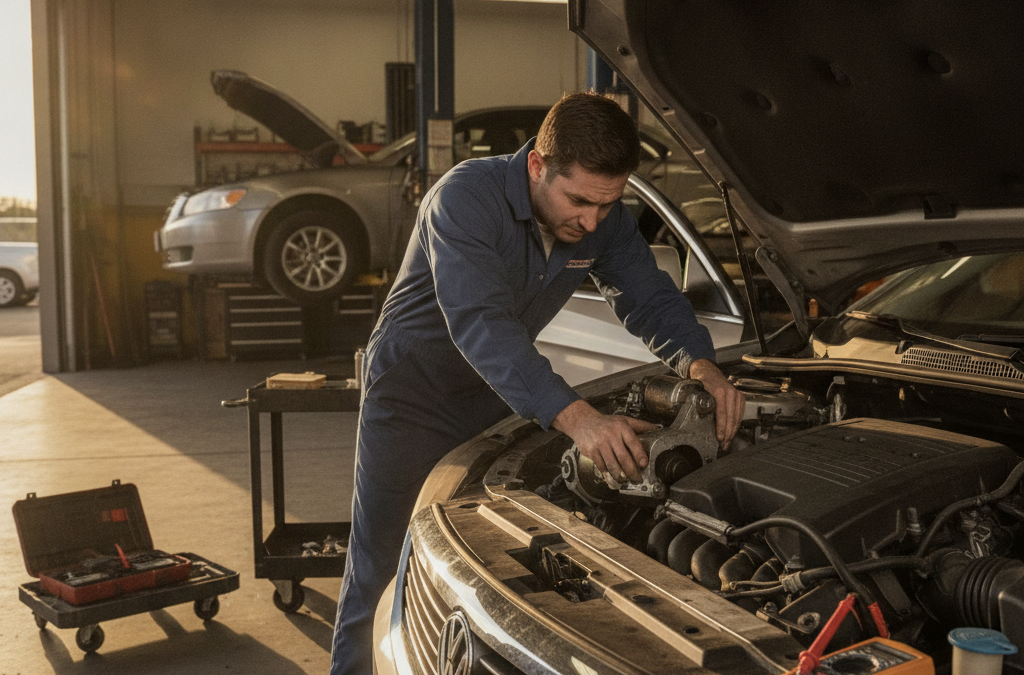
How Do You Know If Your Car’s Starter Is Failing — and What Does It Cost to Fix in Glendale, AZ?
You walk out to your car on a Tuesday morning — maybe you’re already running a little late — turn the key, and instead of the engine firing up, you get a rapid clicking sound. Or worse, complete silence. That moment is instant dread. Before you start assuming the worst, there’s a good chance your starter motor is the culprit. In Glendale and across the Phoenix West Valley, starters take a beating from the heat and don’t always fail with much warning. Here’s how to recognize the signs, what causes them to go out, and what a fair repair should actually cost you.
What Does a Starter Motor Actually Do?
The starter is an electric motor that gets your engine spinning fast enough to fire on its own. When you turn the key or push the start button, the battery sends power to the starter, which engages a small gear (the pinion) against your engine’s flywheel. That brief spin is all it takes to get combustion going. Once the engine’s running, the starter disengages and stays quiet until you need it again.
It’s a simple job, but it’s a high-stress one — especially in a place like the greater Phoenix metro, where heat accelerates wear on every electrical component in your vehicle.
Signs Your Starter Is Going Out
Starter problems tend to show up in a few recognizable ways. Here’s what to watch — and listen — for:
- A rapid clicking sound when you turn the key. This is the most common starter symptom. One single click usually points to a dead battery. A fast series of clicks — click-click-click-click — is often the starter solenoid trying and failing to engage.
- Nothing happens at all. You turn the key or press the button, and the car is completely silent. The dashboard lights may be on, but nothing cranks. This can be the starter, a bad battery connection, or a failed starter relay.
- Grinding noise when starting. If you hear a harsh grinding sound during startup, the starter’s pinion gear may be worn or not engaging the flywheel correctly. Ignoring this can damage your flywheel — a much more expensive fix.
- The engine cranks slowly or intermittently. Sometimes the starter works, but it sounds labored. The engine turns over sluggishly before starting — or it only starts on the second or third attempt.
- Smoke or a burning smell. If the starter is getting too much power — or if it’s being operated continuously — it can overheat. A burning smell near the engine bay is a warning you shouldn’t ignore.
Why Starters Fail Faster in Arizona
Here’s something a lot of drivers don’t realize: starters in Phoenix, Glendale, Peoria, and surrounding areas tend to wear out faster than the national average. The extreme heat — we’re talking 115°F summers and engine bays that get even hotter — degrades the internal windings and solenoid contacts inside the starter over time. Add in the fact that Arizona’s heat is also hard on batteries, and you get a double problem: a weakened battery forces the starter to work harder every single time you start the car, wearing it down faster.
In milder climates, a starter might last 100,000 to 150,000 miles without issue. Out here in the Valley of the Sun, it’s not unusual to see starters fail significantly earlier, especially on vehicles that have been sitting in the heat for extended periods — like a second car or a vehicle parked outside all summer in Sun City or El Mirage.
Starter vs. Battery: How Do You Tell the Difference?
This is the question that trips up a lot of drivers — and unfortunately, it’s where some shops take advantage. A dead battery and a bad starter can look almost identical from the driver’s seat. Here’s a simple way to think about it:
- If your car won’t start but the lights, radio, and accessories all work fine, the battery likely has enough charge — the starter may be the issue.
- If everything is dim or dead — no lights, no radio, nothing — the battery is the more likely culprit.
- If you jump-start the car and it runs fine but won’t restart once you shut it off, your battery may be failing (or your alternator isn’t recharging it properly).
- If jump-starting does nothing and you still get clicks or silence, the starter itself is a strong suspect.
The right answer is a proper diagnostic, not guesswork. A shop should test your battery, check the charging system, and inspect the starter circuit before recommending any parts. At All Valley Car Care’s Glendale location, we run computerized diagnostics to pinpoint the actual failure — so you’re not replacing parts that don’t need replacing.
What Does Starter Replacement Actually Cost?
Starter replacement is one of those repairs where the cost varies quite a bit depending on your vehicle. Here’s a realistic breakdown:
- Labor: Starter access varies by engine layout. On some vehicles it’s straightforward; on others the starter is buried under intake components or requires partial disassembly. Plan for one to two hours of labor in most cases.
- Parts: Starter motors range from relatively affordable on common domestic trucks and SUVs to significantly more on European imports or certain hybrid systems. Remanufactured starters are a legitimate option and often come with a warranty — a good shop will discuss both new and reman options with you.
- Total cost range: Most starter replacements in the Phoenix area run somewhere between $250 and $600 all in, depending on vehicle make, model, and accessibility. Some vehicles — particularly luxury imports — can run higher.
Any shop should be willing to give you a written estimate before touching anything. If they won’t, walk out. At All Valley Car Care, you always get a written estimate upfront — no surprises on the final bill.
What Competitors’ Sites Often Get Wrong About This Topic
If you’ve searched around for starter repair info from local shops in the West Valley, you’ve probably noticed most shop websites say almost nothing useful about it. They might list “electrical repair” as a service, but there’s no guidance on how to tell if it’s actually the starter, how the desert heat plays a role, or what a fair price looks like. That leaves drivers guessing — or worse, trusting the first shop that tells them they need a $900 repair without explanation.
This is exactly why it matters to work with a shop that explains what they found and why a repair is needed before they do anything. You should never feel pressured or confused walking out of an auto shop. See our full list of services to understand what we cover and how we approach every repair.
Can You Drive with a Failing Starter?
Technically, once the engine is running, a bad starter doesn’t affect how the car drives. The problem is getting it started in the first place. A starter that’s on its way out might work fine one day and leave you stranded the next — often at the worst possible time, like a parking lot in 110°F heat. If you’re noticing intermittent starting issues, don’t wait for a complete failure. Get it looked at while you still have a choice about when and where.
Frequently Asked Questions: Starter Repair in the Phoenix West Valley
How long does starter replacement take?
Most starter replacements take one to two hours at the shop. Some vehicles with difficult starter placement may take a bit longer. We’ll let you know before we start what to expect on your specific vehicle.
My new battery died again shortly after I installed it. Could the starter be the cause?
Not directly — but a failing starter that draws excessive current can stress a battery. More likely, if a new battery keeps dying, the alternator isn’t properly recharging it. We check the full charging system whenever a customer comes in with repeated battery issues.
Is it safe to try jumping a car with a bad starter?
If the issue is truly the starter (not the battery), jump-starting won’t help — there’s no charge problem to fix. Repeated attempts to crank a failing starter can overheat it and cause additional damage.
How long should a starter last in Arizona?
In cooler climates, starters often last the life of the vehicle. In the Phoenix area, expect more like 80,000 to 120,000 miles depending on how hard the heat has been on the rest of your electrical system. Vehicles regularly parked outside in full sun tend to see shorter component life across the board.
Can I replace a starter myself?
It’s possible on some vehicles, but it involves working around high-current electrical connections and tight engine bay access. An incorrect installation can damage the flywheel or cause an electrical short. For most drivers, this is one where the peace of mind from a professional install — and a warranty on the work — is worth it.
Don’t Get Left Stranded — Get It Checked Before It Fails Completely
A starter that’s acting up doesn’t always give you a lot of warning. If you’ve heard that clicking sound once or twice and brushed it off, it’s worth getting it diagnosed before it leaves you sitting in a parking lot in July with no options. At All Valley Car Care, we’ve been serving drivers across Glendale, Surprise, Peoria, Phoenix, and the surrounding West Valley since 2010 — with straightforward diagnostics, honest recommendations, and a 3-year/36,000-mile warranty on repairs (extendable to 5 years/60,000 miles).
No unnecessary repairs. No hidden costs. Just an honest answer about what’s actually wrong and what it will take to fix it. Contact us or schedule your appointment online — we’ll take a look and tell you exactly what’s going on.