
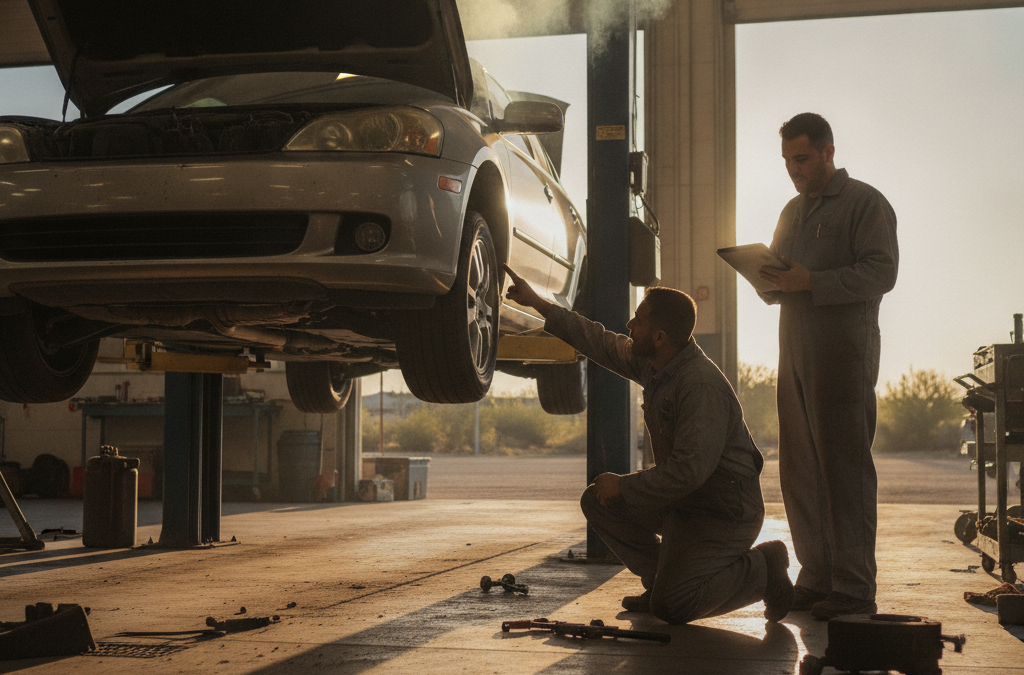
How Do You Know If Your Car’s Catalytic Converter Is Failing — and What Does It Cost to Fix in Surprise, AZ?
If your car suddenly smells like rotten eggs, feels sluggish when you accelerate, or your check engine light just came on out of nowhere, your catalytic converter might be to blame. It’s one of those parts most drivers never think about — until it fails. And in Surprise, where most of us put serious miles on our vehicles commuting across the West Valley, a struggling catalytic converter can go from annoying to expensive in a hurry. Here’s what you need to know: what it does, how to tell when it’s going bad, what it actually costs to fix, and how to avoid getting overcharged.
What Does a Catalytic Converter Actually Do?
Your catalytic converter sits in the exhaust system between the engine and the muffler. Its job is to convert the harmful gases your engine produces — things like carbon monoxide and hydrocarbons — into less harmful emissions before they exit the tailpipe. It’s been required on vehicles in the U.S. since the mid-1970s, and Arizona takes emissions compliance seriously, especially if you’re driving in Maricopa County where smog checks apply to many vehicles.
Inside the converter is a honeycomb-like structure coated with precious metals — platinum, palladium, and rhodium — that trigger the chemical reactions that clean up exhaust gases. That precious metal content is also exactly why catalytic converter theft has become such a widespread problem across the Phoenix metro area, including neighborhoods in Surprise, Peoria, and Glendale. But more on that in a moment.
Warning Signs Your Catalytic Converter Is Failing
A catalytic converter doesn’t usually fail overnight. It tends to degrade gradually, and the warning signs build up over time. Here’s what to watch for:
- Rotten egg or sulfur smell from the exhaust. This is the most recognizable symptom. A healthy catalytic converter converts hydrogen sulfide into odorless sulfur dioxide. When it’s failing, that conversion breaks down and you get that unmistakable smell.
- Check engine light. The oxygen sensors upstream and downstream of the converter monitor its efficiency. When the converter isn’t doing its job, you’ll often see codes like P0420 or P0430 — both of which indicate catalyst efficiency below threshold.
- Sluggish acceleration or poor engine performance. A clogged or damaged converter creates backpressure in the exhaust, which chokes your engine. You might notice it especially when merging onto the Loop 303 or trying to accelerate at highway speeds.
- Rattling noise from under the car. If the internal honeycomb structure has broken apart, you’ll hear a metallic rattling, especially at startup or during acceleration. This is typically a sign that replacement is unavoidable.
- Failed emissions test. If your car fails a smog check in Maricopa County, a failing catalytic converter is often the culprit. You won’t be able to renew your registration until it’s fixed.
- Reduced fuel economy. A struggling converter can indirectly hurt your gas mileage as the engine works harder to compensate for restricted exhaust flow.
If you’re seeing more than one of these symptoms at the same time, don’t wait it out. A proper computerized diagnostic scan will pull the trouble codes and tell you what’s actually going on — so you’re not guessing or replacing parts you don’t need.
What Causes a Catalytic Converter to Fail?
Catalytic converters are built to last — typically 100,000 miles or more under normal conditions. But a few things can shorten that lifespan significantly, and some of them are common here in the Phoenix West Valley.
- Oil or coolant burning. If your engine is burning oil due to worn rings or valve seals, or if coolant is leaking internally from a failing head gasket, those contaminants coat and destroy the converter’s internal substrate over time.
- Rich fuel mixture. If your engine is running too rich — too much fuel, not enough air — unburned fuel enters the converter and can overheat and damage it. This often traces back to a failing oxygen sensor or fuel injector issue.
- Physical damage. Arizona’s road construction is relentless. Between potholes, unpaved shoulders, and debris, catalytic converters on lower-clearance vehicles take a beating from road impact damage.
- Age and heat cycling. Our desert summers are brutal on exhaust components. The constant heating and cooling cycles that come with 115°F+ summers and extended stop-and-go commutes accelerate wear on the converter’s internal structure.
- Theft. Increasingly, the symptom isn’t a slowly failing converter — it’s a missing one. If you start your car and it suddenly sounds like a loud, roaring muscle car with no muffler, check underneath. Catalytic converter theft is a real problem across the Phoenix area, and Surprise, El Mirage, and Sun City residents have not been immune.
What Does It Cost to Replace a Catalytic Converter in Surprise?
This is where a lot of drivers get a shock, and it’s worth being straightforward about it. Catalytic converter replacement is one of the more expensive repairs you’ll encounter, and the cost varies widely based on your vehicle.
For most cars and trucks, you’re generally looking at somewhere between $800 and $2,500 or more for parts and labor combined. The range is wide because the part itself is the biggest cost driver — and that price depends heavily on your make and model. A converter for a Honda CR-V is very different in cost from one for a Toyota Tundra or a Ford F-250. Vehicles with multiple converters (like many V6 and V8 trucks and SUVs) can run higher.
A few things worth knowing:
- OEM vs. aftermarket: Original equipment manufacturer (OEM) converters are built to your vehicle’s exact specs. Quality aftermarket converters are a legitimate and often more affordable option — but not all aftermarket parts are equal. A shop worth trusting will explain the difference and let you make an informed choice.
- California-compliant vs. federal: Some vehicles require a CARB-compliant (California Air Resources Board) catalytic converter, even in Arizona. If your car originally came equipped with a CARB-compliant unit, replacing it with a federal-only converter can cause it to fail a smog check even after the repair.
- Underlying causes matter: If something else caused your converter to fail — like burning oil or a bad oxygen sensor — replacing the converter without fixing the root cause means you’ll be replacing it again sooner than you’d like. A good diagnostic scan before replacement can catch this.
At All Valley Car Care, we give you a written estimate before any work starts. No surprises, no pressure. If the diagnostic points to something you need to be aware of, we’ll tell you — and let you decide. See our full range of repair and diagnostic services here.
Catalytic Converter Theft: What West Valley Drivers Need to Know
This is a topic that most local auto repair shops’ websites barely touch — but it’s something we hear about from customers regularly, especially in the Surprise, Glendale, and Peoria areas. Catalytic converter theft takes less than two minutes with a reciprocal saw, and the stolen converter can be sold to a scrap yard for the precious metals inside.
Trucks and SUVs with higher ground clearance are the easiest targets because the converter is more accessible. Toyota Priuses are among the most frequently stolen because their converters have a higher concentration of precious metals and retain value longer. If you drive a truck or hybrid in the West Valley, it’s worth being aware.
If your converter is stolen, you’re looking at the same replacement costs as above — but your comprehensive auto insurance may cover it, minus your deductible. Check your policy. In the meantime, you can’t legally drive the vehicle because it won’t pass emissions and the exhaust noise alone will get you pulled over.
Should You Ever Skip the Repair?
Technically, a car with a failing catalytic converter will still run. But in Maricopa County, you won’t pass your emissions test, which means you can’t renew your registration. Beyond the legal issue, ignoring a failing converter can eventually lead to engine damage from backpressure, and it won’t fix the underlying issue that caused the failure in the first place. It’s not a repair you can defer indefinitely.
If a shop is recommending catalytic converter replacement based solely on a P0420 code without a thorough diagnostic, that’s worth questioning. That code can sometimes be triggered by a failing oxygen sensor — a much cheaper fix. A shop that skips the diagnostic and jumps straight to replacing the converter may not be looking out for your wallet. Our Surprise location always starts with a full diagnostic before recommending any major repair.
Frequently Asked Questions
Can I drive with a bad catalytic converter?
For short distances, yes — a failing converter won’t immediately leave you stranded. But a severely clogged converter can cause the engine to stall or overheat, and you’ll likely fail your next emissions test. It’s not a repair to put off for long.
Will a bad catalytic converter always trigger the check engine light?
Usually, yes. The oxygen sensors that monitor converter efficiency will typically trigger a P0420 or P0430 code when efficiency drops below the acceptable threshold. But early-stage failure may not show up immediately — which is why other symptoms like a sulfur smell or rattling shouldn’t be ignored even if the light isn’t on yet.
Does insurance cover catalytic converter theft in Arizona?
Comprehensive auto insurance typically covers catalytic converter theft, but it depends on your policy and your deductible. Contact your insurance provider right away if your converter has been stolen. A police report is usually required to file a claim.
How long does catalytic converter replacement take?
For most vehicles, the actual replacement takes one to three hours in the shop. If there are rusted or seized bolts (common on older vehicles), it can take longer. We’ll give you an honest timeline estimate when you drop the car off.
Does a new catalytic converter come with a warranty?
At All Valley Car Care, our repairs are backed by our 3-year/36,000-mile warranty, with options to extend to 5 years/60,000 miles. We’ll walk you through what’s covered before any work begins.
Ready to Get It Diagnosed the Right Way?
If your check engine light is on, your exhaust smells off, or your car just doesn’t feel like it used to on the highway, don’t guess — and don’t let a shop guess either. A proper computerized diagnostic is the right starting point, and it protects you from paying for a repair you might not need.
All Valley Car Care has been serving drivers in Surprise and across the Phoenix West Valley since 2010. We’re ASE-certified, we give written estimates, and we won’t recommend a repair unless it’s actually needed. Contact us or schedule your diagnostic appointment here — and let’s figure out what’s actually going on with your car.