
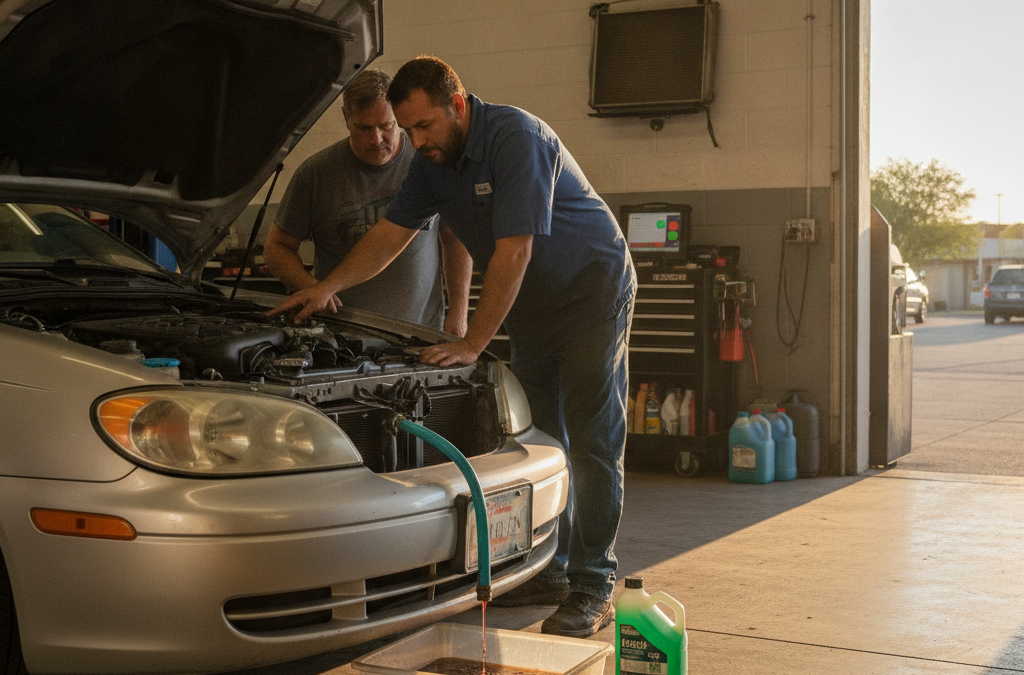
How Do You Know If Your Car’s Coolant Needs to Be Flushed — and What Happens If You Skip It in Surprise, AZ?
If your coolant hasn’t been changed in the last few years, there’s a decent chance it’s no longer doing its job — and in Surprise, AZ, where summer temperatures routinely hit 115°F and your engine is fighting that heat every single day, degraded coolant is one of the fastest paths to a blown head gasket or a cracked radiator. The good news: a coolant flush is one of the more affordable maintenance services on the list. The bad news: most drivers wait until something breaks before they think about it.
Let’s walk through what coolant actually does, how to tell when it needs to be replaced, and why Arizona’s climate means you probably shouldn’t wait as long as your owner’s manual says.
What Does Coolant Actually Do?
Your engine generates an enormous amount of heat — enough to destroy itself within minutes if nothing carried that heat away. Coolant (also called antifreeze) circulates through the engine, absorbs that heat, carries it to the radiator where it gets dissipated into the air, and then cycles back to do it again.
But coolant does more than just carry heat. It also contains corrosion inhibitors that protect the metal surfaces inside your engine, radiator, water pump, and heater core. Those inhibitors break down over time. When they’re gone, the coolant becomes acidic — and acidic coolant starts eating your cooling system from the inside out. Rust, scale, and sludge build up. Water pump seals fail early. Radiator hoses degrade faster. And eventually, you’re looking at a repair bill that’s ten times what the flush would have cost.
How Often Should You Flush Your Coolant in the Phoenix West Valley?
The typical manufacturer recommendation is every 30,000 miles or every two to five years, depending on whether your car uses conventional green coolant or a longer-life formula (usually orange, pink, or blue). But those intervals were written for average driving conditions — and there’s nothing average about running your engine in 115-degree heat for eight or nine months a year.
In the Phoenix West Valley, the cooling system works overtime. Whether you’re commuting on the 303 from Surprise into Peoria, sitting in stop-and-go traffic on Grand Ave, or running errands across El Mirage and Youngtown, your engine spends a lot of time running hot. That thermal stress breaks down coolant chemistry faster than milder climates would. Many mechanics in the Valley — including our team at All Valley Car Care — recommend checking coolant condition every 24 months and not pushing past 30,000 miles regardless of coolant type.
Signs Your Coolant Is Ready for a Flush
You don’t have to wait until a dashboard light tells you something’s wrong. Here are the most common signs that your coolant is overdue:
- Coolant that looks brown, rusty, or murky. Fresh coolant is bright green, orange, or pink depending on the type. If it looks like dirty coffee, it’s acidic and contaminated. This is the biggest red flag.
- A sweet smell coming from under the hood or inside the cabin. Coolant has a distinct sugary odor. If you smell it, you may have a small leak or a heater core issue — and it’s worth having both checked at the same time as the flush.
- The temperature gauge creeping higher than usual. If your engine is running warmer than it used to, degraded coolant or a partially clogged radiator could be the culprit.
- Visible gunk or debris in the overflow reservoir. Pop the hood and take a look at the coolant reservoir. If you see floating particles or a sludgy residue on the inside of the cap, the coolant is well past due.
- You can’t remember the last time it was flushed. If you’ve owned the car for three or four years and it’s never come up at a service appointment, it’s probably time.
What Happens If You Skip the Flush?
This is where the real cost conversation starts. A coolant flush at a shop like ours typically runs in the range of $100–$175 for most cars and light trucks — a price that includes draining the old fluid, flushing the system, refilling with fresh coolant, and checking hoses and the radiator cap while we’re in there. It’s a straightforward service that takes less than an hour.
Skipping it can lead to:
- Water pump failure — corrosive coolant destroys the pump’s internal seals and bearing. Replacement typically costs $300–$600 or more depending on the vehicle.
- Radiator damage — scale buildup restricts flow and causes leaks. A new radiator can run $400–$900 installed.
- Head gasket failure — this is the one everyone dreads. When the cooling system can’t keep up and the engine overheats repeatedly, the head gasket often pays the price. Repair can run $1,500–$2,500 or higher.
- Heater core clogs — not a big deal in Surprise’s summers, but when the desert does cool down in January, you’ll notice when there’s no heat.
None of those repairs are fun. More importantly, none of them are necessary if the cooling system gets basic attention on schedule.
What’s Included in a Coolant Flush — and What Should You Ask For?
A real coolant flush isn’t just a drain-and-fill. Here’s what a thorough service should include:
- Draining the entire cooling system, not just the reservoir
- Flushing the system with a cleaning agent to remove scale and deposits
- Inspecting radiator hoses, clamps, and the radiator cap for wear
- Checking the water pump for leaks or play in the bearing
- Refilling with the correct coolant type for your specific vehicle
- Testing the new coolant’s freeze/boil protection with a refractometer
When you bring your car in, ask if the flush includes a hose inspection. Rubber hoses deteriorate faster in desert heat, and a cracked hose on a freshly flushed system can still leave you stranded on the side of the road in Sun City West or Goodyear. It’s worth the extra two minutes to look.
At All Valley Car Care, we give you a written estimate before we touch anything. If we find something that needs attention — a soft hose, a weeping radiator cap, a small drip at a fitting — we’ll show you and explain it. No pressure, no surprises. You decide what gets done. Learn more about the full range of services we offer at our auto repair and maintenance services page.
Does the Type of Coolant Matter? (Yes, and Here’s Why)
This is one of those details that a lot of quick-lube shops gloss over, and it’s actually important. Using the wrong coolant type — or mixing different types — can accelerate the very corrosion the coolant is supposed to prevent. Most modern vehicles require a specific formulation: HOAT, OAT, or NOAT, depending on the manufacturer. European vehicles and many newer Asian imports are particularly sensitive to this.
The bottle at the parts store that says “universal” or “all makes and all models” should be approached with caution. If you’re not sure what your car needs, a shop with ASE-certified technicians and the right shop management software can look it up in about thirty seconds. That’s a better approach than guessing and potentially shortening the life of a water pump you just replaced.
Frequently Asked Questions About Coolant Flushes in Surprise, AZ
Can I just top off my coolant instead of flushing it?
Topping off fixes a low level, but it doesn’t address degraded or contaminated fluid. If the coolant is already acidic or rusty, adding fresh coolant to the mix doesn’t neutralize it — you’re just diluting a bad situation. A flush removes the old fluid entirely.
How long does a coolant flush take?
Most coolant flushes take 45 minutes to an hour. If we find a hose that needs replacement or a radiator cap that’s lost its pressure rating, that adds a little time, but it’s still typically a same-day service.
Is it okay to drive with low coolant in the short term?
Very short term — like, pulling over and getting a tow or limping a few miles to a shop. Running with low coolant in Arizona summer heat is genuinely risky. The engine can overheat within minutes, and the damage can happen fast. If your low coolant light comes on, take it seriously.
Does the color of the coolant really tell me if it’s bad?
Color is a starting point, not the whole picture. Brown or rusty coolant is definitely bad. But some OAT-type coolants (orange or red) naturally darken a bit with age and may still be chemically okay. The most accurate test is with a test strip or a refractometer — something a shop can do in about a minute.
Do I need a coolant flush if I just bought a used car?
If you don’t have records showing when it was last done, yes — it’s worth having the fluid tested at minimum. Used cars often come with maintenance gaps, and the cooling system is one of the first things we check during a pre-purchase inspection or a post-purchase review.
Schedule Your Coolant Flush at All Valley Car Care in Surprise
If you’re not sure when your coolant was last flushed — or if it’s been more than two years — it’s worth a quick check before the next summer hits. We serve drivers throughout Surprise, Glendale, Peoria, El Mirage, and across the Phoenix West Valley, and we’ve been doing this since 2010. No unnecessary repairs, no hidden costs, no upsell pressure. Just an honest look at your cooling system and a straight answer about what it needs.
If you’re near our Surprise location, we’d be glad to take a look. You can also reach us online to schedule a time that works for your schedule. Don’t wait until July to find out your cooling system wasn’t ready for it.
Contact All Valley Car Care to schedule your coolant flush or cooling system inspection today.