
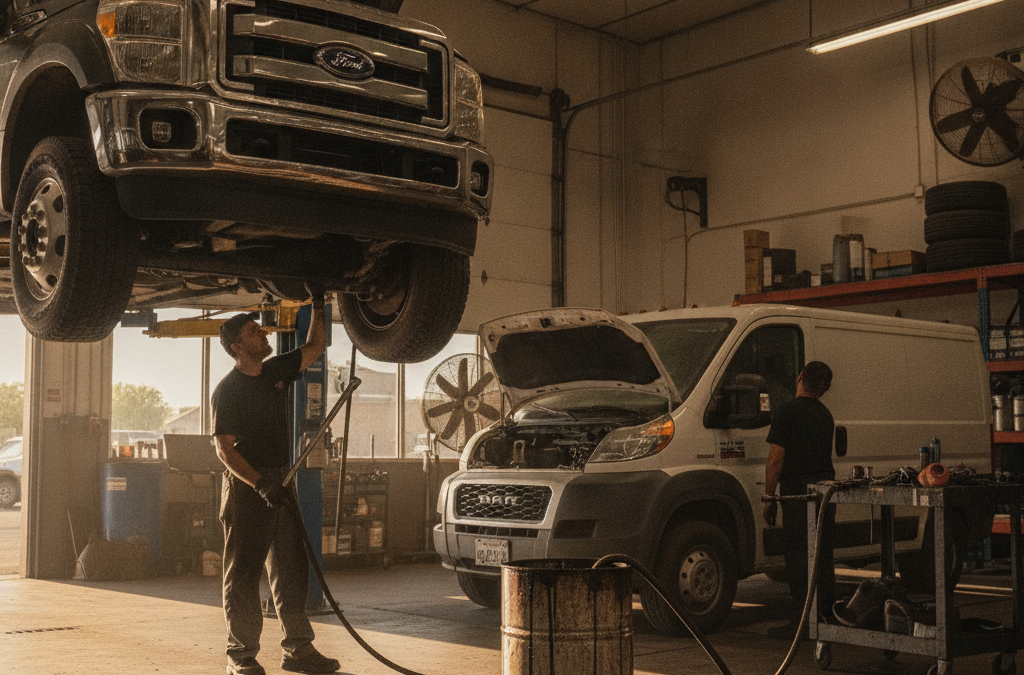
What’s Included in a Diesel Oil Change — and Why It’s Different From a Regular Service in Gilbert, AZ?
If you drive a diesel-powered truck, van, or work vehicle in Gilbert or anywhere around the greater Phoenix metro, you already know these engines aren’t like your neighbor’s four-cylinder commuter car. And that means the oil change isn’t like a regular service either. A diesel oil change typically involves more oil, a different oil specification entirely, a larger and more expensive filter, and several checks that a standard quick-lube bay simply won’t cover. Get it wrong — or skip it too long in Arizona’s brutal summer heat — and you’re looking at repairs that make an oil change look like pocket change.
Why Diesel Engines Require a Different Type of Oil
Diesel engines run under significantly higher compression than gas engines, and they generate more combustion byproducts — soot, acids, and carbon — that end up in the oil over time. Diesel engine oil is specifically formulated to handle that kind of punishment. It contains additive packages designed to neutralize acids, suspend soot particles, and protect components that gas engine oil simply isn’t built to protect.
Using the wrong oil — or letting a shop that doesn’t know diesel put standard motor oil in your Duramax, Powerstroke, or Cummins — can cause premature wear on your injectors, turbocharger, and cylinder walls. It’s not a matter of being picky. It’s a matter of keeping a $50,000+ truck out of the shop for something avoidable.
Diesel oil specs like CJ-4, CK-4, and FA-4 aren’t interchangeable, and the right spec depends on your engine, model year, and whether your truck has a diesel particulate filter (DPF). A shop that actually works on diesels will know which spec your truck needs without you having to look it up yourself.
How a Diesel Oil Change Is Different — Beyond Just the Oil
Here’s where a diesel service goes further than what you’d get at a typical quick-lube franchise in Chandler or Mesa:
- More oil volume. Most diesel trucks take 10 to 15 quarts of oil, sometimes more. A Ford 6.7L Powerstroke, for example, takes about 13 quarts. Compare that to the 5 quarts in a typical gas engine. More oil means a higher parts cost per service — but that’s the nature of the engine, not a shop trying to pad your bill.
- Larger, more expensive filter. Diesel filters are bigger and cost more than standard filters. There’s no way around it. A shop should be transparent about that upfront.
- Fuel filter inspection or replacement. Diesel fuel systems are sensitive to water and contaminants. Many diesel service intervals call for fuel filter replacement at the same time as the oil change, especially on older Power Stroke trucks that are notorious for water-in-fuel issues.
- DEF level check. If your truck was built after 2010, it likely has a diesel exhaust fluid (DEF) system. Low DEF will trigger a warning light and can eventually limit engine power. A proper diesel service includes checking and topping off DEF as needed.
- DPF and EGR inspection. Diesel particulate filters and EGR valves need periodic attention — especially if you’re not doing a lot of highway miles. A shop that handles diesel regularly will flag early signs of DPF restriction before it becomes a full regen failure.
None of these are upsells invented to inflate your invoice. They’re legitimate parts of keeping a diesel running the way it should.
What Arizona Heat Does to Diesel Engines — and Why It Matters in the Phoenix East Valley
Phoenix summers are hard on every vehicle. But diesel trucks — especially work trucks and commercial vans running routes in Gilbert, Chandler, Mesa, or out through the West Valley — take an extra beating. Sustained high temperatures thin oil faster, accelerate oxidation, and put extra strain on cooling systems that are already working overtime.
If you’re running a diesel truck in July when pavement temperatures hit 150°F and the air temperature is pushing 115°F, your engine oil is working harder than it would in any other part of the country. That’s one reason Arizona diesel owners often need to be more attentive to their service intervals than what’s printed in a generic owner’s manual written for a national average climate.
Turbochargers are particularly vulnerable. The turbo on a diesel engine depends on clean, fresh oil for lubrication and cooling. When oil gets contaminated or breaks down from heat and extended intervals, the turbo bearings are often the first thing to go. A turbo replacement on a modern diesel can run $1,500 to $3,000 or more. An oil change costs a fraction of that.
The Gap Most Shops in the Valley Leave — No Real Diesel Expertise
Here’s the honest truth about finding diesel service in the Phoenix area: a lot of general repair shops and nearly every quick-lube franchise will tell you they can do a diesel oil change. Some of them can handle the basic fluid swap. But doing it right — knowing the correct spec for your engine, checking the fuel filter, flagging a DPF that’s getting restricted, catching a slow coolant leak in a 6.0L Powerstroke before it becomes a head gasket failure — that requires technicians who actually work on diesel engines regularly.
When you’re driving a truck that your family’s livelihood depends on, or running a small fleet of service vans across the Valley, that difference matters. You need someone who will tell you what your truck actually needs, not just what’s on a laminated upsell menu behind the counter.
At All Valley Car Care, diesel service is part of what we do — not a side note. Our ASE-certified technicians handle diesel maintenance and diagnostics with the same no-unnecessary-repairs approach we bring to every vehicle. Written estimates, straight answers, and a 3-year/36,000-mile warranty on repairs (extendable to 5 years/60,000 miles) so you’re not gambling on who’s working on your truck.
How Often Should You Change the Oil in a Diesel Truck?
It depends on the engine, the oil spec, your duty cycle, and how hard the truck is working. Here’s a general starting point:
- Most modern diesel trucks with full synthetic oil: Every 7,500 to 10,000 miles under normal conditions. Under severe duty (towing heavy loads, lots of short trips, extreme heat), closer to every 5,000 to 7,500 miles.
- Older diesel trucks (pre-2008, especially Ford 6.0L and 7.3L Power Strokes): Many owners and experienced diesel techs recommend every 5,000 miles, especially in Arizona heat. These older engines have less sophisticated oil cooling and filtration systems.
- Commercial fleet vehicles doing high annual mileage: You may hit your service interval every few months depending on routes. Flexible scheduling is important — your trucks can’t sit in a waiting room for half a day.
If you’re not sure what interval is right for your specific truck, a shop that knows diesel can look at your engine, your oil type, and your driving patterns and give you a straight answer.
Frequently Asked Questions About Diesel Service in the Phoenix Area
Can I take my diesel truck to a regular quick-lube shop?
Technically, yes — but you’re taking a risk. Quick-lube franchises may not carry the correct diesel oil spec for your engine, may not have the right filter, and almost certainly won’t check your fuel filter, DEF level, or DPF status. For a basic oil change on a newer truck, it might be fine. For anything older or more complex, find a shop with actual diesel experience.
Why does a diesel oil change cost more than a regular oil change?
Mostly volume and parts. Diesel engines require significantly more oil and a larger, more expensive filter. A diesel oil change that costs $120–$180 isn’t a shop gouging you — it reflects the actual cost of the materials. Be skeptical of shops offering diesel oil changes at gas-engine prices. Something is being cut.
My diesel truck has a DPF warning light on. Is that related to oil changes?
It can be. Using the wrong oil spec — especially oil not rated for DPF-equipped engines — can contaminate and clog the DPF faster than normal. If your DPF light is on, get it diagnosed before assuming it just needs a forced regeneration. An experienced diesel tech can read the codes and tell you what’s actually happening.
Do you service diesel trucks from Surprise and the West Valley, or just Gilbert?
All Valley Car Care serves the entire greater Phoenix metro area. Our Surprise location is convenient for West Valley diesel truck owners in Peoria, Glendale, Sun City, and beyond. We also have a Glendale location for drivers on that end of the Valley.
I run a small fleet of diesel vans. Can you schedule service without taking multiple vehicles off the road at once?
Yes. Fleet scheduling is something we actively work with small business owners on. We can stagger service appointments so your operation keeps moving. Reach out and we’ll figure out a schedule that works for your business.
Ready to Schedule Diesel Service Near Gilbert or Anywhere in the Valley?
Whether you’ve got a single diesel pickup you rely on for work or a small fleet of commercial vehicles running across the Phoenix metro, All Valley Car Care will give you a straight answer on what your truck needs — and only what it actually needs. No guessing, no upsell pressure, no surprises on your invoice.
Contact us to schedule your diesel service or ask a question about your truck. We’ll get back to you promptly and give you an honest assessment before any work begins.