
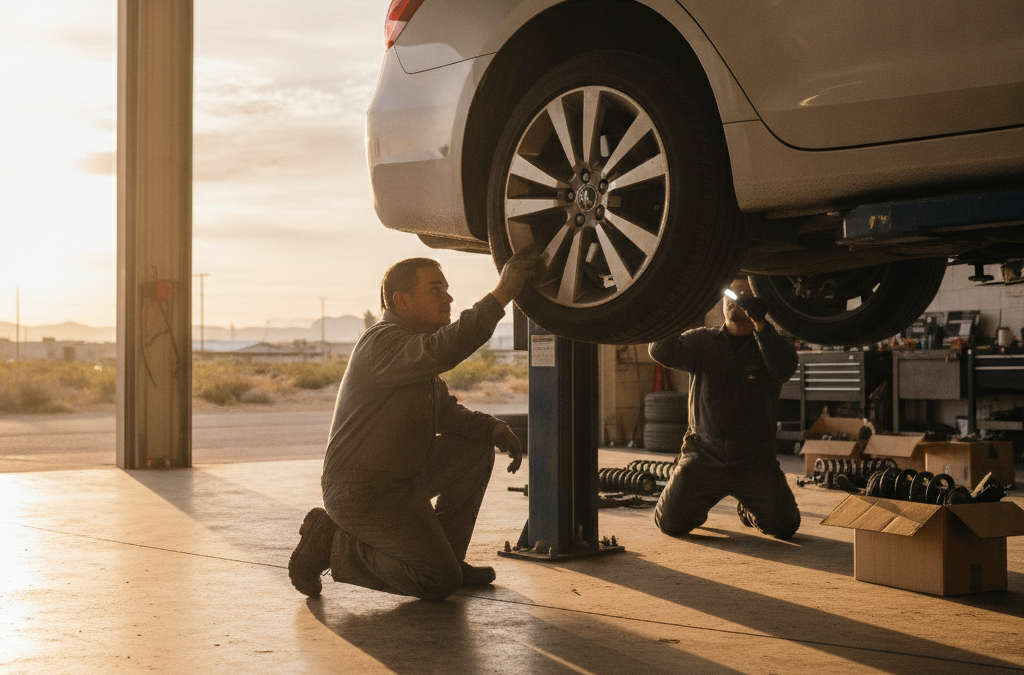
How Do You Know If Your Car Needs New Shocks or Struts — and What Does It Cost to Fix in Surprise, AZ?
If your car bounces three times after every speed bump, floats through lane changes like a boat, or the front end dips dramatically every time you brake, there’s a good chance your shocks or struts are worn out. It’s one of those problems that sneaks up gradually — you get used to the mushy ride without realizing how much your vehicle’s handling and safety have actually changed. For drivers in Surprise and across the West Valley, where road construction is constant and every road seems to have its share of dips, patches, and rough spots, worn suspension parts wear out faster than most people expect.
Shocks vs. Struts — What’s the Actual Difference?
A lot of people use the terms interchangeably, but they’re not the same thing — and it matters when it comes to repair cost and scope of work.
Shock absorbers are standalone components. They dampen the up-and-down movement of your suspension after hitting a bump. On many trucks, SUVs, and rear axles, shocks are a separate part that can be replaced on their own.
Struts are a more complex, structural component. They combine the shock absorber function with part of the suspension itself — on most front-wheel-drive cars and crossover SUVs, the front suspension is built around the strut assembly. Because struts are load-bearing, replacing them also affects your alignment and, in many cases, requires a wheel alignment afterward.
So if a shop tells you that you need struts and an alignment together, that’s not them padding the bill — that’s just how the repair works. At All Valley Car Care, we always explain exactly what we’re doing and why before any work is authorized. No surprises on the invoice.
Signs Your Shocks or Struts Are Worn Out
These are the most common things drivers notice before realizing their suspension is the culprit:
- Bouncing after bumps. Your car should settle quickly after hitting a dip or bump. If it keeps bouncing two or three times, the shocks aren’t doing their job.
- Nose-diving when you brake. If the front of the car dips down sharply when you apply the brakes — especially in a parking lot or at a stoplight — that’s a worn front strut symptom.
- Body roll in turns. Feeling like the car is leaning too much when you go around a curve is a sign that the suspension isn’t keeping the vehicle stable.
- Uneven tire wear. Cupped or scalloped tire wear — where the tread wears in a wavy pattern — often traces back to worn shocks bouncing the tire off the pavement unevenly.
- Steering feels vague or wandery. If you feel like you’re constantly making small corrections to stay in your lane, worn struts can contribute to that instability.
- Clunking or knocking over bumps. A metallic clunk when you go over a dip often means a strut mount or shock mount has failed, not just the absorber itself.
Some of these symptoms overlap with other issues — wheel balance, worn tie rods, or alignment problems can produce similar feelings. That’s why a proper inspection matters before anyone starts replacing parts. Our full suspension inspection looks at the whole picture before recommending any repair.
Why Arizona Roads Are Especially Hard on Suspension
Here in the Phoenix metro — and especially in faster-growing areas like Surprise, Goodyear, and Peoria — road construction seems to be a permanent fact of life. Between new development expanding in every direction and the expansion of major corridors, you’re constantly dealing with uneven pavement, lane shifts, and rough transitions between old and new asphalt.
Add the extreme desert heat into the mix, and suspension components that might last 70,000 or 80,000 miles in a milder climate often show wear signs earlier here. Heat accelerates rubber degradation — the bushings and mounts surrounding your struts and shocks are made of rubber, and when those break down, the metal components take more abuse. Drivers in Sun City and El Mirage who are putting steady highway miles on older vehicles often come in with suspension problems that have been quietly building for years.
If you’ve been driving the same car for five or more years in the Valley of the Sun and haven’t had the suspension inspected, it’s worth having someone take a look — not because something is definitely wrong, but because catching worn components early is a lot cheaper than replacing tires ruined by uneven wear or dealing with a handling emergency on the freeway.
What Does Shock and Strut Replacement Actually Cost?
This is where people often get sticker shock — no pun intended. Strut replacement is more labor-intensive than a lot of people expect, especially on the front axle where the strut is structural.
Here’s a general picture of what to expect, though actual costs vary by vehicle:
- Rear shocks (pair): Generally more affordable, since rear shocks on trucks and SUVs are often a simpler bolt-on job.
- Front struts (pair): More involved — often includes strut mounts, bearing plates, and spring compression work, plus an alignment afterward.
- Full set (all four corners): If all four are worn, doing them together saves labor time and gets everything balanced at once.
We won’t invent numbers here, because the difference between a compact sedan and a three-row SUV can be significant. What we can tell you is that you’ll get a written estimate before anything is touched — that’s not optional at All Valley Car Care, it’s just how we operate.
Do You Need an Alignment After Replacing Struts?
On front struts — almost always yes. The strut assembly is a key part of how the wheel is positioned relative to the road, and removing it disrupts the alignment geometry. Skipping the alignment after strut replacement is a common mistake, and it costs you in tire wear and handling quality over the next 30,000 miles.
If a shop tells you that you don’t need an alignment after replacing front struts, that should give you pause. It’s either a shortcut or a misunderstanding — neither one is good. We always recommend and perform a post-strut alignment at our Surprise location because it’s part of doing the job right.
Can You Drive on Bad Shocks or Struts?
Technically yes, for a while. But it’s worth understanding what you’re accepting by delaying the repair:
- Longer stopping distances — worn shocks can add meaningful feet to your braking distance, especially in emergency stops
- Faster tire wear, often in an uneven pattern that can’t be corrected by rotation alone
- More stress on other suspension and steering components — ball joints, tie rod ends, and wheel bearings all take more abuse when the shocks aren’t absorbing impact correctly
- Worse handling in emergency maneuvers — the kind that matters when something unexpected happens on the freeway
Worn shocks aren’t usually a drop-everything emergency the way a brake failure would be, but they do affect safety — and they get worse, not better, with time.
Frequently Asked Questions
How long do shocks and struts last in Arizona?
In moderate climates, most shocks and struts are rated for 50,000 to 100,000 miles. In the Phoenix area, with the heat degrading rubber components and constant road construction putting extra stress on suspension, many drivers see wear signs earlier — especially in the 50,000–70,000 mile range. If your vehicle is over five years old and you’ve never had the suspension inspected, it’s worth checking.
Can I replace just one strut instead of doing them in pairs?
Replacing struts or shocks in pairs — at least on the same axle — is strongly recommended. If one is worn out, the other is likely close behind, and mismatched components create uneven handling that’s uncomfortable and potentially unsafe. Doing them together also saves on labor.
Will new shocks or struts make my ride feel completely different?
If you’ve been driving on worn suspension for a while, yes — noticeably. Drivers often say the car feels like it’s new again. Better bump absorption, less body roll, more confident steering response. It’s one of those repairs that makes an immediate difference you can feel on the first drive home.
Do Avondale and Goodyear drivers face the same suspension wear issues as Surprise?
Yes. The West Valley as a whole is dealing with the same combination of rapid road construction, heavy traffic, and desert heat. Drivers throughout the greater Phoenix area — from Avondale to Peoria to El Mirage — deal with the same road conditions that accelerate suspension wear. It’s not unique to one city.
How do I know if it’s my shocks or something else causing the rough ride?
Tire pressure, wheel balance, worn bushings, and alignment issues can all create a rough or wandery feel. That’s why a proper inspection — not just a visual look, but physically checking the components — is the right starting point. We won’t guess and we won’t recommend parts you don’t need.
Get Your Suspension Checked at All Valley Car Care
If your car isn’t riding the way it used to — or you just can’t remember the last time anyone looked at the suspension — we’re happy to take a look. All Valley Car Care has been serving drivers in Surprise and across the West Valley since 2010. Our techs are ASE-certified, we give you a written estimate before anything is done, and we back our work with a 3-year/36,000-mile warranty that’s extendable to 5 years or 60,000 miles.
No pressure, no unnecessary repairs — just an honest look at what your vehicle needs. Contact us or schedule your inspection online and let’s figure out what’s going on with your ride.