
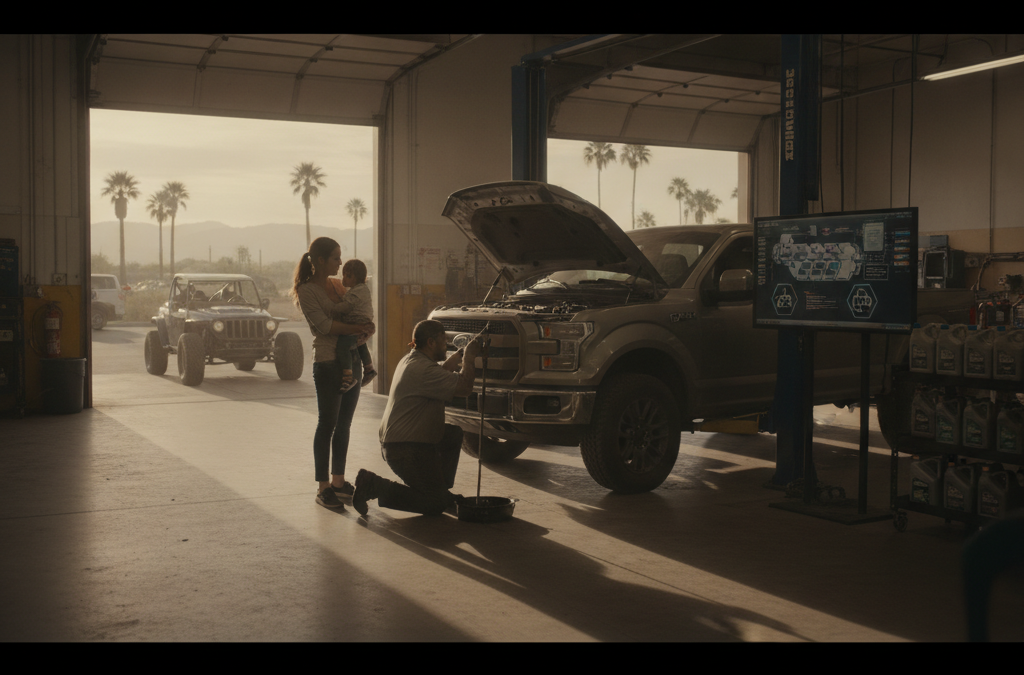
How Often Should You Change Your Oil in Surprise, AZ — and Does the Desert Heat Change the Answer?
Short answer: yes, the desert absolutely changes the answer. If you’re driving around Surprise, Peoria, or anywhere else in the Phoenix West Valley, your engine is working harder than most people realize — and your oil is taking the brunt of it. The old “every 3,000 miles” rule is mostly outdated, but that doesn’t mean you can stretch to 10,000 miles without thinking twice. What you should actually do depends on your vehicle, the oil type you’re running, and the conditions you’re driving in. Let’s break it down in plain terms.
Why Arizona Heat Is Harder on Engine Oil Than You Think
When summer temperatures hit 115°F here in the West Valley, your engine’s internal temperature can climb well above 200°F under normal driving conditions. That heat does something specific to oil: it thins it out. Thinner oil doesn’t cling to engine components the way it should, which means metal parts are working with less protection between them.
On top of that, oil oxidizes faster at high temperatures. That means it breaks down chemically and loses its lubricating ability sooner than it would in a milder climate like Minnesota or Oregon. The oil in your Phoenix-area vehicle is essentially aging faster just because of where you live.
Short trips make this worse. If you’re doing a lot of stop-and-go driving — school drop-offs in Surprise’s Marley Park, errands along Bell Road, commuting through construction zones on the Loop 303 — your engine never fully reaches operating temperature before you shut it off. That allows moisture and unburned fuel to build up in the oil, degrading it faster than the mileage on your odometer would suggest.
So What’s the Right Interval for Desert Drivers?
Conventional Oil: 3,000–5,000 Miles in Arizona
If you’re running conventional (non-synthetic) oil, sticking to the lower end of your manufacturer’s recommendation makes sense here in the Valley of the Sun. That typically means somewhere in the 3,000–5,000 mile range depending on your driving habits. Conventional oil just doesn’t hold up as well under prolonged heat stress, and in a place where your AC is running eight-plus months a year and your engine is already working overtime, that matters.
Synthetic Oil: 5,000–7,500 Miles for Most Arizona Drivers
Full synthetic oil is formulated to resist heat breakdown and oxidation much better than conventional. In a cooler climate, some manufacturers say you can go 10,000 miles or more on full synthetic. In Arizona, we’d generally recommend treating that as a ceiling, not a target. For most drivers in the greater Phoenix metro — especially those doing a mix of city and highway driving — 5,000 to 7,500 miles is a more realistic and protective interval.
If you drive a high-mileage vehicle, tow a trailer, or run a commercial vehicle out of Glendale or Goodyear, you should lean toward more frequent changes regardless of oil type. Working engines build heat faster, and heat is the enemy of oil.
What Your Owner’s Manual Actually Says
Most modern vehicles have a manufacturer recommendation somewhere between 5,000 and 10,000 miles. That range is generally based on “normal” driving conditions — which does not describe Arizona summers, stop-and-go valley traffic, or hauling gear across Surprise’s growing neighborhoods. Many manufacturers acknowledge this by also listing “severe” driving conditions, which typically include extreme heat, frequent short trips, and towing. If your driving fits that description (and for most people in this area, it does), use the severe-condition interval — it’s in your manual and it’s there for a reason.
The Real Cost of Waiting Too Long
Here’s something quick-lube chains don’t always tell you: an oil change costs you roughly $50–$100. An engine that’s been starved of proper lubrication can cost you thousands. Sludge buildup from degraded oil is one of the most common causes of premature engine wear, and once it sets in, it doesn’t just wash out. We see this regularly — vehicles that look fine on the outside but have engines that are silently wearing down because the oil was stretched too far.
We’re not saying this to scare you into unnecessary service. We’re saying it because it’s genuinely one of the cheapest ways to protect a vehicle you’ve already paid for. Oil changes are one of the most straightforward services we offer, and our ASE-certified technicians will tell you what interval actually makes sense for your specific vehicle and how you drive — not just whatever gets you back in the door faster.
Synthetic vs. Conventional: Which Should You Be Running in Arizona?
If you’re still running conventional oil in a vehicle that can use synthetic, it’s worth switching — especially in the Phoenix West Valley. The cost difference per oil change is real, but so is the protection difference. Synthetic handles our extreme heat better, lasts longer between changes, flows more easily during cold starts, and does a better job keeping your engine clean over time.
That said, not every vehicle needs full synthetic. Some older vehicles or engines with higher mileage do better with a conventional or high-mileage blend. If you’re not sure which is right for your car, truck, or SUV, just ask. We’ll tell you straight, without steering you toward the pricier option just because we can.
What to Watch For Between Oil Changes
Even if you’re on a good schedule, keep an eye on a few things in between services:
- Oil level: Check it monthly. Some engines use a bit of oil between changes, and running low is genuinely harmful.
- Oil color: Fresh oil is amber. Dark brown or black oil that’s milky or gritty means it’s overdue — or there’s a bigger problem.
- Oil pressure warning light: Don’t ignore this. Pull over and call a shop. Driving on low oil pressure can destroy an engine quickly.
- Engine noise: Ticking, knocking, or a louder-than-usual engine can be an early sign your oil isn’t doing its job.
If you’re a snowbird with a second home in Sun City West or El Mirage, pay particular attention when you return in the fall. A vehicle that sat through a brutal Phoenix summer — even in a garage — may need an oil and filter change before you get back on the road, regardless of mileage.
Frequently Asked Questions About Oil Changes in Arizona
Can I go 10,000 miles between oil changes if my car recommends it?
Possibly — but we’d recommend being cautious here in Arizona. A 10,000-mile interval assumes moderate driving conditions. If you’re dealing with extreme summer heat, short daily trips, or towing, shorter intervals protect your engine better. Ask us and we’ll give you a straight answer for your specific vehicle.
Does synthetic oil really matter in a hot climate?
Yes. Synthetic oil is specifically engineered to resist heat breakdown and oxidation better than conventional oil. In a place where your engine runs hot eight months a year, that matters more than it would in a cooler state.
My oil life monitor says I have 40% left — should I trust it?
Oil life monitors are a reasonable guide, but they’re calculated using algorithms, not actual oil analysis. In extreme heat like we get in the Valley, those numbers can be optimistic. If you’re past 5,000 miles and haven’t changed your oil in a while, it’s worth a quick check regardless of what the monitor says.
Is it okay to switch between synthetic and conventional oil?
Yes, you can switch back and forth without damaging your engine. Modern synthetic and conventional oils are compatible. That said, once you’re on synthetic, there’s not much reason to go back — especially in Arizona.
What if my car is leaking oil? Does that change how often I need a change?
Yes — if you’re losing oil to a leak, your oil level is dropping between changes whether you notice it or not. A leak should be diagnosed and repaired, not just topped off. We can check for leaks during any service visit and tell you exactly what’s going on.
Get an Honest Oil Change from a Shop That Knows the Valley
At All Valley Car Care, we’ve been doing oil changes — and everything that goes along with keeping Valley vehicles healthy — since 2010. We’re not going to push you into an unnecessary service or charge you for things your car doesn’t need. We’ll look at your vehicle, listen to how you drive, and tell you exactly what we recommend and why.
Whether you’re in Surprise, dropping in from Peoria, or you’ve been meaning to find a reliable shop near you for a while, we make it easy. Schedule your oil change or ask us a question online — no pressure, no surprises on your bill.