
How Do You Know If Your Car’s Alternator Is Failing — and What Does It Cost to Fix in Surprise, AZ?
Here’s a situation that happens more often than it should: you replace your car battery, feel good about it, and then two weeks later your car won’t start again. You blame the new battery. But in many cases, the battery is just fine — it’s the alternator that’s the real problem, and it quietly drained your new battery the same way it drained the old one.
This mix-up is one of the most common (and frustrating) misdiagnoses in auto repair. If you’re in Surprise or anywhere across the West Valley, knowing the difference between an alternator problem and a battery problem can save you from replacing the wrong part — and getting stranded again. Here’s what to watch for, how a shop diagnoses it correctly, and what you can realistically expect to pay.
What Does the Alternator Actually Do?
Your battery starts the engine. But once the engine is running, it’s the alternator that keeps everything powered — the lights, the radio, the AC blower, the ignition system, and every other electrical component in your vehicle. The alternator also recharges the battery while you drive, so the next time you turn the key, there’s enough juice to start again.
When the alternator starts to fail, it stops doing that job properly. The battery runs down even while the car is running. Electrical systems start behaving strangely. And eventually, the car dies — sometimes on the freeway, sometimes in a parking lot, sometimes right in your driveway.
Warning Signs Your Alternator Might Be Going Out
The tricky part is that alternator symptoms can look like a dozen other problems. Here are the ones worth paying attention to:
- Dimming or flickering headlights. This is one of the most reliable early signs. If your headlights dim when you’re idling and brighten when you rev the engine, your charging system isn’t keeping up.
- Dashboard warning lights. A battery-shaped warning light — or a check engine light — can both be triggered by a failing alternator. Many drivers assume the battery light means they need a battery, but it’s really a charging system warning.
- Electrical weirdness. Windows rolling slower than usual, the radio cutting in and out, the AC acting inconsistent — these are signs that your car isn’t getting enough electrical power to run everything at once.
- A dead battery that keeps coming back. If you’ve replaced your battery and it keeps dying, stop buying batteries. Have the charging system tested first.
- A whining or grinding noise from under the hood. Alternators have internal bearings that wear out over time. A grinding or growling sound from the front of the engine — especially one that changes pitch with engine speed — can point to a failing alternator bearing.
- The car dies while driving. When an alternator fails completely, the battery eventually drains to nothing, and the engine shuts off. This is the stage you don’t want to reach.
Why Arizona Heat Makes Alternator Problems Worse
You already know that Phoenix-area summers are brutal on vehicles. What most drivers don’t realize is that extreme heat is as hard on alternators as it is on batteries — and the two failures are often connected.
Alternators run hot by design. But when ambient temperatures are already above 110°F and your engine bay is absorbing that heat on top of its own output, the internal components of the alternator wear out faster. The voltage regulator, the diodes, and the rotor windings all degrade more quickly under sustained heat stress.
The pattern we see in Surprise, Goodyear, El Mirage, and throughout the West Valley is that alternators often start showing signs of trouble in late spring — right before summer peaks — and then fail outright during the hottest months. If your electrical system has been acting a little odd since April or May, don’t wait until August to look into it.
All Valley Car Care’s Surprise location handles charging system diagnostics year-round, and summer is genuinely the worst time to find out your alternator has been struggling for months.
How a Shop Properly Diagnoses an Alternator vs. a Battery Problem
This is the section that most competitor sites skip — and it’s the one that matters most if you’ve already been down the road of replacing parts that didn’t fix the problem.
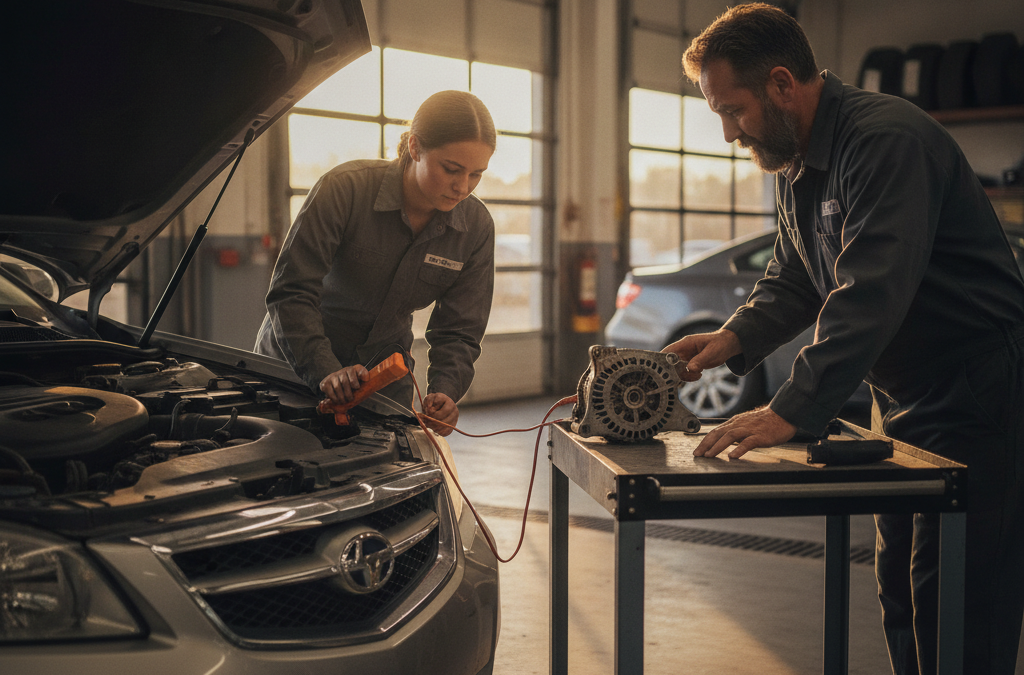
A proper charging system diagnosis isn’t just plugging in a code reader. It involves:
- Battery load testing — checking whether the battery can hold a charge under real-world demand, not just whether it reads 12 volts sitting still
- Alternator output testing — measuring actual voltage output while the engine runs and electrical loads are applied (AC on, lights on, etc.)
- Voltage drop testing — checking the wiring and connections in the charging circuit, because sometimes a corroded cable or a bad ground is the real culprit
- Diode testing — checking whether the alternator’s internal diodes are allowing AC current to leak into the DC system, which can drain batteries and cause all kinds of electrical gremlins
If a shop just swaps a battery or alternator without doing this testing, they’re guessing. That’s how people end up replacing both parts and still having the same problem. At All Valley Car Care, we run through the full charging system before recommending any parts — because replacing the wrong component wastes your money and your time.
What Does Alternator Repair Cost in the Surprise Area?
Alternator replacement costs vary depending on your vehicle’s make, model, and engine. Generally speaking, here’s what most drivers in the Phoenix West Valley can expect:
- Alternator replacement (parts + labor): roughly $350–$700 for most domestic cars and trucks
- Higher-end or European vehicles (BMW, Audi, Mercedes) can run higher depending on parts availability and labor complexity
- Rebuilt vs. new alternator: Rebuilt units cost less but may carry shorter warranties — ask your shop which they use and what the warranty covers
We give you a written estimate before any work starts. No surprises, no hidden fees, no pressure to approve something you’re not comfortable with. That’s been our approach since we opened in 2010, and it’s not something we plan to change.
Alternator vs. Starter: Two Different Problems That Get Confused
While we’re here, it’s worth clearing up another common mix-up. Alternators and starters both affect whether your car starts, but they fail in different ways:
- A bad starter usually shows up as a rapid clicking or a single loud click when you turn the key — with nothing else happening. The engine doesn’t crank at all, but your electrical accessories (radio, lights) still work fine.
- A bad alternator shows up as a battery that keeps dying, electrical weirdness while the car is running, and eventually a car that dies while driving — not just at startup.
If your car clicks but won’t crank, that’s usually a starter or a severely drained battery. If your car starts but dies later, or your battery keeps running down, look at the charging system first.
Drivers across Sun City, Sun City West, Peoria, and Glendale bring us both kinds of problems regularly. The diagnosis tells us which direction to go — we don’t just assume.
See our full list of diagnostic and electrical services if you want to know more about what we check during a charging system inspection.
Frequently Asked Questions: Alternator Repair in Surprise, AZ
Can I drive with a failing alternator?
For a short distance if you absolutely have to — but it’s risky. A failing alternator will continue draining the battery while you drive. Depending on how much charge is left, you might have 30 minutes or you might have five. If your battery light comes on or your lights start dimming, get off the road and call for help rather than trying to make it across town.
Will a failing alternator set off my check engine light?
Yes, it can. Low charging voltage often triggers a check engine light, though the code won’t say “alternator” — it’ll reference something like a voltage regulation fault or a charging system issue. That’s why computerized diagnostics alone aren’t enough. You need the full charging system test to confirm what’s actually going on.
How long do alternators last in Arizona?
In milder climates, alternators often last 100,000 miles or more. In the Valley of the Sun, the combination of extreme heat and heavy electrical demand — especially from running AC almost year-round — tends to shorten that lifespan. Many Arizona drivers see alternator issues in the 80,000–100,000 mile range, and some earlier if they run a lot of aftermarket electrical accessories.
Is it worth getting an alternator remanufactured instead of new?
Remanufactured alternators are a reasonable option if they come with a solid warranty. Ask the shop what warranty they offer on the unit and the labor. At All Valley Car Care, all repairs are backed by our 3-year/36,000-mile warranty — extendable to 5 years/60,000 miles — so you’re covered either way.
My car battery keeps dying even after I replaced it. What should I do?
Stop replacing the battery and get the charging system tested. A battery that keeps dying after a fresh install is almost always a sign that the alternator isn’t keeping it charged — or that something is drawing current while the car sits (a parasitic drain). Both of those are diagnosable problems. Bring it in and we’ll find out which one you’re dealing with.
Don’t Guess — Get It Tested
Charging system problems are genuinely confusing, and most drivers don’t know the difference between an alternator issue and a battery issue until they’ve already wasted money replacing the wrong one. The good news is that a proper diagnosis isn’t complicated — it just takes a shop willing to do it right instead of reaching for parts first.
If your car has been acting up electrically, your battery light is on, or you’ve replaced a battery that keeps dying, come see us. We’ll run the full charging system test, explain exactly what we find, and give you a written estimate before we touch anything.
Schedule a charging system inspection at All Valley Car Care — we serve Surprise, Glendale, Peoria, El Mirage, Sun City, Goodyear, and the surrounding West Valley. No pressure, no unnecessary repairs, no surprises on your bill.