
How Do You Know If Your Car’s Intake Manifold Gasket Is Failing — and What Does It Cost to Fix in Gilbert, AZ?
Your car is acting strange. Maybe it idles rough at a red light on Higley Road. Maybe your temperature gauge keeps creeping up even though you just had the coolant flushed. Or maybe you keep topping off your coolant reservoir but can never find a puddle under the car. If any of that sounds familiar, you might be chasing a problem that has nothing to do with what you’ve already had looked at — and everything to do with a small rubber-and-metal seal called the intake manifold gasket.
This is one of the most commonly misdiagnosed failure points we see here in the greater Phoenix metro, and it’s a topic that almost nobody in the local repair space talks about clearly. Here’s what it is, how to recognize it, and what you can expect to pay to have it fixed properly.
What Does the Intake Manifold Gasket Actually Do?
Your engine’s intake manifold is the part that routes air — and on many engines, air mixed with fuel — into each cylinder. The gasket sits between the intake manifold and the engine block, creating a sealed connection. When it’s working right, you never think about it. When it starts to fail, it can cause a surprising range of symptoms because it’s sitting right in the middle of two critical systems: your air/fuel delivery and, on many older V6 and V8 engines, your cooling system.
Depending on your vehicle, a leaking intake manifold gasket can let outside air sneak into the engine (a vacuum leak), or it can allow coolant to seep internally into the combustion chamber or externally onto the engine block. Sometimes both. That’s why the symptoms can be so confusing — you’re essentially dealing with an air leak, a coolant leak, or both at the same time.
The Warning Signs You Shouldn’t Ignore
Here’s what a failing intake manifold gasket often looks like from the driver’s seat:
- Rough or unstable idle — The engine hunts for the right RPM at a stoplight, shakes, or feels like it might stall.
- Coolant loss with no visible leak — You’re adding coolant regularly but never see a puddle. Coolant may be leaking internally and burning off.
- Overheating or climbing temperature gauge — A coolant leak, even a slow internal one, can cause your engine to run hot.
- White smoke from the exhaust — A sweet smell and white or gray smoke can mean coolant is entering the combustion chamber and burning.
- Check engine light with lean mixture codes — A vacuum leak from the gasket causes the engine’s computer to see too much air relative to fuel, which often triggers codes like P0171 or P0174.
- Engine runs rough under load — Acceleration feels sluggish or choppy, especially on the freeway or going uphill.
- Oily residue or coolant staining on the outside of the engine block — On external leaks, you may see wet or crusty buildup near the manifold seam.
None of these symptoms automatically point to the intake manifold gasket — that’s the tricky part. A rough idle could be spark plugs. Coolant loss could be a water pump. White exhaust smoke could be a head gasket. That’s exactly why proper diagnostics matter so much before any parts get replaced.
Why Arizona’s Heat Makes This Problem Worse
In a milder climate, intake manifold gaskets can last the life of the engine. Here in the Phoenix metro — where summer temperatures regularly hit 115°F and the air itself is searingly dry — rubber and composite gasket materials age faster. The constant expansion and contraction from extreme heat cycles puts stress on every seal in the engine bay. Vehicles sitting in parking lots in Gilbert, Chandler, or Mesa all summer long are especially vulnerable, because heat soaks into the engine compartment even when the car is off.
Older vehicles with plastic intake manifolds — which were common on GM 3.1L and 3.4L V6 engines throughout the 1990s and early 2000s — are particularly known for intake manifold gasket failures, and Arizona’s climate accelerates that timeline considerably. If you’re driving an older Chevy, Buick, Pontiac, or similar platform, and your car has started running rough or using coolant without explanation, this is one of the first things a good shop should check.
What a Real Diagnosis Looks Like — and Why It Matters
One thing that frustrates drivers is when a shop replaces parts based on a guess rather than a confirmed diagnosis. We see it all the time: someone replaces spark plugs, then a MAF sensor, then a fuel injector — and the rough idle is still there. Eventually, somebody does a smoke test or a pressure test on the cooling system and finds the intake manifold gasket was the problem the whole time.
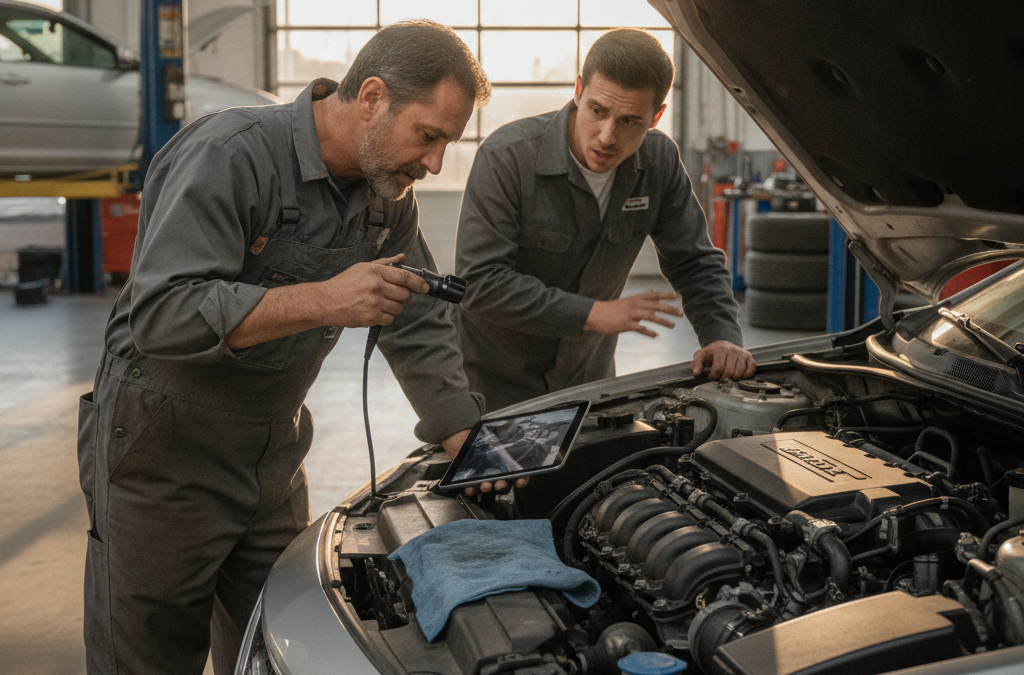
A proper diagnosis for a suspected intake manifold gasket leak typically involves:
- A computerized scan to pull any stored or pending trouble codes
- A smoke test to identify vacuum leaks (smoke is pumped into the intake, and it will escape wherever there’s a breach)
- A coolant pressure test to confirm whether coolant loss is internal or external
- A visual inspection of the manifold seam for staining, residue, or wet spots
If a shop wants to replace your intake gasket based purely on symptoms without running these checks first, push back. A confirmed diagnosis protects you from paying for a repair that doesn’t solve the problem. At All Valley Car Care, we don’t recommend repairs until we’ve confirmed the cause — that’s not a sales pitch, it’s just how we work.
What Does It Cost to Replace an Intake Manifold Gasket?
The honest answer is: it depends heavily on your vehicle. On an older V6 engine where the intake manifold is relatively accessible, the job might run $300–$600 in total, parts and labor. On a modern V8, a turbocharged engine, or a vehicle where the intake sits deep in the engine compartment and requires significant disassembly, you could be looking at $600–$1,200 or more.
Labor is the big variable. Replacing the gasket itself is inexpensive — it’s getting to it that takes time. A good shop should be able to give you a written estimate before any work begins. If they can’t, or won’t, that’s a red flag.
One more thing: if the gasket has been leaking coolant internally for a while without being caught, there may be secondary damage — fouled spark plugs, coolant-contaminated oil, or in the worst cases, early signs of head gasket stress. That’s another reason to catch this early rather than letting it ride.
How All Valley Car Care Can Help — Whether You’re in Gilbert or Surprise
We serve drivers all across the Valley, including folks from Gilbert, Chandler, and Mesa who need a shop they can actually trust. Our ASE-certified technicians use computerized diagnostics to confirm what’s causing your symptoms before anything is recommended. We give you a written estimate, we explain what we found in plain English, and we back our work with a 3-year/36,000-mile warranty — extendable to 5 years/60,000 miles — so you’re not rolling the dice on a repair.
If you’re experiencing any of the symptoms listed above, don’t keep throwing parts at it and hoping something sticks. Schedule a diagnostic at our Surprise location or reach out through any of our Valley-area shops. We’ll tell you exactly what’s going on.
Frequently Asked Questions
Can I drive with a failing intake manifold gasket?
For a short time, possibly — but it’s not something you want to ignore. If coolant is leaking internally, you risk overheating the engine or contaminating your oil, both of which can cause serious engine damage quickly. If it’s purely an air leak causing a rough idle, the urgency is lower, but the fuel economy hit and wear on related components add up. Get it diagnosed sooner rather than later.
Will a failing intake manifold gasket trigger the check engine light?
Often, yes. Vacuum leaks commonly trigger lean mixture codes (P0171, P0174) because the engine’s computer detects too much air in the fuel-air mix. However, not all intake gasket failures throw a code right away — especially if the leak is primarily coolant-based. The check engine light alone won’t tell you it’s the gasket; that’s what proper diagnostics are for.
How long does it take to replace an intake manifold gasket?
On most vehicles, the job takes 3–6 hours of labor. More complex engines or configurations can run longer. Most shops can complete it in a single day if the parts are available. Ask your shop for a realistic timeline when you drop the car off.
Is an intake manifold gasket the same as a head gasket?
No, and this is a common mix-up. The head gasket seals the cylinder head to the engine block. The intake manifold gasket seals the intake manifold to the top of the engine. Both can leak coolant and both can cause overheating, which is why they’re sometimes confused. Head gasket failure is generally a much more serious and expensive repair — another reason getting the right diagnosis up front matters so much.
Are some vehicles more prone to this problem than others?
Yes. GM vehicles from the late 1990s through mid-2000s with 3.1L or 3.4L V6 engines are well-known for intake manifold gasket failures. Many Ford, Dodge, and Chrysler V6 and V8 platforms have also had documented issues. Japanese vehicles are generally more reliable in this area, though no gasket lasts forever — especially in a desert climate like the Phoenix metro where heat cycling is relentless.
Ready to Get a Straight Answer?
If your car is running rough, losing coolant without explanation, or running hotter than it should, don’t keep guessing. Contact All Valley Car Care to schedule a diagnostic appointment. We serve drivers throughout the Valley — from Gilbert and Chandler in the East Valley to Surprise, Glendale, and Peoria on the west side. No unnecessary repairs, no hidden costs, and no runaround. Just an honest answer about what your car actually needs.