
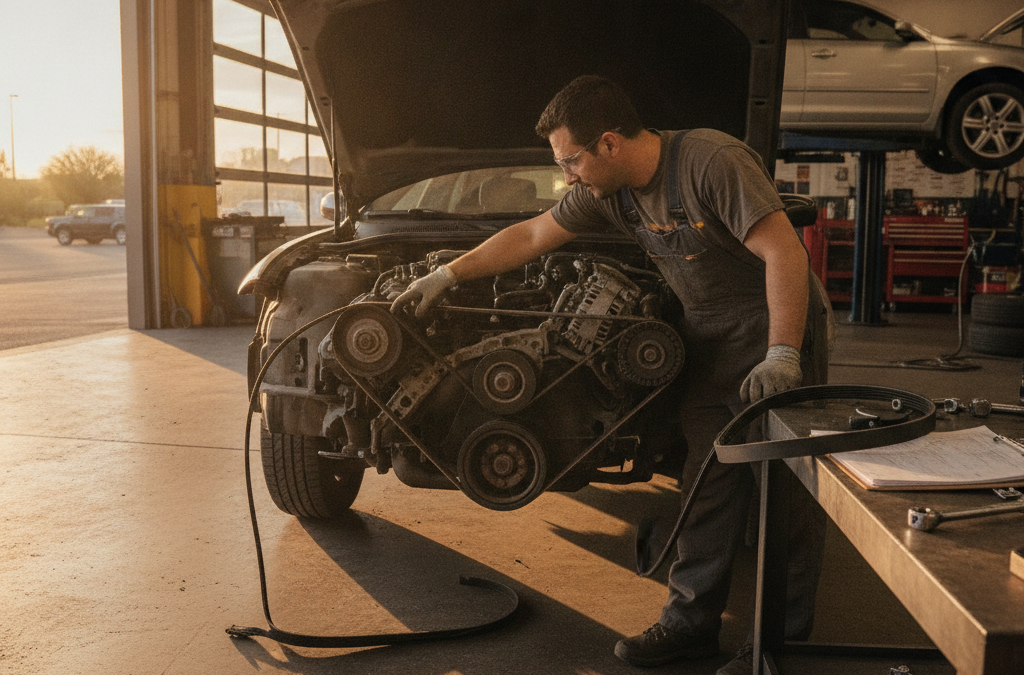
How Do You Know If Your Car’s Serpentine Belt Is Failing — and What Does It Cost to Fix in Chandler, AZ?
If you’ve ever heard a high-pitched squealing sound coming from under the hood — especially when you first start the car or crank up the AC — there’s a decent chance your serpentine belt is trying to tell you something. In Chandler and across the greater Phoenix metro, that belt takes a beating year-round from extreme heat, and when it finally gives out, it doesn’t just fail quietly. It can take your power steering, air conditioning, alternator, and water pump down with it, often leaving you stranded on the side of the road in 110-degree heat. The good news: catching it early is straightforward, and replacing it isn’t expensive — especially compared to what happens if you let it snap.
What Does the Serpentine Belt Actually Do?
Think of the serpentine belt as the one belt that runs everything. Unlike older vehicles that had multiple belts for different accessories, most cars built in the last 25 years use a single serpentine belt that loops around several engine components simultaneously. That includes the alternator (which charges your battery), the AC compressor, the power steering pump, and the water pump on many vehicles.
When that belt is in good shape, everything hums along. When it starts cracking, glazing, or slipping — or when it snaps entirely — all of those systems stop working at the same time. Your battery warning light might come on. Your AC stops blowing cold. Your steering gets stiff. And if the water pump is belt-driven on your vehicle, your engine can start overheating within minutes. That’s a lot of consequences from one part that often costs less than $100 in parts.
Warning Signs Your Serpentine Belt Is Wearing Out
The most common symptom is a squealing or chirping noise from the front of the engine. It might happen when you start the car, when you turn the wheel sharply, or when you switch on the AC. The sound tends to be loudest when the belt is cold or when it’s slipping under load.
Other signs to watch for:
- Visible cracking or fraying — If you can safely peek under the hood, look at the belt’s surface. Cracks running across the ribs, chunks missing, or a shiny glazed surface are all red flags.
- Battery warning light — If the belt is slipping, the alternator can’t keep up with charging, and you’ll see a battery or charging system warning on the dash.
- AC stops working suddenly — Especially in summer, a belt that’s slipping under load will cause your AC compressor to underperform or cut out entirely.
- Power steering feels heavy — On vehicles with belt-driven hydraulic power steering, a loose or worn belt makes the wheel noticeably harder to turn at low speeds.
- Engine overheating — If your water pump is belt-driven and the belt breaks or slips badly, coolant stops circulating and the engine temperature climbs fast. Pull over immediately if this happens.
None of these symptoms should be ignored, especially here in Arizona. Desert heat — regularly hitting 115°F or higher in summer — accelerates rubber degradation significantly. A belt that might last 100,000 miles in a milder climate can show wear much earlier when it’s baking under the hood in Phoenix metro heat every day for years.
How Long Should a Serpentine Belt Last in Arizona?
Most manufacturers list a serpentine belt replacement interval somewhere between 60,000 and 100,000 miles. But in the Valley of the Sun, that upper end of the range is optimistic. The combination of high ambient temperatures, engine heat, and the near-constant use of your AC compressor — which puts extra load on the belt for eight or more months a year — means your belt is working harder than it would anywhere else in the country.
A realistic rule of thumb for drivers in Chandler, Goodyear, Peoria, and surrounding desert communities: have the belt inspected visually at every oil change, and plan on replacement somewhere in the 60,000–80,000-mile range unless your mechanic finds a reason to do it sooner. If you’re not sure how old your current belt is — maybe you bought the vehicle used — it’s worth having a shop take a look. All Valley Car Care performs belt inspections as part of a full-service maintenance check, and we’ll tell you honestly what we see.
What Does Serpentine Belt Replacement Cost in the Chandler Area?
This is one of the more affordable repairs you’ll face as a car owner. In the greater Phoenix metro, most drivers can expect to pay somewhere in the range of $75 to $200 for a serpentine belt replacement on a typical passenger car or SUV — parts and labor combined. That range varies based on your vehicle’s make and model, since some engines make the belt easier to access than others.
There are a few things that can push the cost higher:
- Belt tensioner replacement — The tensioner keeps the belt at the correct tension. If it’s worn or seized, it should be replaced at the same time. Most shops recommend doing both together since the labor is already there.
- Idler pulley replacement — Same idea. If the idler pulley bearings are rough or the pulley is wobbling, it’s worth replacing while the belt is off.
- Luxury or European vehicles — On some German and European imports, the belt system is more complex and labor time increases accordingly.
What you should never do is let a shop talk you into a serpentine belt replacement on a belt that still has plenty of life in it. At All Valley Car Care, we show you what we’re looking at and explain what we see. No unnecessary repairs — that’s not how we operate.
Why This Topic Gets Glossed Over at Most Local Shops
Here’s something worth knowing: a lot of local competitor websites talk about brakes, oil changes, and AC repair — but very few of them have clear, plain-language information about serpentine belt service, what it costs, or why it matters specifically in Arizona’s climate. That leaves a lot of drivers without a clear picture of what to watch for or when to act.
That gap is worth closing, because belt failure is one of those things that catches people completely off guard. You’re driving through Gilbert on the way to work, everything seems fine, and then the belt snaps and suddenly your temperature gauge is climbing, your steering is heavy, and you’re pulling off the road. It’s preventable. A quick visual inspection during your next oil change is all it takes to know where you stand.
All Valley Car Care serves drivers across the Phoenix metro from our Surprise location, and our ASE-certified technicians check belts and hoses as part of routine service visits — not as an add-on upsell.
Can You Drive With a Worn Serpentine Belt?
Technically, a belt that’s cracked but still intact will keep the engine running — for now. But you’re gambling with how long “for now” actually lasts. If the belt snaps while you’re driving, you could be looking at an overheated engine, a dead battery, no power steering, and a tow bill on top of whatever repair comes next. In the middle of a Phoenix summer, that’s a situation nobody wants to be in.
If you’re hearing squealing, if a shop has flagged cracking on your belt, or if you’re simply past the 70,000-mile mark and can’t remember the last time the belt was inspected — get it looked at. The peace of mind is worth far more than the cost of the belt itself.
Frequently Asked Questions
How often should I replace my serpentine belt in Arizona?
Plan for somewhere in the 60,000–80,000-mile range, depending on your vehicle. Arizona’s extreme heat accelerates belt wear, so err on the earlier side of your manufacturer’s recommendation and have it visually inspected at every oil change.
What happens if my serpentine belt breaks while I’m driving?
Your alternator, AC compressor, power steering pump, and potentially your water pump will stop working simultaneously. If the water pump is belt-driven, your engine can overheat quickly. Pull over safely, turn the engine off, and call for a tow.
Should I replace the belt tensioner at the same time as the belt?
Usually, yes. If the tensioner is worn, it’ll continue stressing the new belt and shorten its life. Since the labor is already done when replacing the belt, it makes sense to handle both at the same time.
Is a squealing belt always the serpentine belt?
Not always. On some vehicles, there’s a separate smaller belt for certain accessories. But on most modern cars, the serpentine belt is the most likely cause of belt noise. A mechanic can pinpoint the source quickly with a visual inspection.
Does All Valley Car Care service European vehicles and larger trucks?
Yes. We work on domestic, European, and import vehicles — cars, trucks, and SUVs. We also serve commercial fleet customers who need flexible scheduling. Reach out to schedule an appointment and let us know what you’re driving.
Get Your Belt Inspected Before It Becomes an Emergency
A failing serpentine belt rarely gives you much warning before it becomes a roadside problem. The smartest move is a quick inspection at your next service visit — something our team does as a matter of routine, not as a way to find extra things to charge you for. If the belt looks fine, we’ll tell you that. If it’s showing signs of wear, we’ll show you and give you an honest recommendation.
All Valley Car Care has been serving drivers across the Phoenix metro since 2010, with locations in Surprise, Gilbert, and Glendale. All repairs come backed by our 3-year/36,000-mile warranty — extendable to 5 years and 60,000 miles. No hidden costs. No unnecessary repairs. Just straight answers from people who know what they’re doing.
Contact us today to schedule a belt inspection or any other maintenance service. We’re here to help you stay ahead of the problem, not deal with it on the side of the road.