
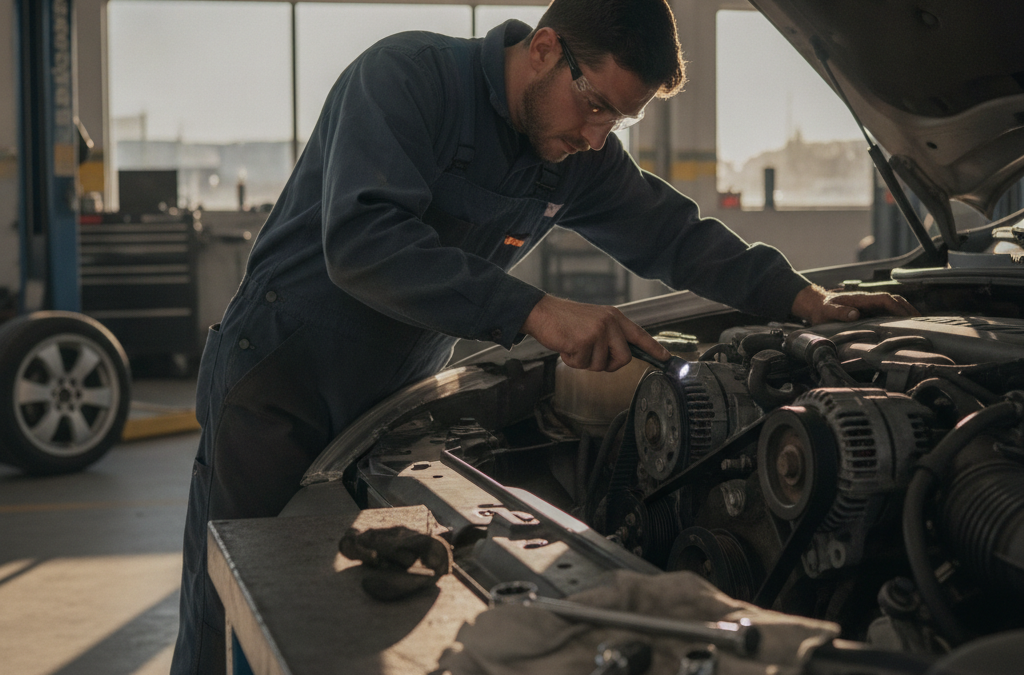
How Do You Know If Your Car’s Serpentine Belt Is About to Fail — and What Does It Cost to Fix in Surprise, AZ?
If your serpentine belt snaps while you’re driving, your car doesn’t slowly wind down — it stops working almost immediately. The AC cuts out. The battery stops charging. The power steering goes stiff. And if your engine relies on that belt to drive the water pump, you’re looking at an overheating situation within minutes. It’s one of those small parts that most drivers in Surprise and across the West Valley never think about until it’s too late. The good news? It almost always gives you warning signs before it goes — if you know what to look for.
What Does the Serpentine Belt Actually Do?
The serpentine belt is a single, long rubber belt that loops around several pulleys under your hood. It’s what transfers power from your engine’s crankshaft to the accessories your car depends on every day — the alternator, the AC compressor, the power steering pump, and in many vehicles, the water pump. It’s called a serpentine belt because of how it winds around all those components in one continuous path.
On older vehicles, each of those accessories had its own dedicated belt. Modern cars consolidated everything into one. That’s simpler and more efficient — but it also means when that one belt fails, everything it drives fails with it at the same time.
Warning Signs Your Serpentine Belt Is Wearing Out
Most belts don’t fail without warning. Here’s what to watch (and listen) for:
- A squealing or chirping noise from under the hood — especially when you first start the car or turn on the AC. This is often the first sign the belt is slipping or glazed over from heat and age.
- Visible cracking, fraying, or glazing on the belt surface — if you can safely look under the hood, a healthy belt looks slightly textured and dark. One that’s cracked, shiny, or has chunks missing is overdue for replacement.
- The AC suddenly stops cooling well — if the belt is slipping, the AC compressor isn’t spinning at full speed, which means reduced cooling output.
- Your battery warning light comes on — a slipping belt means the alternator isn’t keeping up with charging, so the battery light may trigger even if your battery itself is fine.
- Stiff or heavy power steering — if the belt drives your power steering pump, a worn belt can make the wheel noticeably harder to turn.
- The belt snaps entirely — at that point, you’re pulling over. There’s no driving through a broken serpentine belt.
Why Arizona Heat Is Especially Hard on Serpentine Belts
Rubber degrades faster in extreme heat — and in the Phoenix metro, that heat is relentless. Summer temperatures in Surprise, El Mirage, and Peoria regularly push past 115°F. Engine bays under those conditions can run significantly hotter than that for months at a stretch. Most manufacturers design belts to last somewhere between 60,000 and 100,000 miles, but here in the Valley of the Sun, don’t be surprised if a belt starts showing wear earlier than the service manual suggests.
This is especially true if your vehicle sits outside all day — in a driveway in a neighborhood like Rancho Gabriela or Sun City — baking in the afternoon sun before you even turn the key. That constant heat cycling accelerates the breakdown of the rubber compounds in the belt. It’s not a scare tactic. It’s just desert physics.
We’ve seen plenty of belts that looked fine from above but were cracking underneath — which is the surface that actually contacts the pulleys. A proper inspection means checking the whole belt, not just glancing at the top side.
What Does Serpentine Belt Replacement Cost in Surprise?
The belt itself is relatively inexpensive — typically $25 to $75 depending on your vehicle. Labor is the bigger variable. For most cars, replacement takes under an hour. For some European vehicles or trucks where access is more complicated, it may take longer. All-in, most drivers are looking at somewhere in the $100 to $200 range for a straightforward replacement, though your specific vehicle may vary.
What makes this repair a genuinely good value is the damage it prevents. A snapped belt strands you on the road. On a hot July afternoon on the Grand Ave corridor or I-10, that’s not just inconvenient — it can mean a tow, a longer repair bill if the engine overheated, and a day without your vehicle. Replacing a worn belt proactively is one of the least expensive forms of insurance you can buy for your car.
At All Valley Car Care, we give you a written estimate before any work starts. No surprises, no pressure. If the belt looks good and has plenty of life left, we’ll tell you that too. You can see the full range of services we offer at our auto repair and maintenance services page.
Should You Replace the Belt Tensioner and Idler Pulleys at the Same Time?
This is a question a lot of shops skip over — and it’s worth addressing directly because it’s where some shops upsell unnecessarily while others miss a legitimate recommendation.
The serpentine belt runs over a tensioner pulley (which keeps the belt tight) and one or more idler pulleys (which guide the belt’s path). These components have bearings inside them that wear over time. If the bearings are rough or noisy, or if the tensioner isn’t holding proper tension, a new belt will wear faster and may squeal even right after replacement.
A good mechanic will spin the pulleys by hand during inspection to feel for roughness or wobble. If they’re still smooth and quiet, you leave them alone. If they’re rough or the tensioner spring feels weak, replacing them alongside the belt makes sense — because you’re already right there with the same labor. We won’t recommend it unless we can show you why.
How Often Should the Serpentine Belt Be Inspected?
Most shops, including ours, do a visual belt inspection during routine oil changes. That’s your best defense — catching wear gradually rather than walking out to a car that won’t start. If you’re driving a vehicle that’s past 60,000 miles and you’re not sure when the belt was last replaced or inspected, it’s worth asking about it at your next service visit.
Drivers in Youngtown and Sun City with older vehicles that don’t get driven as often should pay particular attention. Low mileage doesn’t protect against age-related rubber cracking — heat and time break belts down whether the car is driven daily or sits most of the week.
If you’re at our Surprise location, we’re happy to take a quick look at the belt during any service visit at no extra charge.
Frequently Asked Questions
Can I drive with a cracked serpentine belt?
You can — briefly — but it’s risky. A belt that’s visibly cracking is one hard acceleration or one hot afternoon away from snapping completely. Once it goes, you lose charging, AC, and possibly power steering and cooling simultaneously. Don’t push it. Get it checked.
How do I know if the noise I’m hearing is the serpentine belt or something else?
Belt noise tends to be a high-pitched squeal or chirp that shows up on startup or when accessories are under load (like when you turn on the AC). A grinding noise usually points elsewhere — wheel bearings, brakes, or a failing pulley bearing. A diagnostic inspection can sort it out quickly.
Does heat really shorten belt life that much in Arizona?
Yes. Rubber degrades faster under sustained high heat. Phoenix area vehicles — especially those parked outside — often show belt wear earlier than the national average. We’d rather tell you to check at 60,000 miles than assume you have until 100,000.
Will replacing the serpentine belt fix my squealing noise?
Often, yes — but not always. If a pulley bearing is rough or the tensioner is weak, a new belt may still squeal. That’s why we inspect the pulleys and tensioner at the same time. We want to fix the actual cause, not just the most obvious part.
Do you service European cars and trucks, not just domestic vehicles?
Yes. We work on domestic, European import, and most Asian makes. Serpentine belt access and belt routing can vary a lot by manufacturer, and we’re set up to handle the differences. If you drive a BMW, Audi, or Mercedes in the Glendale or Peoria area, that’s not a problem for us.
Get Your Belt Inspected Before It Becomes a Problem
The serpentine belt isn’t glamorous. It doesn’t have a dashboard warning light dedicated to it. But it’s one of the more important things keeping your car running normally every single day. If you’re hearing a squeal, if your AC has gotten worse, or if you just can’t remember the last time anyone looked at it — bring it in.
All Valley Car Care has been serving drivers across the West Valley since 2010. We’ll check the belt and pulleys, give you an honest read on what we find, and only recommend work that actually needs to be done. No pressure, no unnecessary repairs, and no hidden costs.
Contact us to schedule an inspection at our Surprise location or any of our Valley locations. We’ll take a look and tell you exactly where things stand.