
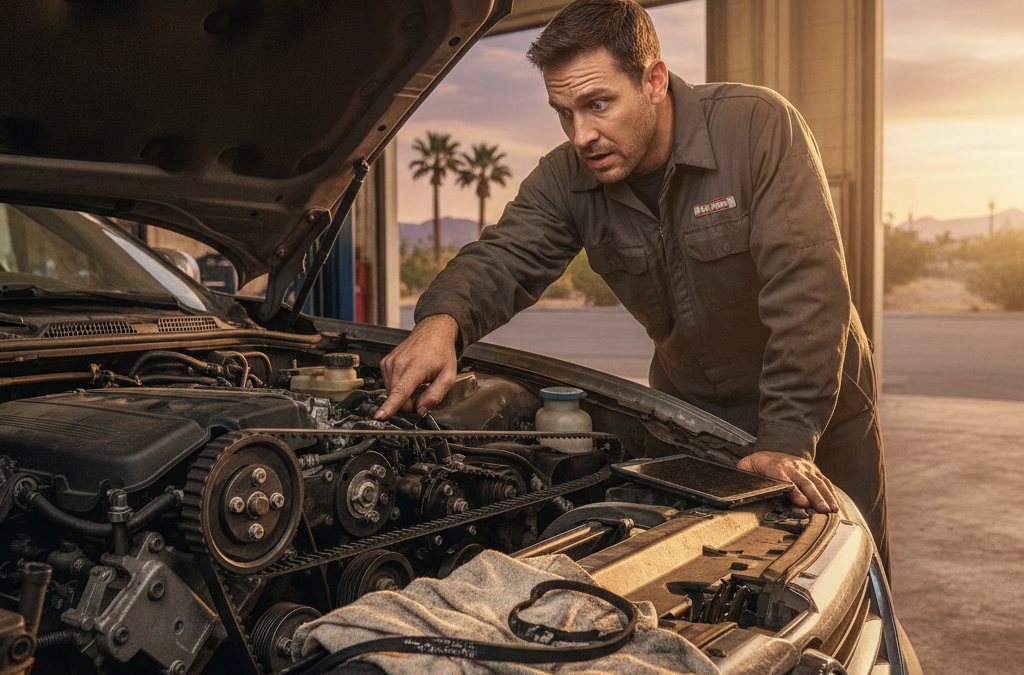
How Do You Know If Your Car’s Timing Belt Needs to Be Replaced — and What Happens If You Wait Too Long in Surprise, AZ?
Your timing belt is one of those parts that works silently in the background — you never think about it until something goes very wrong. And when a timing belt snaps without warning, you’re not looking at a repair bill. You’re looking at a potentially destroyed engine. For drivers in Surprise and across the Phoenix West Valley, the stakes are even higher because our extreme heat shortens belt life in ways that the national maintenance guides simply don’t account for.
The good news: if you stay ahead of the replacement interval, you never have to find out what a failed timing belt feels like firsthand. Here’s what you need to know.
What Does a Timing Belt Actually Do?
Think of your timing belt as the conductor of your engine’s orchestra. It synchronizes the rotation of the crankshaft and the camshaft, which controls when your engine’s valves open and close relative to the pistons. Everything has to happen in exactly the right sequence, at exactly the right moment, thousands of times per minute.
When that belt is healthy, you don’t notice it. When it slips or snaps, pistons and valves can collide — and that collision is what turns a $600 belt job into a $4,000 engine rebuild. This is especially true for what mechanics call an interference engine, which is the design used in the majority of modern vehicles. In an interference engine, the pistons and valves share the same space at different times. If the timing belt fails and they try to occupy that space at the same time, serious internal damage happens immediately.
When Should a Timing Belt Be Replaced?
Most manufacturers recommend replacing the timing belt somewhere between 60,000 and 100,000 miles, or every 7 to 10 years — whichever comes first. That last part matters more than people realize. A belt that hasn’t hit the mileage threshold can still be cracked, glazed, or weakened simply from age and heat exposure.
In Phoenix’s West Valley, where summer temperatures regularly push past 115°F and under-hood temps climb even higher, rubber components age faster than they would in a milder climate. A belt that might last 90,000 miles in Seattle could be showing stress at 70,000 miles in Surprise. If you’re in Sun City West or El Mirage driving a vehicle that’s been sitting in the heat for several summers, the calendar matters as much as the odometer.
The safest move is to check your owner’s manual for your specific vehicle’s recommendation and then have a shop inspect the belt visually if you’re approaching that window. Don’t assume you have more time just because the belt hasn’t broken yet.
Warning Signs Your Timing Belt May Be in Trouble
Here’s the frustrating reality: timing belts often give little to no warning before they fail. That’s why maintenance intervals exist — because you can’t always feel the problem coming. But there are some symptoms worth paying attention to:
- A ticking or slapping noise from the engine — especially when the engine is cold — can indicate a worn or loose timing belt.
- Engine misfires or rough running — if the belt has slipped even slightly, the timing can be off enough to cause the engine to misfire or run unevenly.
- Difficulty starting — a stretched or damaged belt may not be turning the camshaft reliably, which makes starting harder.
- Visible cracks or fraying — if a technician can see the belt during a routine inspection, worn edges, cracking, or glazing are red flags.
- Oil leaks near the timing cover — a failing camshaft or crankshaft seal can soak the timing belt in oil, dramatically accelerating its wear.
If you notice any of these, don’t wait. Have it inspected right away. A timing belt replacement on a schedule is a manageable expense. A timing belt failure on the road is a much bigger problem.
What Gets Replaced Along With the Timing Belt?
This is where a lot of drivers get tripped up — or where less scrupulous shops try to upsell unnecessarily. When a timing belt is replaced, there are a handful of related components that should almost always be done at the same time, because accessing them requires removing the same covers and components anyway. Paying for the labor twice would cost far more than just replacing them now.
These typically include the timing belt tensioner, the idler pulleys, and the water pump — since the water pump on many engines is driven by the timing belt itself. Replacing the water pump at the same time is nearly always the right call. If the water pump fails six months after a timing belt job, you’ll pay the full labor cost again to get back in there.
At All Valley Car Care in Surprise, we walk you through exactly what’s included in the job and why — no mystery charges, no pressure. You’ll get a written estimate before anything gets done.
Timing Chains vs. Timing Belts — Does Your Car Have One?
Not every vehicle has a timing belt. Many modern engines — particularly domestic brands and some European vehicles — use a timing chain instead, which is metal and generally lasts the life of the engine under normal conditions. Timing chains have their own issues (they can stretch or rattle when the oil isn’t changed regularly), but they don’t have scheduled replacement intervals the way belts do.
If you’re not sure whether your vehicle has a belt or a chain, that’s worth a quick check. Look at your owner’s manual, or just ask a trusted shop. This is one of those questions that takes thirty seconds to answer and could save you from worrying unnecessarily — or from missing something important.
Vehicles that commonly use timing belts include many Honda, Toyota, Subaru, Mitsubishi, Volkswagen, and Hyundai/Kia models from the past two decades. If you’re driving one of these and you’re approaching 80,000–100,000 miles, it’s worth having the belt inspected if you don’t have documentation showing it was already replaced.
What Does Timing Belt Replacement Cost in the West Valley?
Timing belt replacement costs vary significantly depending on the vehicle. A straightforward job on a four-cylinder engine with accessible components will cost less than a timing belt service on a V6 or a vehicle with tighter engine bay packaging. When you factor in the tensioner, idler pulleys, and water pump — which is the complete job — you’re generally looking at a few hundred dollars on the lower end for simpler vehicles, and significantly more for complex engines or those with known labor-intensive layouts.
The framing that matters most: a timing belt service is a fraction of the cost of engine repair after a belt failure. Drivers across Peoria, Goodyear, and Glendale who have called us after a belt snapped have learned this the hard way. We’d much rather you come in for the scheduled service.
See our full list of services for more on what’s included in a timing belt inspection and service visit.
Why This Service Gets Overlooked — and How to Stay on Top of It
Unlike brakes that squeak or a battery that leaves you stranded, a timing belt doesn’t typically announce its problems. It’s not a warning light. It’s not a sound most drivers connect to something specific. It’s just quietly aging in the background while you drive to work, drop the kids off at school, and rack up miles on the highway.
The best way to stay ahead of it is simple: keep a record of your maintenance history. If you bought a used car and don’t have documentation of a prior timing belt replacement, assume it hasn’t been done and have it inspected. A lot of drivers in the Phoenix metro area pick up used vehicles with 70,000 to 90,000 miles on them and don’t think to ask about the timing belt. That’s exactly the mileage range where the belt is due or overdue.
If you’re buying a used vehicle and want to know what you’re actually getting into, a pre-purchase inspection is one of the smartest investments you can make. Our team checks belt condition, hose condition, and dozens of other items before you sign anything.
Frequently Asked Questions About Timing Belt Replacement in the Phoenix Area
Can I drive with a bad timing belt?
Technically, you might not know the belt is bad until it snaps — and at that point, you’re not driving anywhere. If you have a reason to suspect your timing belt is worn or overdue, don’t risk it. Have it inspected before your next long drive.
Does Arizona heat really make the timing belt wear out faster?
Yes. Rubber degrades faster under sustained high heat. Under-hood temperatures in the Valley of the Sun can exceed what most manufacturer testing accounts for, especially during our 115°F+ summers. Staying closer to the lower end of your manufacturer’s mileage interval is smart practice here.
How long does a timing belt replacement take?
It depends heavily on the vehicle. Some jobs take two to three hours. Others — especially on vehicles where the engine bay is tightly packed or where the water pump is harder to access — can take a full day. We’ll give you an honest estimate of both time and cost upfront.
What if my car has a timing chain? Do I need to worry about the same thing?
Timing chains don’t have a scheduled replacement interval, but they can stretch or develop noise issues, especially if oil changes have been neglected. If your engine is making a rattle on cold starts, it’s worth having the chain and tensioners inspected.
How do I know if the previous owner already replaced the timing belt on my used car?
Check for service records, a sticker on the timing cover from the previous shop, or ask the seller directly. If there’s no documentation, treat it as unknown and have a mechanic inspect it. On a vehicle approaching 80,000–90,000 miles, that inspection is never wasted money.
Don’t Wait for a Breakdown to Think About This
A timing belt isn’t the kind of repair that gives you a second chance. It either gets replaced on schedule — or it fails, and you deal with whatever comes after. For most drivers, that’s a pretty clear choice.
If your vehicle is approaching the manufacturer’s recommended interval, or if you’ve got a used car and don’t know the maintenance history, come see us. We’ll inspect the belt, give you an honest assessment, and tell you exactly what needs to happen and when — without pressure and without inventing work that doesn’t need to be done. That’s been our approach since 2010, and it’s not changing.
Schedule your timing belt inspection at All Valley Car Care today. We serve drivers throughout Surprise, Peoria, Glendale, El Mirage, Goodyear, Sun City West, and the greater Phoenix area — and we back our work with a 3-year/36,000-mile warranty, extendable to 5 years and 60,000 miles.