
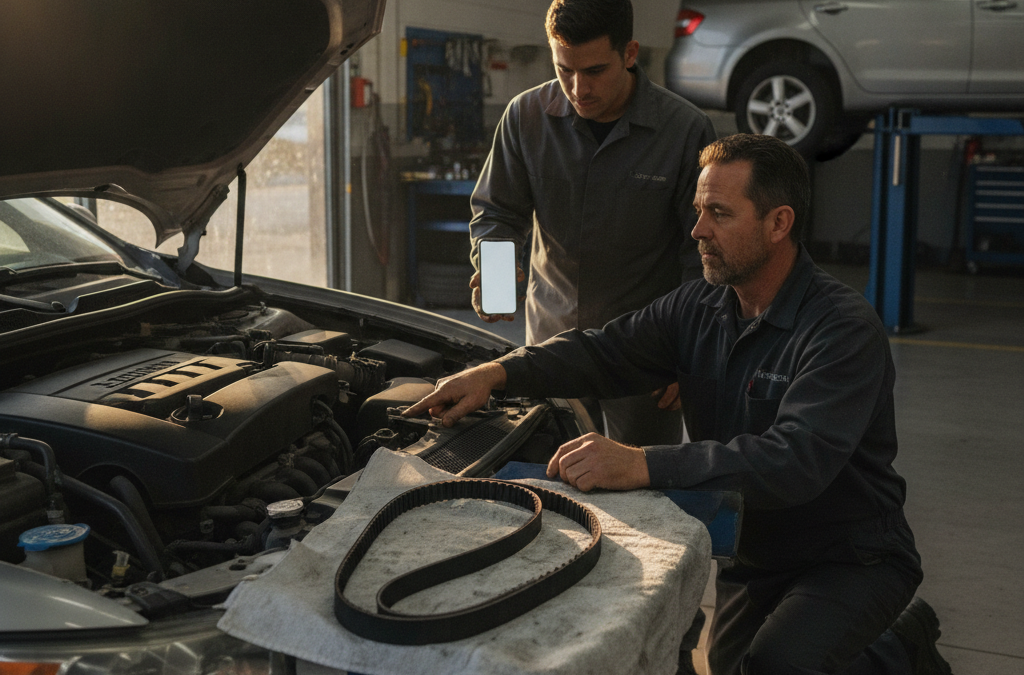
Does Your Car Need a Timing Belt Replacement in Surprise, AZ — and What Happens If You Wait Too Long?
If your car has a timing belt and it’s been 60,000 to 100,000 miles since it was last replaced — or you genuinely have no idea when it was last done — there’s a real chance you’re overdue. For drivers in Surprise and across the West Valley, this is one of those maintenance items that stays completely invisible right up until the moment it becomes a catastrophe. No warning lights. No squeaking. No gradual buildup. One day the belt snaps, and suddenly you’re looking at a bill that can run into the thousands — or an engine that can’t be saved at all.
At All Valley Car Care in Surprise, we’ve seen what happens when timing belts are ignored. We’d rather help you avoid that story entirely.
What Does a Timing Belt Actually Do?
Your engine’s internal parts have to move in perfect sync. The crankshaft (which controls the pistons) and the camshaft (which controls the valves) have to work together with precise timing — and the timing belt is the component that keeps them coordinated. It’s a reinforced rubber belt with teeth, and it runs continuously every time your engine is on.
When it’s working, you never notice it. When it fails, everything stops — often instantly and violently.
Timing Belt vs. Timing Chain: How to Know Which One You Have
Not every vehicle has a timing belt. Many newer vehicles use a metal timing chain instead, which is designed to last the life of the engine and doesn’t require scheduled replacement. If your vehicle has a timing chain, you don’t need to worry about this particular service — though chains can still develop issues and shouldn’t be ignored if you hear a rattling noise on startup.
Whether your vehicle has a belt or a chain depends on the make, model, and year. A quick look at your owner’s manual or a conversation with a trusted shop will tell you which one applies to you. If you drive an older Honda, Toyota, Subaru, Mitsubishi, or many European imports, there’s a solid chance you have a timing belt. If you’re not sure, ask — it’s a fast answer that could save you a lot of money.
Why Arizona Heat Makes This More Urgent Than You Might Think
Timing belts are made of reinforced rubber, and rubber does not hold up well to extreme heat. In most parts of the country, you can push toward the top of a manufacturer’s recommended interval and be reasonably safe. In the Phoenix West Valley, where summer temperatures routinely hit 115°F and your engine bay gets even hotter, that calculus changes.
Heat accelerates the breakdown of rubber compounds. A belt that might last comfortably to 90,000 miles in a cooler climate could show cracking, glazing, or softening sooner here. This is the same reason we see belts, hoses, and seals fail earlier in Arizona than the national averages suggest. If your vehicle spends most of its life parked outside in Surprise, Peoria, or El Mirage rather than in a garage, that heat exposure adds up over time.
The honest advice: don’t wait for the top of the mileage range. If you’re at or past 60,000 miles and you’re not certain the belt has been replaced, have it inspected. The cost of a proactive replacement is a fraction of what you’ll pay if it breaks.
What Happens When a Timing Belt Breaks — and Why It’s So Serious
This is where many drivers get a shock. The severity of a timing belt failure depends on whether your engine is what mechanics call an interference engine or a non-interference engine.
In a non-interference engine, the pistons and valves operate in separate zones and won’t collide even if the belt fails. The engine simply stops — which is bad, but survivable. You get towed, the belt is replaced, and you’re back on the road.
In an interference engine — which is the majority of modern engines — the pistons and valves share the same space and only avoid each other because of precise timing. When that timing belt snaps, the pistons can smash directly into the open valves at engine speed. The result is bent valves, damaged pistons, and often a destroyed cylinder head or worse. That kind of damage can easily cost more than the vehicle is worth.
Most vehicles on the road today have interference engines. If yours is one of them, a broken timing belt isn’t just an inconvenience — it may be the end of the engine.
What a Timing Belt Service Actually Involves
A timing belt replacement is not a quick job. It requires removing a significant amount of engine components to access the belt, and the labor time is a real factor in the overall cost. That’s why — if your car is due for a timing belt — it almost always makes sense to replace the water pump at the same time.
Here’s the logic: the water pump is typically located right behind the timing belt cover, and getting to it requires most of the same disassembly. If you replace the belt now and skip the water pump, and that water pump fails six months later, you’ll be paying the full labor cost all over again to get back in there. Bundling both services in one visit saves you money over the long run, even though the upfront cost is higher.
We’ll always walk you through what’s included in the quote and explain what we recommend and why. No surprises, no unnecessary add-ons — that’s how we’ve operated since 2010.
Signs Your Timing Belt May Already Be in Trouble
As mentioned, a failing timing belt rarely gives clear warning. But there are a few things worth paying attention to:
- A high-pitched ticking or slapping sound from the engine — this can indicate a belt that’s loose, worn, or misaligned
- The engine misfiring or running rough — if the belt has slipped even slightly, engine timing is off and you’ll feel it
- Difficulty starting — a worn belt can cause irregular engine timing that makes starting harder
- Visible cracking or fraying — if a technician can see the belt and it shows obvious wear, don’t wait
- Oil leaking near the timing belt cover — oil contamination destroys belts quickly
If your check engine light is on and you’re not sure why, a full diagnostic inspection can help identify whether timing or related issues are contributing to the problem.
How to Know If Your Vehicle Is Due — Especially If You Bought It Used
This is one of the most common situations we see at our Surprise shop. Someone buys a used car in Glendale or Goodyear, picks up a decent deal, and has no idea what maintenance the previous owner actually did. The service records might show oil changes, but timing belt service is often missing — either because the owner forgot, didn’t know, or didn’t bother to document it.
If you recently bought a used vehicle and the mileage is anywhere near the replacement interval — or if you can’t confirm it was ever done — the safest move is to have it inspected. We can often assess the belt’s condition visually and give you an honest opinion on whether replacement is urgent or whether you have some runway left. Drivers in Sun City West and Youngtown who buy lower-mileage used vehicles often assume they’re safe, but age matters too — rubber degrades over time even when a vehicle isn’t driven hard.
Frequently Asked Questions
How do I know if my car has a timing belt or a timing chain?
Check your owner’s manual under the scheduled maintenance section — it will list timing belt replacement if your vehicle has one. If you don’t have the manual, call or stop by and we can look it up for your specific make, model, and year in a few minutes.
What’s the typical mileage interval for timing belt replacement?
Most manufacturers recommend replacement between 60,000 and 105,000 miles, depending on the vehicle. Some older models have lower intervals. In Arizona’s desert heat, we generally recommend not pushing to the top of that range. When in doubt, inspect it early.
Can I drive my car if the timing belt is cracked but hasn’t broken yet?
We strongly recommend against it. A cracked belt can fail without warning, and if your engine is an interference design, that failure can destroy the engine. The cost of replacement now is always less than the cost of engine damage later.
Does the water pump really need to be replaced at the same time?
It’s not required — but it’s almost always the smart financial move. Since the water pump is accessed during the same disassembly, replacing it now versus waiting for it to fail later saves you a significant amount of labor cost. Most shops and manufacturers recommend doing both together.
How long does a timing belt replacement take?
It varies by vehicle, but most jobs take between three and six hours. We’ll give you a realistic time estimate upfront so you can plan your day. We also offer written estimates before any work begins — no surprises on the final bill.
Don’t Wait Until It’s Too Late
A timing belt replacement isn’t cheap, but it is predictable — and that’s actually a good thing. You can plan for it, budget for it, and get it done on your schedule. A broken timing belt doesn’t give you that option. It happens on the freeway, on the way to work, or on a hot July afternoon in the middle of Surprise, and the aftermath is always more expensive and more stressful than the service would have been.
If you’re not sure where your vehicle stands, come in and let us take a look. We’ll give you a straight answer — whether that means you’re due now, you have some time, or your vehicle has a chain and this isn’t something you need to worry about at all. No pressure, no invented urgency. Just honest information so you can make the right call.
Schedule your timing belt inspection or replacement at All Valley Car Care in Surprise today. Reach out here to set up an appointment — we’re here to help you keep your vehicle on the road without the guesswork.