
How Do You Know If Your Car’s Transmission Fluid Needs to Be Changed — and What Does It Cost to Fix in Surprise, AZ?
If your car hesitates before shifting, shudders when you accelerate from a stop, or just feels a little “off” on the highway, there’s a decent chance your transmission fluid is overdue for a change. Most drivers in Surprise don’t think about their transmission until the warning lights come on or the car starts acting strange — and by that point, you may be looking at a repair that runs into the thousands instead of the hundreds. The good news is that catching worn or degraded fluid early is one of the cheapest forms of insurance your transmission has. Here’s what to watch for, what a service actually involves, and why living in the Phoenix West Valley makes this maintenance more time-sensitive than the owner’s manual might suggest.
What Does Transmission Fluid Actually Do?
Your transmission is full of moving metal parts — clutch packs, bands, gears, solenoids — all working together to move power from your engine to your wheels. Transmission fluid keeps those parts lubricated, helps transfer hydraulic pressure to engage gears, and pulls heat away from the system. When the fluid breaks down, all three of those jobs suffer at once. Shifts become rough or sluggish, heat builds up faster, and internal components start wearing against each other without proper protection.
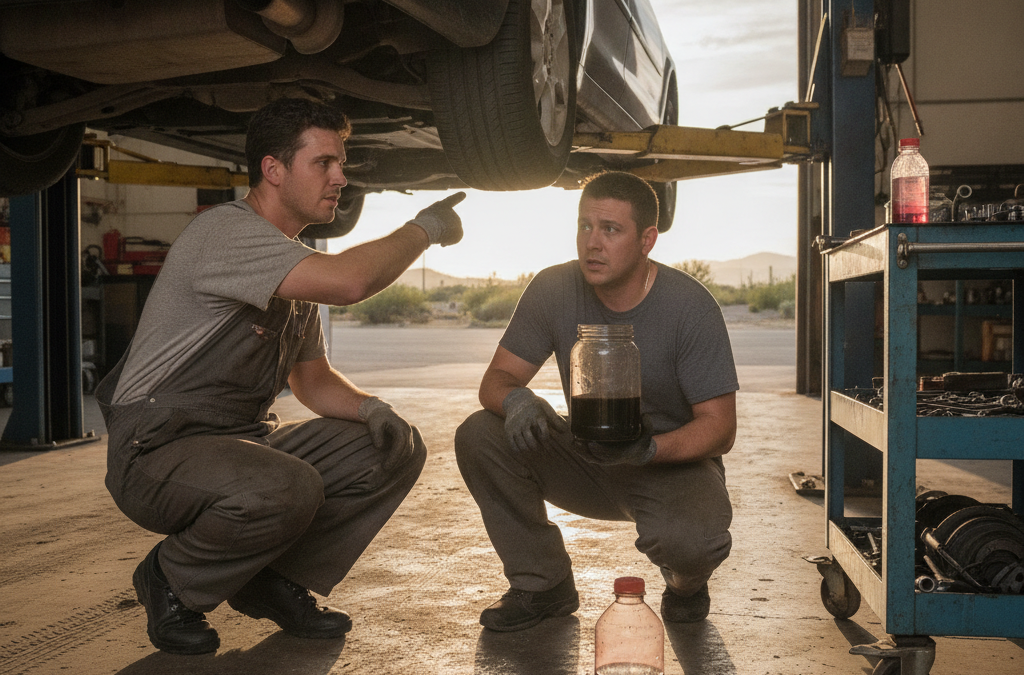
Fresh transmission fluid is typically bright red and slightly sweet-smelling. As it ages and breaks down, it darkens — first to a brownish pink, then to a deep brown or nearly black. At that point, it’s carrying metal particles, moisture, and combustion byproducts that do more harm than good.
Warning Signs Your Transmission Fluid Is Due — or Overdue
You don’t need to be a mechanic to notice when something feels wrong. Here are the most common things drivers describe before bringing their vehicle in:
- Delayed or sluggish shifting: The car hesitates when shifting from park to drive, or pauses noticeably between gears while driving.
- Rough or jerky shifts: Instead of smooth transitions between gears, you feel a thud, clunk, or shudder — especially at lower speeds.
- Slipping gears: The engine revs up but the car doesn’t accelerate the way it should, almost like the transmission is losing its grip on the gear.
- Whining or grinding sounds: Unusual noise while driving, particularly when accelerating or coasting down from highway speed.
- A burning smell: Overheated transmission fluid has a distinct burnt odor. If you’re smelling it, the fluid has likely been degraded for a while.
- Transmission warning light: Many modern vehicles will trigger a warning when the transmission fluid temperature spikes or when the system detects a pressure issue.
None of these symptoms guarantee a simple fluid change will fix everything — that’s why a proper diagnosis matters. But in many cases, especially when caught early, a fluid service stops the problem before it becomes an expensive one.
Why Arizona Heat Is Especially Hard on Transmission Fluid
Here’s something most owner’s manuals don’t account for: they’re written for average driving conditions in average climates. Surprise is not average. When summer temperatures stay above 110°F for weeks at a time, your transmission is working in conditions that would be classified as “severe duty” by most manufacturer standards — even if all you’re doing is running errands.
Heat is the single biggest enemy of transmission fluid. Every 20 degrees of additional operating temperature roughly cuts the fluid’s effective lifespan in half. In a place like Peoria or El Mirage where you’re sitting in stop-and-go traffic with the AC maxed out, your transmission is under real thermal stress on a daily basis. That 60,000-mile fluid change interval your manual suggests assumes you’re not cooking the fluid all summer long.
At All Valley Car Care, we’ve seen plenty of vehicles come in from Sun City and Sun City West where the original owner barely put miles on the car — but the fluid is dark and degraded from years of heat cycles even without high mileage. Miles aren’t the only measure. Time and temperature matter too.
Flush vs. Drain and Fill — What’s the Difference, and Which Do You Need?
This is where a lot of shops get vague or push you toward the more expensive option regardless of what your vehicle actually needs. Here’s the honest breakdown:
Drain and fill: The pan is drained, old fluid is removed, and fresh fluid is added. Depending on your vehicle, this replaces roughly 40–60% of the total fluid in the system. It’s often the right choice for routine maintenance when the fluid isn’t severely degraded and the transmission is functioning normally.
Transmission flush: A machine is used to push all of the old fluid out and replace it with new fluid — closer to a full replacement. This gets more of the old fluid out, but isn’t always necessary, and in some high-mileage transmissions that have never been serviced, flushing can actually disturb debris that was sitting harmlessly and cause new problems.
The right answer depends on your vehicle’s age, mileage, fluid condition, and service history. That’s not something a quick-lube chain running cars through every 15 minutes is going to take the time to figure out. We will.
See the full list of transmission and vehicle maintenance services we offer.
What Does a Transmission Fluid Service Cost in Surprise?
Costs vary based on your vehicle’s make, model, and what type of service it needs. Generally speaking, a drain and fill runs less than a full flush, and some European or import vehicles require proprietary fluids that cost more than standard domestic ATF. Rather than throw out numbers that might not apply to your specific car or truck, the most useful thing we can tell you is this: a transmission fluid service is almost always measured in the low-to-mid hundreds. A transmission rebuild or replacement starts in the thousands and goes up from there.
Routine maintenance on a healthy transmission is one of the best-value services in auto repair. We’ll give you a written estimate before any work starts — no surprises, no pressure.
What About “Lifetime” Transmission Fluid?
Some vehicles come from the factory with fluid labeled as “lifetime” or “sealed for life.” This is one of the most misunderstood claims in the automotive world. “Lifetime” generally means the life of the transmission under normal conditions — not the life of the vehicle. And again, Goodyear in July does not qualify as normal conditions. Many independent mechanics and transmission specialists recommend servicing so-called lifetime fluid on vehicles driven in hot climates, particularly after the 60,000–80,000 mile mark. We’ll check your specific vehicle and give you an honest recommendation.
Can You Check Transmission Fluid Yourself?
On older vehicles, yes — many have a dipstick under the hood, similar to the oil dipstick. You pull it, wipe it, reinsert it, and check the level and color. If it’s low or dark, that’s a sign. On many newer vehicles, there’s no dipstick at all. The transmission is considered sealed, and checking it requires a lift and specialized procedure. If you’re not sure which situation your vehicle is in, we’re happy to check it out during any service visit.
Visit our Surprise location to schedule a transmission inspection or fluid service.
Frequently Asked Questions
How often should I change my transmission fluid in Arizona?
For most vehicles driven in the Phoenix metro area, we recommend checking your fluid condition every 30,000 miles and planning a service every 30,000–45,000 miles depending on how the fluid looks and how the vehicle is driven. If you do a lot of stop-and-go driving or towing, lean toward the shorter end of that range.
Will a transmission fluid change fix slipping gears?
It depends on the cause. If slipping is due to degraded fluid and nothing internal is damaged yet, a fluid service can absolutely help. If internal clutch packs or solenoids are worn, the fluid alone won’t fix it — but we’ll diagnose the issue before recommending anything.
Is a transmission flush bad for high-mileage vehicles?
It can be, in some cases. If a transmission has never been serviced and has significant buildup, a full flush can dislodge debris in ways that cause new problems. That’s exactly why we look at the vehicle’s history and fluid condition before recommending a flush over a drain and fill.
Can I drive with dark or burnt-smelling transmission fluid?
You can, but you’re shortening the life of your transmission every time you do. Dark fluid is no longer providing adequate lubrication or cooling. The longer you wait, the more internal wear accumulates. If you’re noticing the smell or seeing the discoloration, get it looked at soon.
Do you service both domestic and import transmissions?
Yes. We work on domestic vehicles, European imports, and a wide range of makes and models across the board. If your vehicle requires a specific OEM-spec fluid, we source the right product — we don’t just use whatever’s cheapest and closest.
Get Your Transmission Fluid Checked at All Valley Car Care
Transmission problems rarely announce themselves clearly until they’ve already done damage. The smart move is to get the fluid checked before you’re dealing with symptoms — especially if you’re heading into another Phoenix summer or if your vehicle hasn’t had a transmission service in the last 40,000 miles.
At All Valley Car Care, we’ve been serving families and drivers across the West Valley since 2010. We write down what we find, explain it in plain English, and we don’t recommend services you don’t need. If your transmission fluid is fine, we’ll tell you that too.