
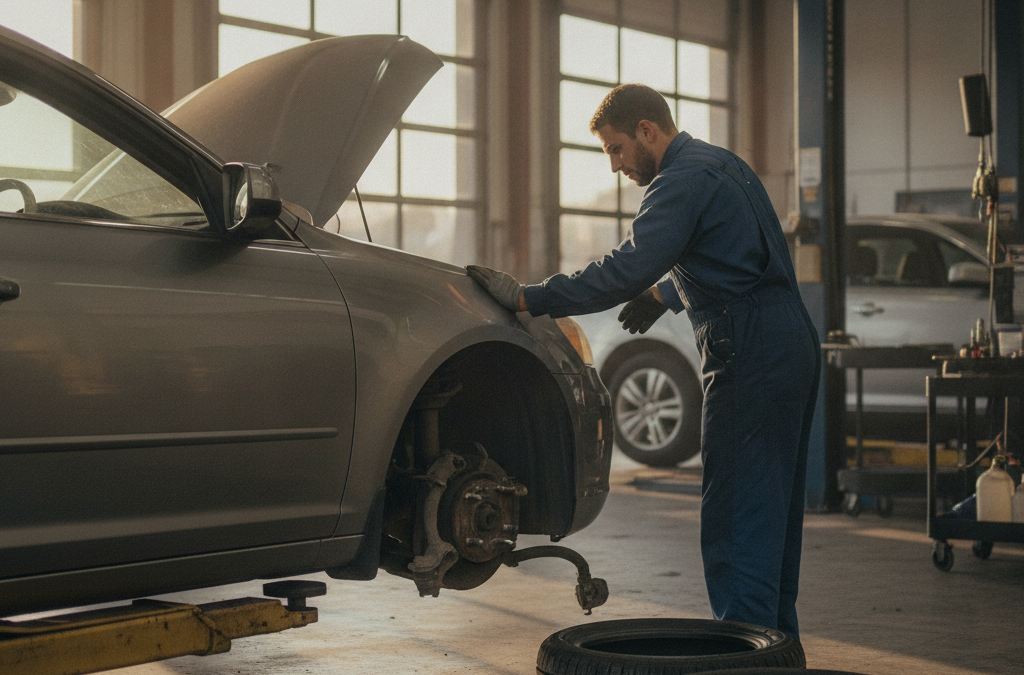
Does Your Car Need a Wheel Alignment in Goodyear, AZ — and What Happens If You Keep Ignoring It?
If your car drifts toward the shoulder the moment you loosen your grip on the wheel, or your steering wheel sits at a slight angle even when you’re going perfectly straight, there’s a decent chance your alignment is off. For drivers in Goodyear, Avondale, and the surrounding West Valley, this is more than a minor annoyance — it’s one of the most common problems we see walk through the door at All Valley Car Care, and one of the most frequently ignored. The good news: an alignment is one of the more straightforward fixes in auto repair. The bad news: skipping it long enough can quietly destroy a brand-new set of tires and strain your suspension components until something breaks.
What Wheel Alignment Actually Means
Your wheels are supposed to point in a very specific direction relative to the road and to each other. When a technician performs an alignment, they’re adjusting the angles of your tires — called camber, toe, and caster — so everything lines up with the manufacturer’s spec for your vehicle. Think of it like calibrating a picture frame on the wall. A millimeter off looks fine from across the room, but zoom in and it’s crooked.
When those angles drift out of spec, your tires no longer roll cleanly. Instead of gliding straight, they’re fighting the road at a slight angle every single mile. That friction eats through rubber fast — and the worst part is it usually happens on just one edge of the tire, so the wear isn’t obvious until it’s too late.
Why the West Valley Is Hard on Alignments
Here’s something worth knowing if you drive regularly in Goodyear, Litchfield Park, or anywhere along the I-10 and Loop 303 corridors: the road conditions out here are genuinely rough on alignment. Ongoing construction zones along major arterials leave uneven pavement edges and rough transitions. Potholes open up fast when summer monsoon storms hit poorly maintained roads. Even smooth-looking asphalt can have subtle dips and heaves from the extreme heat — pavement temperatures in Arizona regularly hit 150°F, which causes expansion and shifting over time.
You don’t have to hit a curb or a massive pothole to knock your alignment off. A few months of commuting on rough road surfaces in Peoria or Tolleson is sometimes enough, especially on vehicles with lower-profile tires that transmit more road impact to the suspension. Trucks and SUVs aren’t immune either — heavier vehicles actually put more stress on steering and suspension components when they take a hit.
Signs Your Alignment Needs Attention
Most alignment problems aren’t dramatic — they creep up gradually, which is exactly why people put off dealing with them. Here’s what to watch for:
- Your car pulls to the left or right when you let go of the wheel on a straight, level road
- Your steering wheel is off-center — tilted noticeably even when you’re driving straight
- Uneven tire wear — one edge of a tire wearing down faster than the other, or one tire wearing faster than its pair
- Vibration at highway speed — though this can also point to a balance issue or tire problem
- The car feels loose or wanders on the freeway, requiring constant small corrections
Any one of these is worth getting checked. Two or more together, and you probably shouldn’t wait.
What Actually Happens When You Ignore a Bad Alignment
This is the part most shops don’t explain well — and something we don’t see covered clearly on a lot of local competitor websites. A bad alignment doesn’t just wear your tires. Over time, it creates a chain of secondary problems.
First, your tires wear unevenly and faster. A set of tires that might last 50,000 miles in normal conditions can be toast at 25,000 or less. In Arizona, where hot pavement already accelerates rubber degradation, this compounds quickly. You’re essentially paying for tires twice as often.
Second, your suspension and steering components — ball joints, tie rods, control arms — take additional stress every time your wheels aren’t pointed where they’re supposed to be. Those parts aren’t cheap to replace. A $100 alignment done today can prevent a $600–$900 suspension repair six months from now.
Third, fuel economy drops. When your tires are fighting the road instead of rolling cleanly, your engine works harder. It’s not a huge difference, but over thousands of miles of commuting between Goodyear and Phoenix, it adds up.
How Often Should You Get an Alignment in Arizona?
A general rule of thumb is once a year or every 12,000–15,000 miles — but in the West Valley, we’d suggest leaning toward the more frequent end of that range. If you drive a lot of construction-zone miles, have a truck or larger SUV, or recently hit something significant (a deep pothole, a curb, a speed bump at speed), get it checked sooner. It’s also smart to check alignment whenever you put on new tires — starting fresh rubber on an out-of-spec vehicle is a quick way to waste that investment.
At our Surprise location, we pair alignment checks with tire rotations as a matter of routine. If something looks off, we’ll show you the before-and-after printout so you can see exactly what was wrong and what we corrected — no guesswork, no vague explanations.
Four-Wheel vs. Two-Wheel Alignment: What’s the Difference?
When you bring your vehicle in, you may hear the question: do you need a two-wheel or four-wheel alignment? Here’s the plain-English version:
- Two-wheel (front-end) alignment adjusts only the front axle. This applies to older vehicles or certain trucks where the rear axle is a fixed solid axle that can’t be adjusted.
- Four-wheel alignment checks and adjusts all four corners. This is standard for most modern cars, crossovers, and many trucks — and it’s typically what your vehicle needs unless a tech tells you otherwise after inspecting the rear suspension design.
A shop that automatically upsells everyone to a four-wheel alignment without checking first — or one that never mentions four-wheel alignment to someone who clearly needs it — isn’t giving you the full picture. We check your vehicle’s specifications before recommending anything. See the full list of services we offer if you want to know what else we cover during a routine maintenance visit.
Frequently Asked Questions
How long does a wheel alignment take?
Usually 45 minutes to an hour for a straightforward alignment on a passenger vehicle. If there are worn suspension components that need to be replaced before the alignment can hold properly, it’ll take longer — but we’ll let you know upfront before any additional work is done.
Can I drive with a bad alignment?
Technically yes, but every mile you put on it is accelerating tire wear and adding stress to your suspension. If the pull is severe or the steering feels unstable, have it checked soon. It’s not an emergency in most cases, but it’s not something to defer for months either.
Will an alignment fix my vibration?
Sometimes, but vibration at highway speed is often caused by tire balance issues rather than alignment. We’ll inspect both. If your tires are out of balance, that’s a separate service — and we can usually identify the cause quickly without guessing or charging you for services you don’t need.
Does hitting a pothole always knock my alignment off?
Not always — it depends on the severity of the impact and your vehicle’s suspension design. But if you hit something hard enough to feel it in your teeth, it’s worth getting checked. Even if the alignment is fine, a hard impact can damage a tire internally or bend a wheel, which we can catch during the inspection.
Do you service trucks and SUVs, not just cars?
Yes. We align cars, trucks, SUVs, and vans across our service area from Goodyear and Buckeye to Glendale and beyond. If you have a commercial vehicle or a small fleet that needs regular attention, we can work with your schedule — reach out to us and we’ll talk through what makes sense for your situation.
Don’t Let a Simple Fix Turn Into a Bigger Problem
An alignment isn’t glamorous. It doesn’t come with a dramatic warning light or a loud noise that forces you to act. It just quietly costs you — in tires, in fuel, in suspension wear — until something finally gives. Drivers all over the West Valley, from Goodyear and Avondale to Litchfield Park and Peoria, deal with road conditions that accelerate this kind of wear more than they realize.
At All Valley Car Care, we’re not going to tell you that you need an alignment if you don’t. We’ll check it, show you the numbers, and let the data speak for itself. If it’s fine, we’ll say so. If it’s not, we’ll fix it right and give you a written estimate before we touch anything. That’s how we’ve operated since 2010, and it’s not going to change.
If your car has been pulling, your tires are wearing unevenly, or you just want peace of mind after a rough stretch of road — schedule a visit with us online or give us a call. We’re easy to get to from Goodyear, Avondale, and the surrounding areas, and we’ll get you back on the road straight.