
How Do You Know If Your Car’s Wheel Bearings Are Failing — and What Does It Cost to Fix in Surprise, AZ?
That low, steady hum coming from somewhere under your car — the one that gets louder the faster you drive — isn’t always a tire noise. If it rises and falls with your speed but doesn’t change when you hit the brakes, there’s a good chance you’re hearing a failing wheel bearing. In Surprise, AZ, where drivers put serious miles on their vehicles commuting through the West Valley and hauling families across town, a worn wheel bearing isn’t just annoying. Left alone long enough, it’s a genuine safety risk. The good news is that catching it early keeps the repair straightforward and the cost reasonable.
What Does a Wheel Bearing Actually Do?
Wheel bearings are the small steel balls or rollers packed inside a metal ring that let your wheels spin smoothly with as little friction as possible. They sit inside the wheel hub, and they take a beating every mile you drive — supporting the full weight of the vehicle, absorbing bumps and road shock, and handling the lateral forces from every turn you make. When the grease inside breaks down or the bearing itself wears out, that friction has nowhere to go. That’s when the noise starts.
Most modern vehicles use a sealed hub bearing assembly, which means the bearing and wheel hub come as one unit. The upside is that they’re cleaner and easier to service than older designs. The downside is that when they wear out, you typically replace the whole assembly rather than just repacking grease — which affects the repair cost.
What Are the Warning Signs of a Bad Wheel Bearing?
Wheel bearings rarely fail all at once. They usually give you weeks or even months of warning before things get serious. Here’s what to pay attention to:
- A humming, growling, or rumbling noise that changes with speed — This is the most common sign. If the noise gets louder as you accelerate and quieter when you slow down, and it doesn’t stop when you press the brakes, it’s likely a bearing and not a brake issue.
- The noise changes when you shift your weight in a turn — If the humming gets louder when you gently swerve left and quieter when you swerve right (or vice versa), that’s a strong indicator of a specific wheel bearing. The weight shift loads and unloads the bearing, changing the sound.
- Vibration you can feel through the steering wheel or floor — As the bearing deteriorates further, the looseness it creates can cause noticeable vibration at highway speeds.
- Uneven tire wear — A worn bearing creates slight wobble in the wheel, which causes the tire to wear in unusual patterns.
- A loose or wobbly wheel when the car is jacked up — If you can grab a tire at 12 and 6 o’clock and feel any play or clunking, the bearing is worn enough to need immediate attention.
The last symptom on that list is serious. A bearing that’s worn to the point of physical looseness is close to failure. If a wheel bearing seizes completely while you’re driving, it can lock the wheel — that’s a loss-of-control situation you don’t want to experience on the 303 at 65 mph.
Why Arizona’s Roads Are Harder on Wheel Bearings Than You Might Think
Wheel bearings are built to last, but they don’t last forever — and driving conditions in the Phoenix West Valley push them harder than in most parts of the country. The ongoing road construction and expansion projects throughout Surprise, Peoria, and El Mirage mean drivers are regularly hitting potholes, bouncing over temporary pavement patches, and navigating rough construction transitions. Every hard jolt sends a shock through the wheel hub that the bearing has to absorb.
Extreme heat plays a role too. Bearing grease is designed to handle high temperatures, but sustained 115°F ambient heat — plus the radiant heat off pavement that can reach 150°F — accelerates breakdown of lubricants across your entire drivetrain. If your vehicle was sitting in a driveway or parking lot for an extended stretch in summer (common with snowbird vehicles returning to Sun City or Youngtown after the summer), the grease can dry out faster than expected, and you may not notice until you’re back on the road putting miles on again.
What Does Wheel Bearing Replacement Actually Cost?
Wheel bearing replacement costs vary depending on which wheel is affected, the make and model of your vehicle, and whether you’re dealing with a standalone bearing press-in or a full hub bearing assembly replacement. For most passenger cars and crossover SUVs in the Phoenix area, you’re typically looking at $250 to $500 per wheel at a reputable local shop. Trucks and larger SUVs with more complex hub assemblies can run higher.
What inflates that cost unnecessarily is when a shop recommends replacing all four bearings when only one is failing — or adds brake work, tire services, or other items to the ticket without clearly explaining why they’re needed. At All Valley Car Care, you’ll get a written estimate before anything is touched, and the recommendation will reflect what your car actually needs — nothing more. That’s been our standard since we opened in 2010, and it’s not changing.
If you’re curious about the full range of services we handle, our services page gives you a clear picture of what we work on day to day.
Can You Drive on a Bad Wheel Bearing?
Technically, yes — for a limited time, in the early stages. But this is one of those repairs where the window closes faster than people expect. A bearing that’s humming today can be grinding badly within a few hundred miles if driving conditions are rough. And once a bearing is failing severely, it can damage the wheel hub, the CV axle, and sometimes the brake rotor. What started as a $350 repair can turn into a $900 repair if you push it too long.
The honest answer is: get it checked as soon as you notice the noise. An inspection costs you nothing at All Valley Car Care, and knowing what you’re dealing with beats guessing.
What to Expect During the Repair
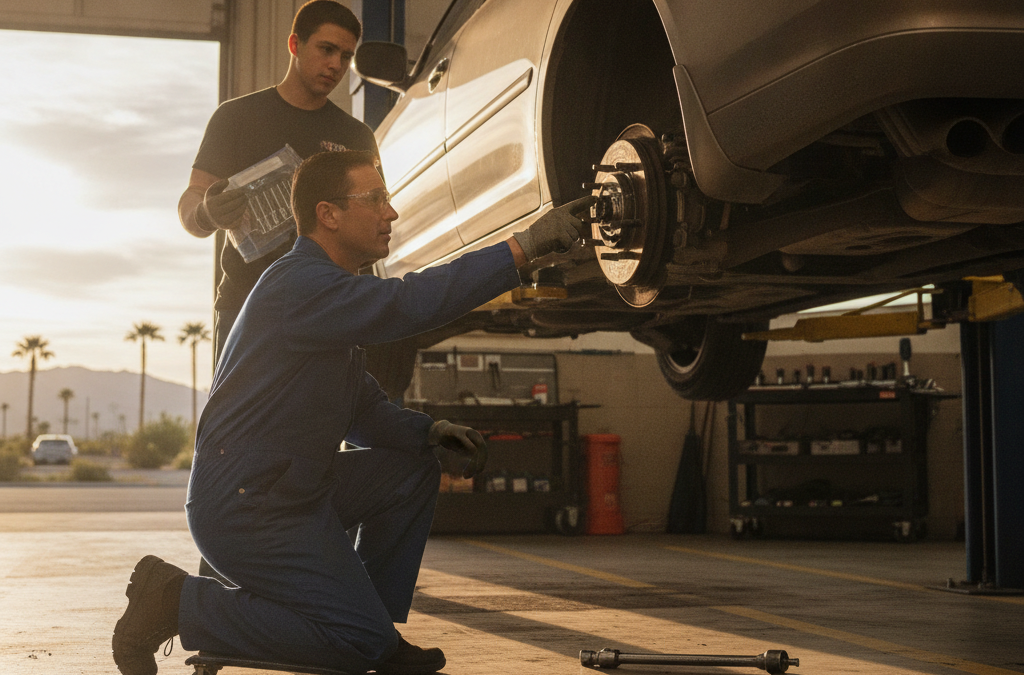
Wheel bearing replacement is a same-day repair in most cases. The technician will lift the vehicle, remove the wheel and brake assembly, pull the hub, and press out or unbolt the old bearing assembly. On most modern vehicles with bolt-on hub assemblies, this is a 1-2 hour job per wheel. On older vehicles or certain European imports where the bearing must be pressed in and out with a hydraulic press, it takes a bit longer and may require specific tooling.
Our ASE-certified technicians work on domestic vehicles, European imports, and a wide range of SUVs and trucks — so whether you’re driving a Ram 1500 out of Litchfield Park, a Toyota Sienna from Goodyear, or a Volkswagen Tiguan from Glendale, the repair process is familiar territory. You can learn more about our team and how we operate at our about page.
Frequently Asked Questions About Wheel Bearings in the Surprise, AZ Area
How do I know if it’s a wheel bearing or a tire noise?
Tire noise tends to stay pretty consistent regardless of which direction you’re turning. Wheel bearing noise usually shifts — it gets louder when you put weight on the bad bearing in a turn and quieter when the weight comes off. If you’re unsure, the quickest answer is to have a tech take a quick drive and listen. It’s usually obvious within a mile.
Can a bad wheel bearing cause my ABS light to come on?
Yes, and this surprises a lot of drivers. The wheel speed sensor that your ABS and traction control systems rely on is often built directly into the hub bearing assembly. When the bearing fails, the sensor can fail with it or give inaccurate readings, triggering the ABS or traction control warning light. If you’ve got a bearing noise and a dashboard warning light at the same time, it’s likely one repair covering both issues.
How long do wheel bearings typically last?
Most wheel bearings are designed to last 80,000 to 100,000 miles under normal conditions. In the West Valley — with heat, road construction, and long daily commutes — many drivers see them wear sooner, especially on front wheels where the bearing takes more stress from steering. If your vehicle has over 80,000 miles and you’re hearing an unusual noise, it’s worth having the bearings checked as part of the diagnosis.
Do I need to replace all four wheel bearings at once?
Not necessarily. Bearings don’t wear evenly, and replacing a single failing bearing is completely acceptable. Some shops recommend replacing in pairs (both fronts or both rears) if one is already worn, since the other side has likely seen similar use. But you don’t need to replace all four unless multiple bearings are actually showing wear. A shop that recommends four new bearings on a car with only one noisy wheel deserves follow-up questions.
Is wheel bearing replacement covered under any warranty?
At All Valley Car Care, all repairs are backed by our 3-year/36,000-mile warranty, which is extendable to 5 years/60,000 miles. That applies to wheel bearing replacements too. You shouldn’t have to wonder whether the work will hold up — it’s in writing.
Ready to Get That Noise Checked Out?
If you’re hearing something that doesn’t sound right while driving around Surprise, whether it’s a hum on the 303, a growl on Bell Road, or a vibration you can’t quite place, don’t sit on it. Wheel bearing problems don’t fix themselves, and waiting usually just means a bigger repair bill. Bring it in, let us take a listen, and we’ll tell you exactly what’s going on — with no pressure and no runaround.
Contact All Valley Car Care to schedule a free inspection at our Surprise location. We’ve been serving families and drivers across the West Valley since 2010, and we’re not going anywhere.